
Short Answer
Main Explanation
The cosmic neutrino background (CνB) is a predicted sea of relic neutrinos that fills the entire observable universe. It is a direct consequence of the hot Big Bang model. Unlike the cosmic microwave background (CMB), which decoupled from matter when the universe was about 379,000 years old, the CνB decoupled when the universe was only about one second old [1]. Today these neutrinos have a temperature of roughly 1.95 K and energies between 10−4 and 10−6 eV [1]. Because neutrinos interact only weakly, they have survived essentially undisturbed since that first second, making the CνB the oldest directly predictable relic radiation in the cosmos.
To understand the CνB, it helps to place it within the larger timeline of cosmic evolution. The early universe was an extremely hot, dense plasma of particles and radiation. As space expanded, the plasma cooled, and different particle species “froze out” or decoupled when their interaction rates fell below the expansion rate. Neutrinos decoupled first, at about one second, when the temperature was around 1010 K. Photons remained coupled to charged matter until neutral atoms formed at recombination, roughly 379,000 years later. This is why the CνB carries information from a much earlier epoch than the CMB.
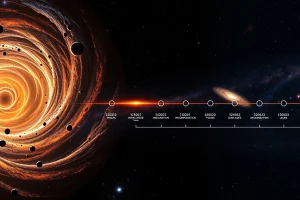
The standard Lambda-CDM model organizes this history into a series of epochs. The table below summarizes the major stages from the Planck epoch to the present.

| Epoch | Time after Big Bang | Temperature | Approximate Redshift | Key Events |
|---|---|---|---|---|
| Planck epoch | < 10−43 s | > 1032 K | — | Quantum gravity dominates; all forces unified |
| Grand unification epoch | 10−43–10−36 s | ~1029 K | — | Strong force separates from electroweak force |
| Inflationary epoch | 10−36–10−32 s | ~1027 K | — | Exponential expansion stretches quantum fluctuations |
| Electroweak epoch | 10−32–10−12 s | ~1015 K | — | Weak and electromagnetic forces become distinct |
| Quark epoch | 10−12–10−6 s | ~1012 K | — | Quarks, leptons, and gauge bosons form a dense soup |
| Hadron epoch | 10−6–1 s | ~1010 K | — | Quarks bind into protons and neutrons |
| Lepton epoch | 1 s–10 s | ~109 K | — | Neutrinos decouple, forming the CνB |
| Photon epoch | 10 s–379,000 yr | ~109–3000 K | — | Photons dominate; light elements form via BBN |
| Recombination | ~379,000 yr | ~3000 K | ~1100 | First atoms form; CMB released |
| Dark Ages | 379,000 yr–~150 Myr | ~3000–60 K | 1100–20 | Universe neutral and opaque to visible light |
| Reionization | ~150 Myr–1 Gyr | ~60–20 K | 20–6 | First stars and galaxies ionize intergalactic gas |
| Structure formation | ~1 Gyr–present | ~20–2.7 K | 6–0 | Galaxies, clusters, and large-scale structure grow |
Each epoch is defined by the dominant physical processes and particle content. The Planck epoch marks the first 10−43 seconds, when quantum gravity dominated. The grand unification epoch saw the strong force separate from the electroweak force. Inflation, a brief period of exponential expansion, stretched quantum fluctuations to cosmic scales and set the initial conditions for structure formation. The electroweak epoch ended when the weak and electromagnetic forces became distinct. The quark epoch was a dense soup of quarks, leptons, and gauge bosons. The hadron epoch saw quarks bind into protons and neutrons. The lepton epoch, beginning around one second, is when neutrinos decoupled, forming the CνB. The photon epoch lasted until recombination, when the first atoms formed and the CMB was released. The dark ages followed, then the first stars and galaxies ignited during reionization, and structure formation has continued ever since.
The CνB is therefore not an isolated curiosity; it is a fossil from the lepton epoch, a direct window into the universe’s first second.
Concept: The Cosmic Neutrino Background
Definition
The cosmic neutrino background is the predicted background particle radiation composed of relic neutrinos produced in the early universe. It is sometimes abbreviated CνB or CNB [1]. It is analogous to the CMB but consists of neutrinos rather than photons and decoupled much earlier.
How It Works
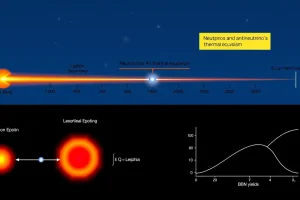
In the first second after the Big Bang, neutrinos were kept in thermal equilibrium with electrons, positrons, and photons by weak interactions. As the universe expanded and cooled, the weak interaction rate dropped below the Hubble expansion rate. At about one second, neutrinos decoupled and began free-streaming through space. Their momenta redshifted with the expansion, so their effective temperature fell as the inverse of the scale factor. When electron-positron annihilation later heated the photons, the neutrino temperature became slightly lower than the photon temperature. The ratio is fixed by entropy conservation: Tν/Tγ = (4/11)1/3 ≈ 0.714. With the CMB temperature today at 2.725 K, this gives Tν ≈ 1.95 K [1].
Equation
The key relation is Tν = (4/11)1/3 Tγ. For Tγ = 2.725 K, Tν ≈ 1.95 K. The number density per neutrino flavor is about 56 cm−3, and the average energy is of order 10−4 eV.
Example
A proposed direct detection method is neutrino capture on tritium, as planned by the PTOLEMY experiment. The reaction νe + 3H → 3He + e− would show a distinctive peak at the endpoint of the beta spectrum if relic neutrinos are captured [3]. This remains technologically challenging because the CνB energies are about 10 orders of magnitude smaller than even high-energy neutrinos [1].
Observable Consequences
Although not yet directly detected, the CνB has measurable effects. It contributes to the radiation energy density of the universe, parameterized by the effective number of neutrino species Neff. It influences the expansion rate during Big Bang nucleosynthesis, the damping tail of CMB anisotropies, and the growth of large-scale structure. Cosmological data already provide strong indirect evidence for its existence [1][2].
Common Misconceptions
- The CνB is dark matter. It is not. Relic neutrinos are hot dark matter with very small masses, and they make up only a tiny fraction of the total matter density.
- The CνB has been directly observed. It has not. All evidence is indirect, from cosmological observations.
- The CνB and CMB are the same. They are different relic backgrounds: one of neutrinos, one of photons, decoupled at very different times.
- Neutrinos are too weakly interacting to matter. Individually they rarely interact, but collectively their density and pressure affect cosmic expansion and structure formation.
Why It Matters
The CνB is a unique probe of the universe at an age of one second, far earlier than the CMB can reach. Detecting it directly would test the standard hot Big Bang model, measure the neutrino mass scale, and search for new physics beyond the Standard Model. It would also provide a snapshot of the lepton epoch, when the universe was a dense plasma of electrons, positrons, and neutrinos. Because neutrinos decoupled so early, they carry information about the thermal history, the number of relativistic species, and possible non-standard interactions [3][4].
Evidence / Sources
Strong indirect evidence for the CνB comes from three independent cosmological probes. Big Bang nucleosynthesis predictions for the primordial abundances of helium, deuterium, and lithium depend on the expansion rate, which is sensitive to the number of neutrino species. The CMB power spectrum, measured by COBE, WMAP, and Planck, shows a damping tail and phase shifts consistent with the expected neutrino background. Large-scale structure surveys also show a small suppression of matter clustering caused by free-streaming relic neutrinos [2]. Together these confirm the standard neutrino cosmology.
Key missions and instruments: COBE first measured the CMB blackbody spectrum; WMAP mapped anisotropies; Planck refined the temperature and polarization maps; JWST is now observing the first galaxies and reionization. These do not detect the CνB directly, but they anchor the cosmological model in which the CνB is a firm prediction.
Related Registry Entries
Last reviewed / updated: September 8, 2026.
FAQ
What is the cosmic neutrino background?
It is a predicted sea of relic neutrinos left over from the Big Bang, decoupled about one second after the universe began, with a temperature today of about 1.95 K.
Why is the CνB so difficult to detect?
Neutrinos interact only weakly, and the CνB has extremely low energies, around 10⁻⁴ to 10⁻⁶ eV, about 10 orders of magnitude smaller than even high-energy neutrinos.
How does the CνB relate to the CMB?
The CMB is relic photons released at recombination about 379,000 years after the Big Bang; the CνB is relic neutrinos released at about one second. The CνB is older and colder.
What evidence supports the existence of the CνB?
Indirect evidence from Big Bang nucleosynthesis, the cosmic microwave background anisotropies, and large-scale structure all match predictions that include the CνB.

Leave a Reply