Short Answer
Short Answer: The Big Bang is the leading scientific explanation for the origin of the universe, describing how it expanded from an extremely hot, dense state about 13.8 billion years ago. The evidence is overwhelming: the observed expansion of galaxies, the cosmic microwave background radiation, and the primordial abundances of light elements.
| Key Facts | |
|---|---|
| Age of universe | 13.8 billion years |
| Expansion | Hubble–Lemaître law |
| CMB temperature | 2.725 K |
| First stars | ~100–200 million years after Big Bang |
| First galaxies | ~400 million years after Big Bang |
| Key missions | COBE, WMAP, Planck, JWST |
Main Explanation
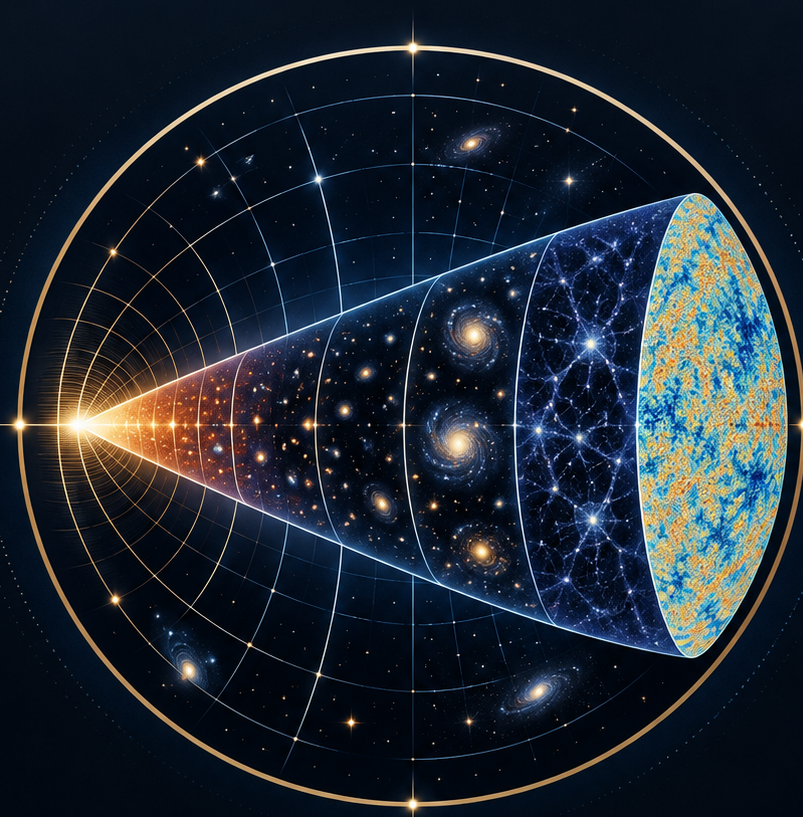
The Big Bang theory is the standard cosmological model that describes the universe’s origin and evolution. According to this theory, the universe began as an extremely small, hot, and dense singularity approximately 13.8 billion years ago and has been expanding and cooling ever since. This expansion is not an explosion in space but rather the stretching of space itself, carrying galaxies apart from one another.
The first major evidence came from observations of galaxy motion. In the 1920s, Edwin Hubble discovered a relationship between a galaxy’s distance from Earth and its recession speed, now known as the Hubble–Lemaître law. Almost all galaxies are moving away from us, with more distant galaxies receding faster. This is exactly what we expect if the universe is uniformly expanding. As BBC Teach explains, “We can see that almost all galaxies appear to be moving away from us,” some at speeds of hundreds of thousands of kilometres per second.
If we run this expansion backward, the universe must have been denser and hotter in the past. This leads to the prediction that a relic radiation from that hot early state should still fill the cosmos. In 1965, the cosmic microwave background (CMB) was discovered—a faint, uniform glow of microwave radiation coming from all directions. The CMB is the afterglow of the Big Bang, released when the universe cooled enough for atoms to form, about 380,000 years after the initial expansion. Its temperature is 2.725 K, remarkably uniform but with tiny fluctuations that seeded the formation of galaxies.
Another pillar of evidence is the primordial abundance of light elements. During the first few minutes of the universe, conditions were hot enough for nuclear fusion to create helium, lithium, and other light nuclei. The observed abundances of these elements match the predictions of Big Bang nucleosynthesis with remarkable precision, as noted in the Cambridge article: “The cosmic background radiation, and the abundances of elements such as helium and lithium, permit quantitative inferences about what the universe was like when it had been expanding for only a few seconds.”
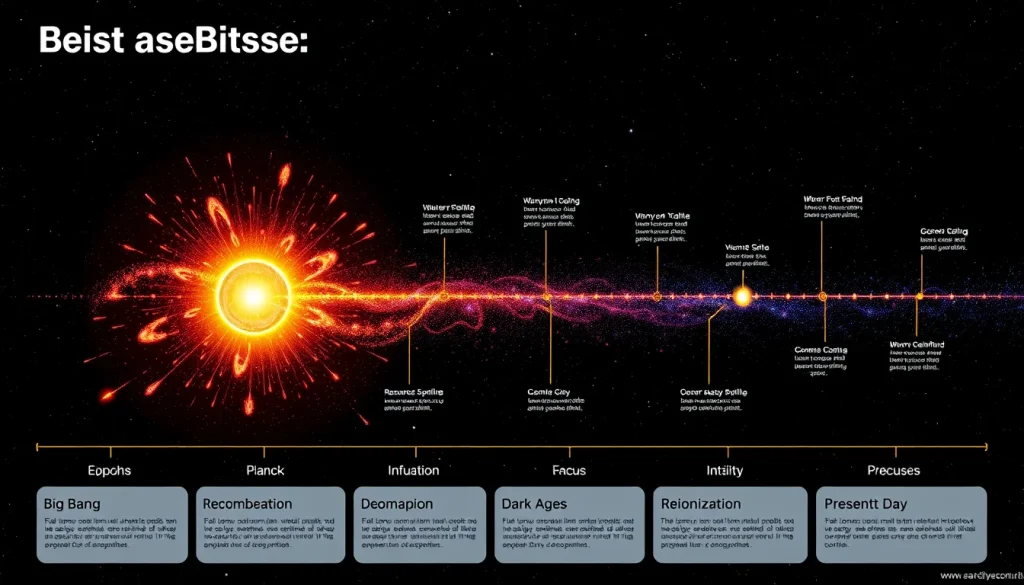
The universe has passed through distinct epochs, each with its own physical processes. The table below summarizes the major cosmic epochs from the Planck epoch to the present day.
| Epoch | Time after Big Bang | Temperature | Key Events |
|---|---|---|---|
| Planck epoch | <10⁻⁴³ s | >10³² K | Quantum gravity dominates; no known physics |
| Grand Unification epoch | 10⁻⁴³–10⁻³⁶ s | 10²⁷–10³² K | Unified forces begin to separate |
| Inflationary epoch | 10⁻³⁶–10⁻³² s | ~10²⁷ K | Exponential expansion; seeds of structure |
| Electroweak epoch | 10⁻³²–10⁻¹² s | 10¹⁵–10²⁷ K | Electromagnetic and weak forces separate |
| Quark epoch | 10⁻¹²–10⁻⁶ s | 10¹²–10¹⁵ K | Quarks and gluons form quark–gluon plasma |
| Hadron epoch | 10⁻⁶–1 s | 10¹⁰–10¹² K | Protons and neutrons form |
| Lepton epoch | 1–10 s | 10⁹–10¹⁰ K | Leptons dominate; neutrinos decouple |
| Photon epoch | 10 s–380,000 yr | 3,000–10⁹ K | Photons dominate; nucleosynthesis occurs |
| Recombination | ~380,000 yr | ~3,000 K | Atoms form; CMB released |
| Dark Ages | 380,000–150 million yr | ~10–3,000 K | No stars yet; neutral hydrogen fills space |
| Reionization | 150 million–1 billion yr | ~10–100 K | First stars and galaxies ionize hydrogen |
| Structure Formation | 1 billion yr–present | 2.7 K | Galaxies, clusters, and large-scale structure form |
The inflationary epoch, proposed by Alan Guth and others, explains the remarkable uniformity of the CMB and the flatness of the universe. During inflation, the universe expanded exponentially, smoothing out any irregularities and stretching quantum fluctuations to cosmic scales. These fluctuations later grew into the large-scale structure we observe today.
The first atoms formed during recombination, when electrons combined with protons to form neutral hydrogen. This allowed photons to travel freely, producing the CMB. The Dark Ages followed, a period with no luminous sources. Then the first stars and galaxies ignited, ending the Dark Ages and beginning reionization. The James Webb Space Telescope (JWST) is now probing this era, revealing galaxies that existed just a few hundred million years after the Big Bang.
Evidence for the Big Bang
Observation
The most direct observation is the expansion of the universe. Vesto Slipher first measured the redshifts of “spiral nebulae” in 1912, finding that most were moving away. Edwin Hubble later established the distance–velocity relationship, now known as the Hubble–Lemaître law. This expansion is observed across all directions, consistent with a homogeneous and isotropic universe.
Prediction
The Big Bang theory predicts that the universe should be filled with a faint, nearly uniform radiation—the cosmic microwave background. It also predicts specific abundances of light elements (hydrogen, helium, lithium) produced during nucleosynthesis. Both predictions have been confirmed.
Measurement
The CMB was discovered in 1965 by Arno Penzias and Robert Wilson, who found an unexplained microwave signal. Subsequent missions—COBE (1989), WMAP (2001), and Planck (2009)—have measured the CMB with increasing precision, mapping its temperature fluctuations to better than one part in 100,000. These measurements have determined the universe’s age, composition, and geometry with remarkable accuracy.
Why It Supports the Model
The expansion of galaxies, the existence and properties of the CMB, and the primordial element abundances all independently point to a hot, dense early universe. The CMB’s near-perfect blackbody spectrum and its tiny anisotropies match the predictions of the Lambda-CDM model, which includes dark matter and dark energy. The observed abundances of helium and deuterium agree with nucleosynthesis calculations, leaving little room for alternative explanations.
Limitations
The Big Bang theory does not explain what happened before the Planck epoch, nor does it account for the initial singularity. It also relies on dark matter and dark energy, which are not yet directly detected. The theory cannot predict the observed baryon asymmetry (why matter dominates over antimatter) without additional physics.
Alternative Explanations
Steady-state theory, once a rival, has been falsified by the CMB and the observed evolution of galaxies. Some alternative models, such as cyclic universes or string gas cosmology, attempt to replace the initial singularity, but none have gained broad acceptance. The Lambda-CDM model remains the consensus because it explains a wide range of observations with minimal assumptions.
Current Scientific Consensus
Over 95% of astronomers accept the Big Bang as the best description of the universe’s origin. The evidence is so strong that the theory is considered a cornerstone of modern cosmology. Ongoing research focuses on the details of inflation, the nature of dark matter and dark energy, and the first moments of cosmic history.
Why It Matters
Understanding the Big Bang is not just about the past—it shapes our view of the universe’s future. The expansion rate, the composition of matter and energy, and the large-scale structure all depend on the initial conditions set by the Big Bang. The CMB provides a snapshot of the universe at 380,000 years, allowing us to test fundamental physics under extreme conditions. Moreover, the Big Bang theory connects cosmology with particle physics, offering a unique laboratory for studying forces and particles at energies far beyond any terrestrial accelerator.
Evidence / Sources
The following sources provide authoritative information on the evidence for the Big Bang:
- BBC Teach: How do we know the Big Bang actually happened?
- University of Western Australia: Evidence for the Big Bang (fact sheet)
- Cambridge University Press: Cosmology: evidence for a ‘big bang’
- Universe Today: What is the evidence for the Big Bang?
Related Registry Entries
Explore related concepts and missions:
- Cosmic Microwave Background
- Hubble–Lemaître Law
- Big Bang Nucleosynthesis
- Inflation
- Recombination
- Dark Ages
- Reionization
- COBE, WMAP, Planck, JWST
FAQ
What is the cosmic microwave background?
The CMB is the oldest light in the universe, emitted about 380,000 years after the Big Bang when the universe cooled enough for atoms to form. It is a faint, nearly uniform glow of microwave radiation that fills all of space, with a temperature of 2.725 K.
How do we know the universe is expanding?
Astronomers observe that almost all galaxies are moving away from us, and the more distant a galaxy is, the faster it recedes. This relationship, known as the Hubble–Lemaître law, is exactly what we expect from a uniformly expanding universe.
What is the evidence for the Big Bang from element abundances?
Big Bang nucleosynthesis predicts that about 75% of the universe's baryonic mass should be hydrogen and about 25% helium, with trace amounts of deuterium and lithium. Observations of ancient gas clouds and the cosmic microwave background confirm these predictions.
What missions have studied the Big Bang?
COBE, WMAP, and Planck have mapped the CMB with increasing precision, revealing the seeds of cosmic structure. The James Webb Space Telescope is now observing the first galaxies and stars, probing the era of reionization.

Leave a Reply