
Short Answer
Main Explanation
The Cosmic Microwave Background
The cosmic microwave background is the oldest light in the universe, a relic of the hot, dense state that existed shortly after the Big Bang. In the 1940s, George Gamow, Ralph Alpher, and Robert Herman predicted that a faint echo of this primordial fireball should still fill the cosmos [1]. In 1964, Arno Penzias and Robert Wilson accidentally discovered this radiation, but its detailed properties remained largely unmeasured. The COBE mission was designed to study the CMB’s spectrum and spatial distribution with unprecedented accuracy.
COBE’s Discoveries
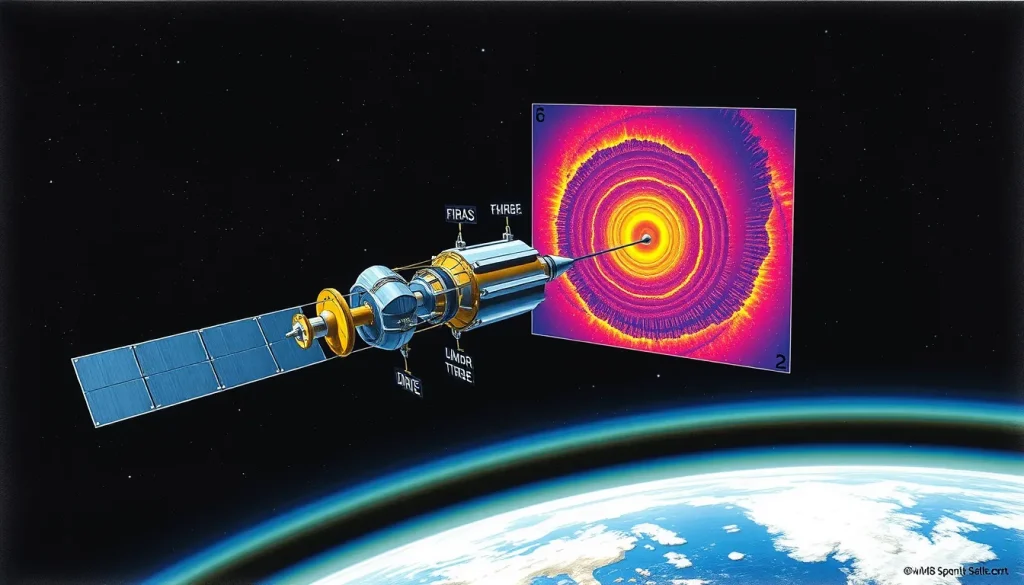
COBE carried three instruments: the Far-Infrared Absolute Spectrophotometer (FIRAS), which measured the CMB spectrum; the Differential Microwave Radiometers (DMR), which mapped its temperature variations; and the Diffuse Infrared Background Experiment (DIRBE), which searched for cosmic infrared background. FIRAS showed that the CMB spectrum matches a blackbody at 2.73 ± 0.06 K, with no deviation greater than 0.25% of peak brightness [2]. This result confirmed the Big Bang prediction and ruled out alternative theories that produced different spectral shapes. The DMR instrument detected statistically significant anisotropy—variations in temperature of about one part in 100,000—consistent with a scale-invariant primordial density fluctuation spectrum [3][4]. These fluctuations are the seeds from which galaxies and large-scale structure eventually grew.
From the Planck Epoch to Structure Formation
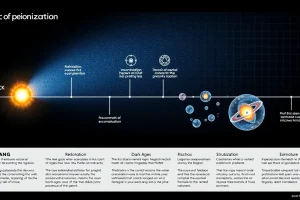
The CMB provides a snapshot of the universe about 380,000 years after the Big Bang, when it became transparent. To understand its significance, we must place it within the full cosmic timeline. The standard model of cosmology (Lambda-CDM) describes the following major epochs:
| Epoch | Time After Big Bang | Temperature (approx.) | Key Events |
|---|---|---|---|
| Planck epoch | 0 – 10⁻⁴³ s | >10³² K | Quantum gravity effects dominate; no known physics |
| Grand Unification epoch | 10⁻⁴³ – 10⁻³⁶ s | 10²⁷ – 10³² K | Strong and electroweak forces unify; inflation begins |
| Inflationary epoch | 10⁻³⁶ – 10⁻³² s | ~10²⁷ K | Exponential expansion; quantum fluctuations stretched to cosmic scales |
| Electroweak epoch | 10⁻³² – 10⁻¹² s | 10¹⁵ – 10²⁷ K | Electromagnetic and weak forces separate; particles acquire mass |
| Quark epoch | 10⁻¹² – 10⁻⁶ s | 10¹² – 10¹⁵ K | Quarks and gluons exist in a quark-gluon plasma |
| Hadron epoch | 10⁻⁶ – 1 s | 10¹⁰ – 10¹² K | Quarks combine into hadrons (protons, neutrons); matter-antimatter annihilation |
| Lepton epoch | 1 – 10 s | 10⁹ – 10¹⁰ K | Leptons dominate; neutrinos decouple |
| Photon epoch | 10 s – 380,000 yr | 3,000 – 10⁹ K | Photons dominate; nucleosynthesis (BBN) produces light elements |
| Recombination | ~380,000 yr | ~3,000 K | Electrons combine with protons to form neutral hydrogen; universe becomes transparent; CMB released |
| Dark Ages | 380,000 yr – ~150 million yr | ~3,000 K – 60 K | No stars yet; only dark matter and neutral gas |
| Reionization | ~150 million – 1 billion yr | ~60 K – 20 K | First stars and galaxies form; their radiation reionizes intergalactic hydrogen |
| Structure Formation | 1 billion yr – present | ~20 K – 2.7 K | Galaxies cluster; dark matter halos grow; large-scale structure emerges |
The CMB we observe today is the relic of the recombination epoch. Its near-perfect blackbody spectrum tells us that the early universe was in thermal equilibrium. The anisotropies detected by COBE reflect tiny density fluctuations that, amplified by gravity, grew into the cosmic web of galaxies we see today. Later missions—WMAP and Planck—mapped these anisotropies in exquisite detail, measuring the curvature of space, the composition of the universe, and the parameters of the Lambda-CDM model.
Mission Profile
Mission Facts
- Full name: Cosmic Background Explorer
- Launch date: November 18, 1989
- Launch vehicle: Delta rocket from Vandenberg Air Force Base
- Orbit: Sun-synchronous low Earth orbit (~900 km)
- Duration: 1989–1993
- Instruments: FIRAS, DMR, DIRBE
Launch and Instruments
COBE was launched to study the origin and dynamics of the universe [1]. Its three instruments covered wavelengths from the far-infrared to microwaves. FIRAS measured the absolute spectrum of the CMB; DMR mapped its temperature across the sky at three frequencies (31.5, 53, and 90 GHz); DIRBE searched for the cosmic infrared background from the first galaxies.
Major Results
- CMB spectrum is a blackbody at 2.73 ± 0.06 K, with deviations less than 0.25% [2].
- First detection of CMB anisotropy at a level of about 1 part in 100,000 [3][4].
- Conservative upper limits on the cosmic infrared background [2].
Dataset and Legacy
COBE’s data are publicly available and have been used in thousands of studies. Its results confirmed the Big Bang model, ruled out many alternative cosmologies, and paved the way for the Wilkinson Microwave Anisotropy Probe (WMAP) and the Planck mission, which refined the measurements of CMB anisotropies and cosmological parameters.
Why It Matters
COBE transformed cosmology from a largely theoretical discipline into a precision science. By showing that the CMB is a near-perfect blackbody, COBE provided direct evidence that the universe expanded from a hot, dense state. The detection of anisotropies gave us the initial conditions for structure formation, linking the quantum fluctuations of the early universe to the galaxies we see today. COBE’s legacy is not only the data it produced but also the demonstration that space-based observatories could test fundamental questions about the origin of the universe.
Evidence / Sources
- NASA Science: COBE Science
- PNAS: Scientific results from the Cosmic Background Explorer (COBE)
- NASA Goddard: COBE Science Results
- Astrophysical Journal: Four-Year COBE DMR Cosmic Microwave Background Observations
Related Registry Entries
- WMAP Mission
- Planck Mission
- Cosmic Microwave Background
- Inflation
FAQ
What was the most important discovery of the COBE mission?
COBE made two key discoveries: the CMB spectrum is a near-perfect blackbody at 2.73 K, confirming the Big Bang model, and it detected the first anisotropies—temperature variations of about 1 part in 100,000—which are the seeds of galaxies.
How did COBE measure the CMB spectrum?
The FIRAS instrument compared the CMB radiation to an internal blackbody calibrator, measuring the spectrum from 0.1 to 10 mm wavelengths. It found no deviation greater than 0.25% from a perfect blackbody.
Why are CMB anisotropies important?
The anisotropies represent small density fluctuations in the early universe. Over billions of years, gravity amplified these fluctuations into the large-scale structure of galaxies and clusters we observe today.
How did COBE's findings lead to the Nobel Prize?
John Mather and George Smoot were awarded the 2006 Nobel Prize in Physics for their roles in leading the COBE project, particularly for the blackbody spectrum measurement and the discovery of anisotropy.
Leave a Reply