Short Answer
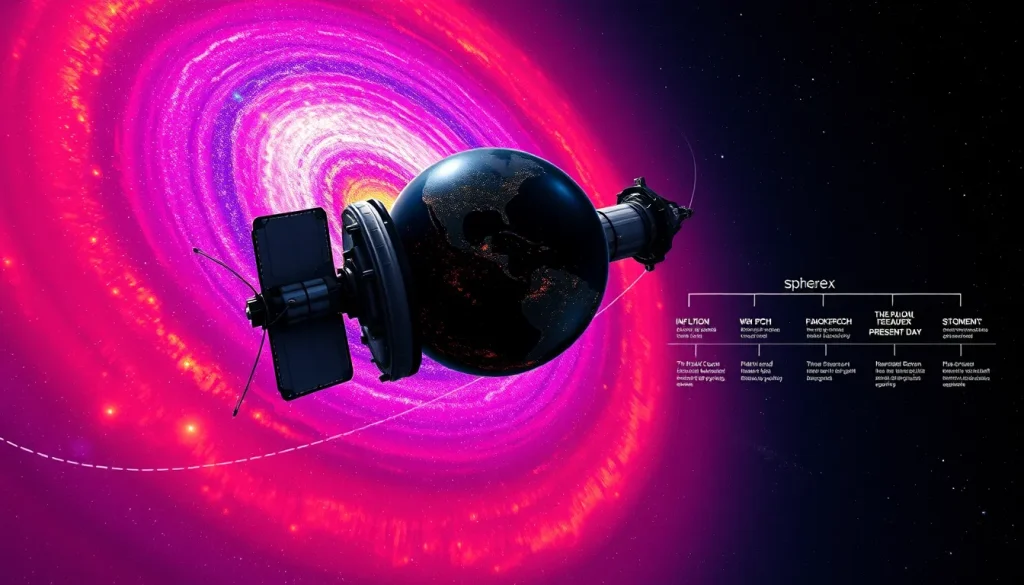
Short Answer: SPHEREx is a NASA space telescope designed to test cosmic inflation by measuring the three-dimensional distribution of hundreds of millions of galaxies across the entire sky in 102 infrared colors. By analyzing statistical patterns in that distribution, it will probe the ripples in spacetime generated during the inflationary epoch, a fraction of a second after the Big Bang.
| Mission Fact | Value |
|---|---|
| Full Name | Spectro-Photometer for the History of the Universe, Epoch of Reionization, and Ices Explorer |
| Launch | No later than April 2025 (planned) |
| Wavelength | Infrared (0.75–5 µm) in 102 spectral bands |
| Primary Objective | Measure inflationary ripples via galaxy clustering and primordial non-Gaussianity (fNL) |
| All-sky survey | Complete spectroscopic survey of the entire sky |
Main Explanation
The Cosmic Timeline
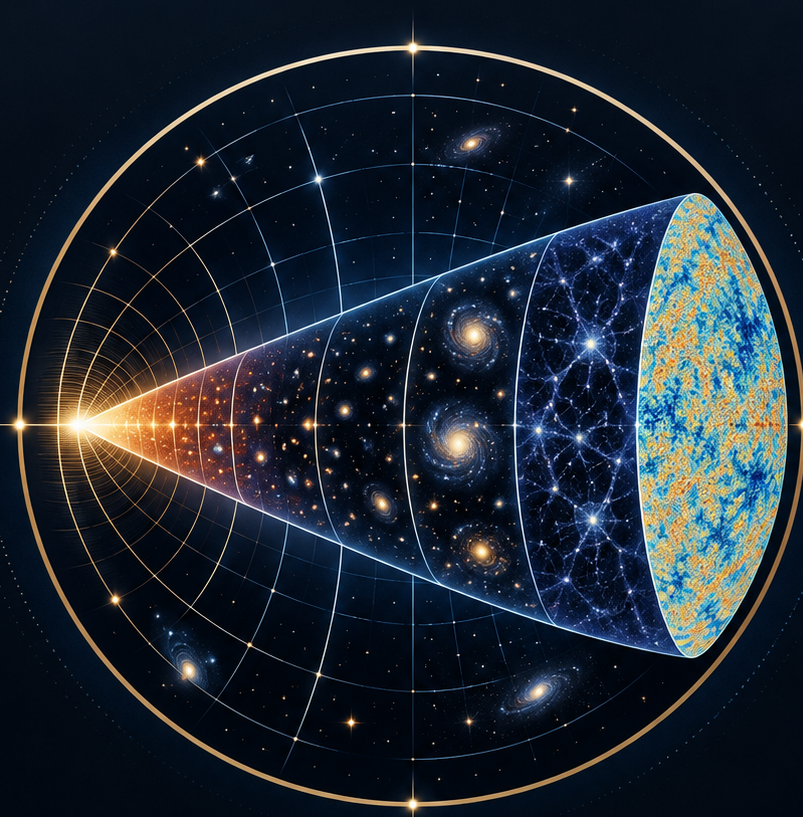
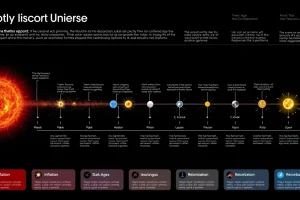
The universe began with the Big Bang, a hot, dense state that expanded and cooled over 13.8 billion years. Cosmologists divide this history into distinct epochs, each governed by different physical processes. The earliest moments—the Planck epoch (up to 10−43 seconds) and the Grand Unification epoch (up to 10−36 seconds)—remain largely speculative because they involve quantum gravity and unified forces. But the inflationary epoch, which occurred around 10−36 to 10−32 seconds, is supported by strong observational evidence.
Inflation Explained
Inflation posits that the universe underwent a rapid, exponential expansion, stretching space-time by at least a factor of 1026. This process explains the remarkable smoothness of the cosmic microwave background (CMB) and the geometric flatness of the universe. Quantum fluctuations during inflation were stretched to cosmic scales, leaving subtle density variations that later seeded the formation of galaxies and clusters. These primordial ripples are the key target for SPHEREx.
The Role of the Cosmic Microwave Background
About 380,000 years after the Big Bang, the universe cooled enough for electrons and protons to combine into neutral hydrogen—an event called recombination. The photons decoupled, creating the CMB, a relic radiation that we observe today at a temperature of 2.725 K. Missions like COBE, WMAP, and Planck have mapped the CMB’s temperature and polarization anisotropies, confirming inflation’s basic predictions and measuring cosmological parameters to high precision.
From Recombination to Structure Formation
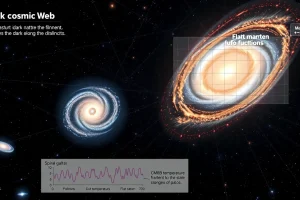
After recombination, the universe entered the Dark Ages—a period with no stars. Over time, gravity amplified the density fluctuations, leading to the formation of the first stars and galaxies during the Epoch of Reionization. This reionized the intergalactic medium. Subsequent structure formation produced the large-scale cosmic web of galaxies, clusters, and voids that we see today. The distribution of galaxies encodes the primordial density field, including any non-Gaussian features that inflation models predict.
How SPHEREx Tests Inflation
SPHEREx will measure the 3D positions of hundreds of millions of galaxies by obtaining redshifts from their spectra. By mapping the large-scale distribution of galaxies, it will measure the statistical signature of inflationary ripples, specifically the parameter fNL, which quantifies deviations from purely Gaussian initial fluctuations. A nonzero fNL would rule out the simplest single-field inflation models and point to more complex physics. SPHEREx will achieve this over a large cosmological volume at low redshifts, complementing CMB experiments that probe earlier times.
Mission: SPHEREx
Mission Facts
SPHEREx is a NASA Medium-Class Explorer (MIDEX) mission, led by the Jet Propulsion Laboratory and Caltech. It will use a technique called spectroscopy to capture the universe in 102 colors, creating the most colorful all-sky map ever made.
Launch and Operations
The mission is scheduled to launch no later than April 2025. It will operate in low Earth orbit, scanning the sky in great circles to cover the entire celestial sphere every six months.
Telescope and Instrument
SPHEREx uses a 20-cm telescope with a linear variable filter that provides spectral resolution across 102 bands from 0.75 to 5 microns. This design allows simultaneous imaging and spectroscopy over a wide field of view.
Wavelength and Survey
The infrared bands are sensitive to redshifted emission from galaxies, enabling precise distance measurements. The all-sky survey will produce a catalog of over 450 million galaxy spectra, providing a 3D map of the large-scale structure.
Objective
The primary cosmological objective is to constrain the primordial non-Gaussianity parameter fNL to a precision of σ(fNL) ≈ 1, a factor of ~20 improvement over current limits. This will test inflation models and potentially reveal the physics of the very early universe. SPHEREx will also study the epoch of reionization, the formation of water in protoplanetary disks, and the history of galactic ice.
Expected Major Results
SPHEREx will deliver the first all-sky spectral survey, enabling measurements of galaxy clustering, baryon acoustic oscillations, and redshift-space distortions. It will also provide a legacy dataset for studies of cosmic dust, interstellar medium, and the infrared background.
Dataset and Legacy
The mission will release catalogs of source positions, fluxes, and redshifts, along with calibrated spectral cubes. These data will remain a public resource for decades, complementing future observatories like the James Webb Space Telescope and the Nancy Grace Roman Space Telescope.
Why It Matters
Testing cosmic inflation is arguably the most important goal in cosmology today. Inflation is the cornerstone of the standard ΛCDM model, yet the physical process driving it remains unknown. SPHEREx will provide a unique window into the earliest moments of the universe, potentially revealing the quantum nature of spacetime and the fundamental physics that operated at energies far beyond any particle accelerator. The results will either strengthen the inflationary paradigm or force a paradigm shift in our understanding of cosmic origins.
Evidence / Sources
- SPHEREx at Caltech – The Origin of the Universe
- NASA – Why NASA’s SPHEREx Mission Will Make ‘Most Colorful’ Cosmic Map Ever
- Science – Modest telescope with big plans, SPHEREx will probe cosmic ‘inflation’ after Big Bang
- arXiv – Cosmology with the SPHEREX All-Sky Spectral Survey
Related Registry Entries
- Cosmic Microwave Background
- Inflation
- Recombination
- Large-Scale Structure
- Primordial Non-Gaussianity
FAQ
How will SPHEREx measure cosmic inflation?
SPHEREx will map the 3D distribution of hundreds of millions of galaxies using infrared spectroscopy. By measuring galaxy clustering, it will detect the statistical imprint of inflationary ripples, specifically the parameter f_NL, which quantifies deviations from Gaussian initial conditions.
What is the significance of the f_NL parameter?
A nonzero f_NL would indicate that the primordial density fluctuations were not purely Gaussian, ruling out the simplest single-field inflation models and pointing to more complex physics during the universe's first moments.
How does SPHEREx complement previous CMB missions like Planck?
While Planck measured the CMB at a redshift of about 1100, SPHEREx probes the large-scale distribution of galaxies at lower redshifts. This provides independent and complementary constraints on inflation, covering different scales and epochs.

Leave a Reply