Short Answer
Short Answer / Definition
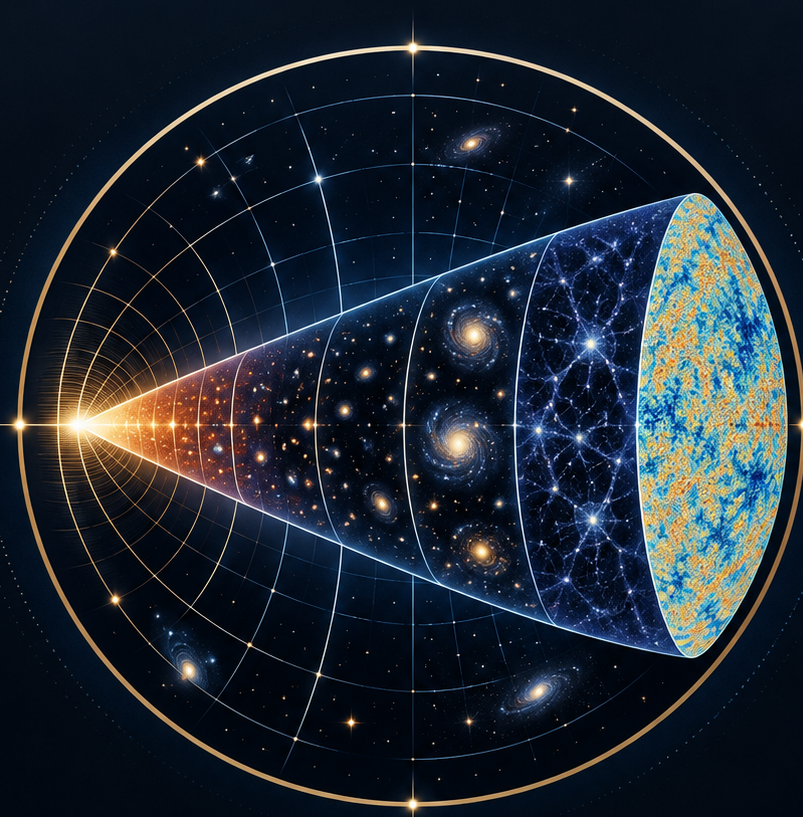
Cosmological redshift is the increase in wavelength (shift toward the red end of the spectrum) of light from distant galaxies and other cosmic sources, caused by the expansion of space itself. As the universe expands, the physical distance between galaxies grows, stretching the light waves traveling through space. The greater the redshift, the farther the light has traveled and the earlier in cosmic history it was emitted. This phenomenon provides direct evidence for the expanding universe and is a fundamental tool for measuring cosmic distances and charting the evolution of the cosmos.
Infographic / Key Facts
| Property | Value |
|---|---|
| Definition | Stretching of light to longer, redder wavelengths due to cosmic expansion |
| Cause | Expansion of space between galaxies |
| First Observed | Edwin Hubble, 1920s (recession of galaxies) |
| Key Formula | 1 + z = λ_obs / λ_rest (where z is redshift) |
| Relation to Distance | Higher redshift = greater distance and earlier cosmic time |
| Role in Cosmology | Confirms Big Bang, measures expansion rate (Hubble constant), probes dark energy |
| Key Missions | COBE, WMAP, Planck, JWST |
Main Explanation
Cosmological redshift arises from the expansion of the universe, a concept rooted in general relativity and first observationally confirmed by Edwin Hubble in the 1920s. As space expands, the wavelength of photons traveling through it is stretched proportionally to the scale factor of the universe. This effect is distinct from the Doppler shift caused by relative motion; it is a property of the expanding spacetime itself.
Light from distant galaxies is shifted toward longer, redder wavelengths because the space between the source and the observer has expanded during the light’s journey. The redshift z is defined by the ratio of observed to emitted wavelength. For nearby objects, z is approximately equal to the recession velocity divided by the speed of light (v/c), but for large distances the full relativistic treatment is needed.
The expansion history of the universe—including the initial deceleration due to gravity and the later acceleration driven by dark energy—imprints a specific relationship between redshift and distance. Measuring this relationship allows astronomers to determine the Hubble constant, the age of the universe, and the nature of dark energy.
Cosmic Epochs: A Timeline
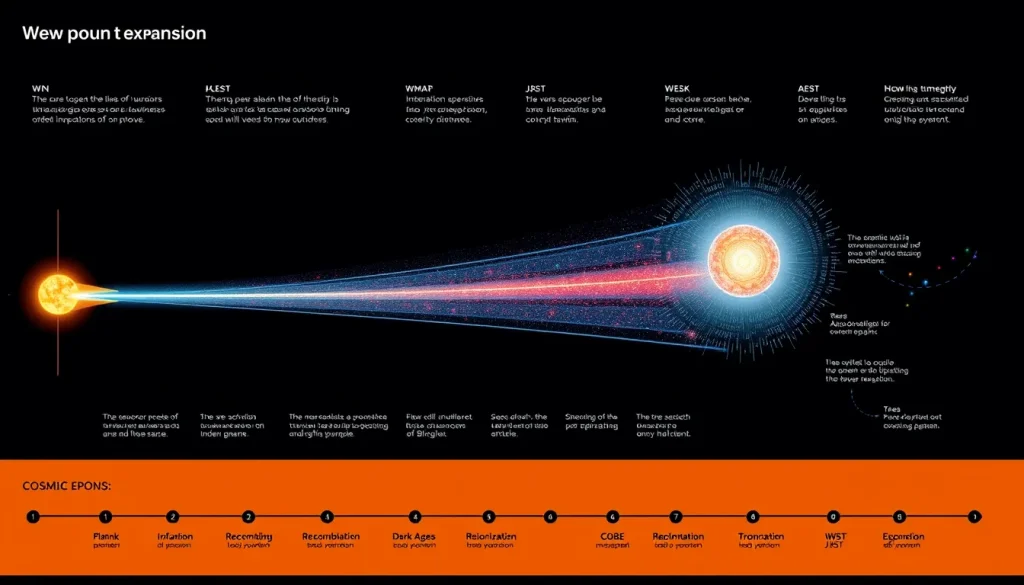
The standard model of cosmology (Lambda-CDM) describes a sequence of epochs from the Planck epoch to the present day. Each epoch is characterized by distinct physical conditions, dominant particles, and processes. The table below summarizes the major epochs, their approximate redshifts, temperatures, and key events.
| Epoch | Approx. Redshift (z) | Temperature | Key Events |
|---|---|---|---|
| Planck | ∞ → 10^32 | ~10^32 K | Quantum gravity era; all forces unified |
| Grand Unification | ~10^32 → 10^28 | ~10^27 K | Strong and electroweak forces separate; potential baryogenesis seeds |
| Inflation | ~10^28 → 10^25 | ~10^27 K | Exponential expansion, smoothing and flattening the universe |
| Electroweak | ~10^15 | ~10^15 K | Electromagnetic and weak forces separate; particles acquire mass |
| Quark | ~10^15 → 10^12 | ~10^12 K | Quarks and gluons form a quark-gluon plasma |
| Hadron | ~10^12 → 10^9 | ~10^12 → 10^9 K | Quarks combine into hadrons (protons, neutrons); matter-antimatter annihilation |
| Lepton | ~10^9 → 10^6 | ~10^9 → 10^6 K | Leptons dominate; neutrinos decouple |
| Photon (Radiation-dominated) | ~10^6 → 1100 | ~10^6 → 3000 K | Photons dominate; primordial nucleosynthesis (BBN) produces light elements |
| Recombination | ~1100 | ~3000 K | Electrons combine with protons to form neutral hydrogen; universe becomes transparent; CMB released |
| Dark Ages | ~1100 → 20 | ~3000 → 60 K | No stars yet; neutral hydrogen fills space; gravitational structures begin to form |
| Reionization | ~20 → 6 | ~60 → 10 K | First stars and galaxies ionize the intergalactic medium |
| Structure Formation | ~6 → 0 | ~10 K → 2.7 K (today) | Galaxies, clusters, and large-scale structure grow under gravity; dark energy accelerates expansion |
When It Happened
The cosmic epochs span from the first instant after the Big Bang (Planck epoch, t < 10^-43 seconds) to the present day (13.8 billion years). Recombination occurred about 380,000 years after the Big Bang, and reionization began roughly 400 million years later.
Temperature
Temperatures ranged from the unimaginable heat of the Planck epoch (10^32 K) down to the current cosmic microwave background temperature of 2.725 K. The CMB temperature scales with redshift as T = 2.725(1+z) K.
Approximate Redshift
Redshift values decrease from z ~ 10^32 at the Planck epoch to z = 0 today. Recombination corresponds to z ≈ 1100, and reionization to z ≈ 6–20.
Dominant Particles/Physics
In the earliest epochs, all four fundamental forces were unified. As the universe expanded and cooled, forces separated, and particles like quarks, leptons, photons, and neutrinos emerged. The physics of each epoch is described by the Standard Model of particle physics and general relativity, with inflation requiring a scalar field (inflaton) not yet directly detected.
What Happened
Each epoch marks a phase transition or a change in the content and behavior of the universe. Inflation solved the horizon and flatness problems. Nucleosynthesis produced helium and trace amounts of lithium. Recombination released the CMB, and reionization marked the end of the cosmic dark ages.
What Came Before
Each epoch follows from the previous one. The Planck epoch is the earliest known, but our understanding of physics breaks down before it. Inflation preceded the hot Big Bang expansion we observe.
What Came Next
The sequence leads to the present universe dominated by dark energy, dark matter, and ordinary matter. The next epoch, if any, is speculative and not part of the standard model.
Evidence
Evidence for these epochs comes from multiple sources: the cosmic microwave background (CMB) measured by COBE, WMAP, and Planck; the primordial abundances of light elements from Big Bang nucleosynthesis; the large-scale distribution of galaxies; and the observed acceleration of cosmic expansion from Type Ia supernovae. The CMB is a direct relic of recombination, and its anisotropies encode the initial conditions for structure formation.
Why It Matters
Cosmological redshift is not just an observational curiosity—it is the key that unlocks the history of the universe. By measuring the redshift of distant galaxies, astronomers can determine how fast the universe is expanding, how that expansion has changed over time, and what the universe was like at different epochs. It allows us to test the Big Bang model, measure the Hubble constant, and probe the nature of dark energy. Redshift also underpins the cosmic distance ladder and enables the study of galaxy evolution across cosmic time. Without it, we would have no way to see the universe as it was billions of years ago.
Evidence / Sources
Direct evidence for cosmological redshift comes from observations of galaxy spectra, where known spectral lines are shifted to longer wavelengths. The Hubble–Lemaître law, which relates redshift to distance, was established by Edwin Hubble in 1929 and has been confirmed to high precision by modern surveys. The CMB, first detected by Penzias and Wilson in 1965, is the ultimate redshifted radiation from recombination, with a present-day temperature of 2.725 K. Missions like COBE, WMAP, and Planck have mapped the CMB with extraordinary precision, revealing the seeds of cosmic structure. The James Webb Space Telescope (JWST) is now pushing redshift limits beyond z ≈ 13, observing galaxies in the early universe.
Related Registry Entries
- Big Bang
- Cosmic Microwave Background
- Hubble–Lemaître Law
- Dark Energy
- Inflation
FAQ
What is the difference between cosmological redshift and Doppler redshift?
Doppler redshift arises from relative motion through space (e.g., a star moving away from us). Cosmological redshift is caused by the expansion of space itself, which stretches the wavelength of light as it travels through the expanding universe. For very distant objects, the cosmological component dominates.
How do astronomers measure redshift?
Astronomers measure the shift of known spectral lines (e.g., hydrogen Lyman-alpha) toward longer wavelengths. By comparing the observed wavelength to the laboratory value, they calculate the redshift z.
Why is the CMB redshifted to microwave wavelengths?
The CMB was emitted as visible light during recombination, but the expansion of the universe over 13.8 billion years has stretched those photons to microwave wavelengths, corresponding to a redshift of about 1100.
Leave a Reply