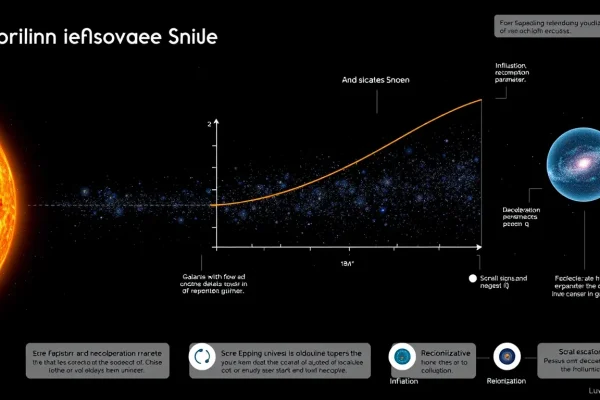
What Is the Deceleration Parameter?
The deceleration parameter q measures how the expansion of the universe changes over time. A negative q today indicates cosmic acceleration, a discovery that reshaped modern cosmology.

The deceleration parameter q measures how the expansion of the universe changes over time. A negative q today indicates cosmic acceleration, a discovery that reshaped modern cosmology.
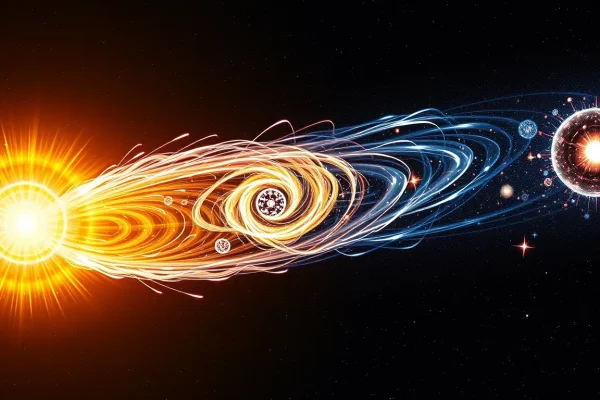
Baryogenesis is the hypothetical process that generated the observed imbalance between matter and antimatter in the early universe. This article explains the Sakharov conditions, the leading scenarios, and how this asymmetry shaped the cosmic timeline from the Planck epoch to the formation of galaxies.
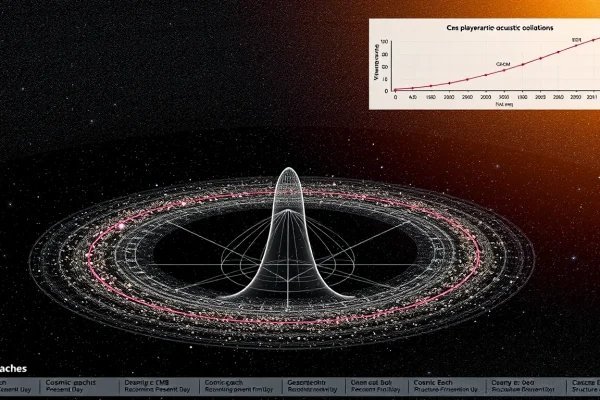
Baryon acoustic oscillations (BAOs) are a fossil imprint of sound waves in the early universe, appearing as a subtle clustering pattern in galaxy distributions. Galaxy surveys detect this pattern by measuring the correlation function or power spectrum, revealing a characteristic scale that serves as a standard ruler for cosmic expansion. This guide explains the detection method, its cosmic significance, and the full timeline of cosmic evolution from the Planck epoch to today.
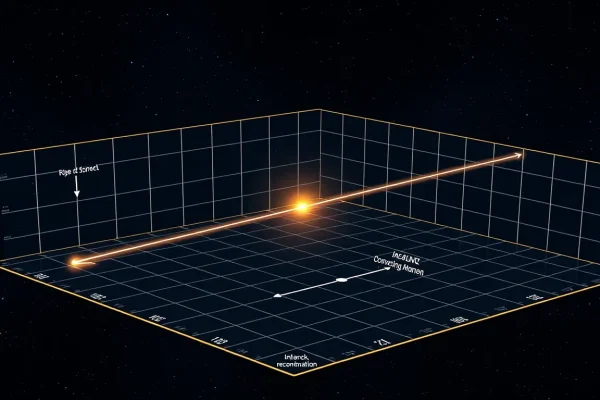
Conformal time is a coordinate that factors out cosmic expansion, letting light travel in straight lines on a comoving grid. It underlies the particle horizon and provides a natural timeline for the universe’s major epochs, from the Planck era to structure formation.
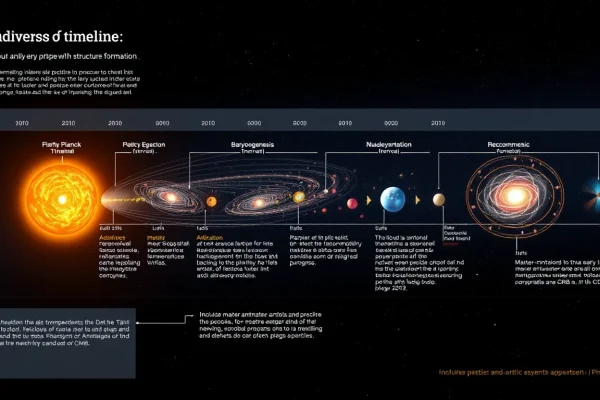
Baryogenesis is the hypothesized process that created the observed excess of matter over antimatter in the early universe. This article explains the problem, Sakharov’s conditions, candidate mechanisms, and the cosmic timeline from the Planck epoch to structure formation.
The cosmic Dark Ages were a period after recombination when the universe was filled with neutral hydrogen and no stars had yet formed. This article explores this pivotal epoch and the full timeline of cosmic evolution, from the Planck epoch to the present day.
Cosmic inflation, the exponential expansion of the universe in its first fraction of a second, is predicted to have generated a background of primordial gravitational waves. Detecting these ripples in spacetime would provide direct evidence for inflation and reveal physics at energies far beyond particle accelerators, connecting quantum mechanics with gravity.
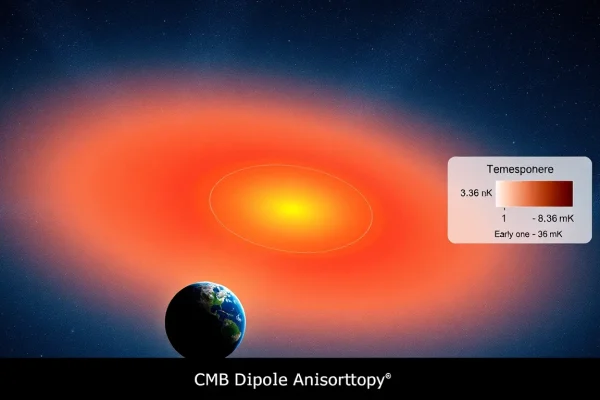
The dipole anisotropy is the largest temperature variation in the cosmic microwave background, a ~3.36 mK pattern caused by our motion relative to the CMB rest frame. It reveals the velocity of the Local Group and provides a crucial reference for cosmological measurements.
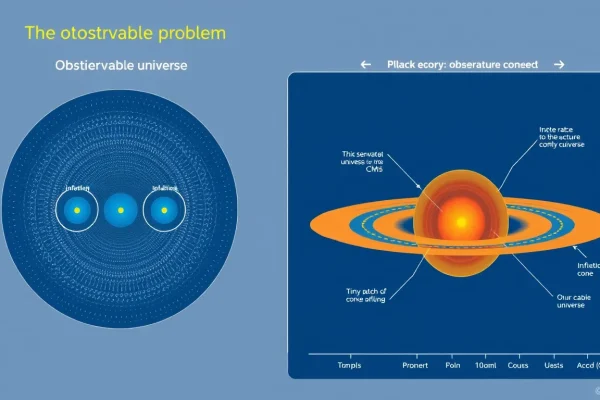
A comprehensive guide to the horizon problem, why the cosmic microwave background is so uniform, and how cosmic inflation resolves this paradox, with a timeline of cosmic epochs.
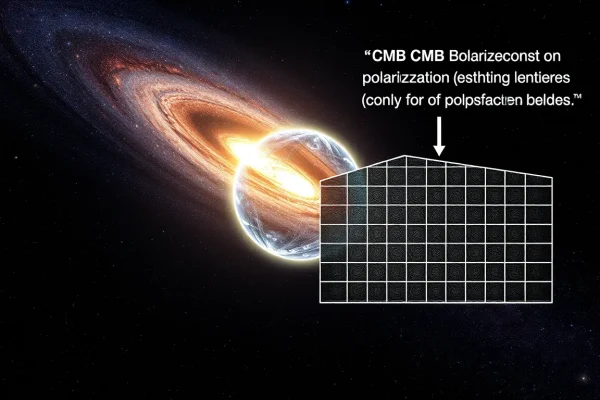
Gravitational lensing of the cosmic microwave background (CMB) subtly distorts its polarization, converting E-modes into B-modes and contaminating the primordial signal from inflation. This article explains the physics, the cosmic epochs that shaped the CMB, and how modern experiments disentangle the lensing signal to probe the early universe.