
Short Answer
The cosmic microwave background (CMB) is the faint, uniform glow of microwave radiation that fills all of space. It is the oldest light in the universe, emitted when the cosmos was only about 380,000 years old. This relic radiation is the single most powerful piece of evidence for the Big Bang theory, because it is exactly what the theory predicts: a snapshot of the universe when it first became transparent, still carrying the imprint of its primordial structure.
| Key Fact | Value |
|---|---|
| Discovery | 1965 by Arno Penzias and Robert Wilson |
| Average temperature | 2.725 Kelvin |
| Epoch of emission | Recombination (~380,000 years after the Big Bang) |
| Redshift of emission | z ≈ 1100 |
| Key missions | COBE, WMAP, Planck |
| Spectrum | Perfect blackbody |
| Anisotropy | ~1 part in 100,000 |
Main Explanation
The Big Bang theory describes the universe as having begun in an extremely hot, dense state and expanding ever since. For the first ~300,000 years, the universe was so hot that protons and electrons could not combine into atoms; instead, matter existed as a plasma of charged particles that scattered light effectively, making the universe opaque. As the universe expanded, it cooled. When the temperature dropped to about 3,000 K, electrons and protons combined to form neutral hydrogen atoms—a moment called recombination. At that instant, photons decoupled from matter and began to travel freely. Those photons, stretched by the expansion of space over 13.8 billion years, now appear as the cosmic microwave background.
The Cosmic Epochs: A Timeline
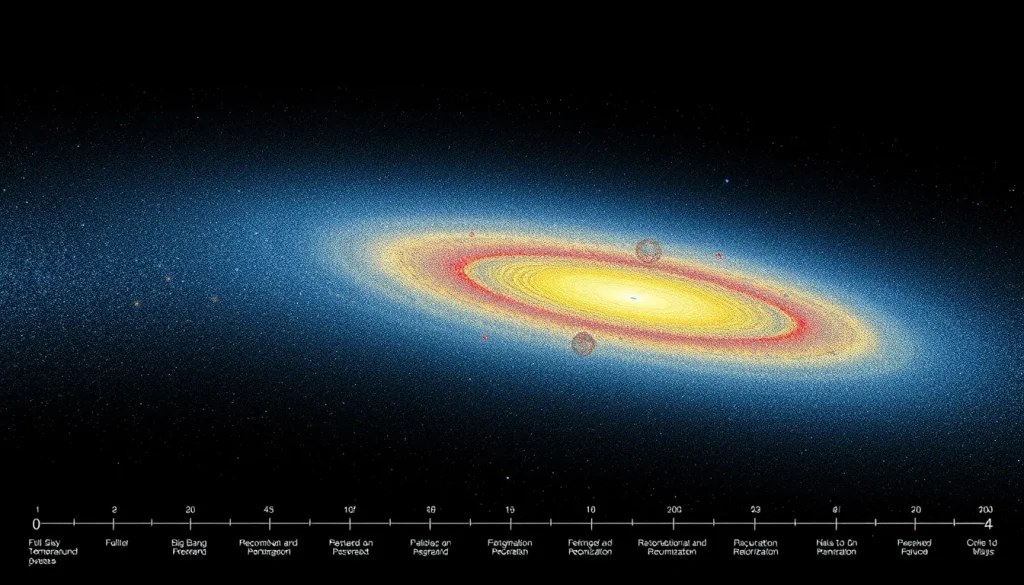
To understand the CMB’s role, we must place it within the full sequence of cosmic epochs. The standard Lambda-CDM model describes the following stages:
| Epoch | Time after Big Bang | Key Events |
|---|---|---|
| Planck epoch | 0 – 10⁻⁴³ s | Quantum gravity era; physics unknown |
| Grand Unification epoch | 10⁻⁴³ – 10⁻³⁶ s | Fundamental forces unify; inflation begins |
| Inflationary epoch | 10⁻³⁶ – 10⁻³² s | Exponential expansion; seeds of structure formed |
| Electroweak epoch | 10⁻³² – 10⁻¹² s | Electromagnetic and weak forces separate |
| Quark epoch | 10⁻¹² – 10⁻⁶ s | Quarks and gluons exist freely |
| Hadron epoch | 10⁻⁶ – 1 s | Quarks combine into protons and neutrons |
| Lepton epoch | 1 – 10 s | Leptons dominate; neutrinos decouple |
| Photon epoch | 10 s – 380,000 yr | Photons dominate; universe is plasma |
| Recombination | ~380,000 yr | Atoms form; CMB released |
| Dark Ages | 380,000 – ~150 million yr | No stars; neutral hydrogen fills space |
| Reionization | ~150 million – 1 billion yr | First stars and galaxies ionize hydrogen |
| Structure Formation | 1 billion yr – present | Galaxies, clusters, and large-scale structure grow |
The CMB as a Relic
The CMB is the direct observational link to the epoch of recombination. Its spectrum is a near-perfect blackbody with a temperature of 2.725 K, exactly as predicted for radiation that has cooled from the hot early universe. The tiny temperature fluctuations—about one part in 100,000—map the slight density variations that grew into galaxies and clusters. These fluctuations were first measured by the COBE satellite (1989–1993), then refined by WMAP (2001–2010) and Planck (2009–2013). Planck’s final data in 2018 provided the most precise values of cosmological parameters, confirming the Lambda-CDM model to remarkable accuracy.
Why the CMB Confirms the Big Bang
Before the CMB’s discovery, the steady-state theory was a serious alternative. The Big Bang predicted a faint background of microwave radiation, while steady-state models did not. Penzias and Wilson’s accidental detection in 1965—a persistent hiss in a radio antenna—matched the predicted temperature of about 3 K. This was the first decisive confirmation. Subsequent measurements of the blackbody spectrum and anisotropies have ruled out all non-standard models. The CMB also independently confirms the expansion of the universe (via its redshift), the primordial abundance of light elements (via baryon density), and the existence of dark matter and dark energy (via the acoustic peaks in the power spectrum).
Observational Evidence
Observation: The CMB is observed as an almost uniform microwave glow in every direction. Its temperature is 2.725 K, with small fluctuations at the level of 10⁻⁵.
Prediction: The Big Bang theory predicts a blackbody spectrum with a temperature that cools as the universe expands. The specific pattern of anisotropies is predicted by inflation and the growth of perturbations.
Measurement: COBE measured the spectrum to be a perfect blackbody (Nobel Prize in Physics 2006). WMAP and Planck mapped the anisotropies with increasing resolution, revealing acoustic peaks that match theoretical predictions.
Why It Supports the Model: The existence, spectrum, and statistical properties of the CMB are unique predictions of the Big Bang model. No other theory explains why space is filled with a nearly uniform 2.7 K radiation.
Limitations: The CMB alone cannot determine the Hubble constant precisely, and there is a tension between early-universe and late-universe measurements. Also, the CMB is a surface of last scattering; it cannot probe earlier times directly.
Alternative Explanations: Some have proposed that the CMB could arise from scattered starlight, but the blackbody spectrum and isotropy rule this out. No viable alternative exists.
Current Scientific Consensus: The Lambda-CDM model, which incorporates the CMB, is the standard model of cosmology. Its predictions have been confirmed to high precision by Planck and other experiments.
Why It Matters
The CMB is not just a fossil; it is a treasure trove of information about the universe’s composition and history. It tells us that the universe is 13.8 billion years old, that ordinary matter constitutes only 5% of the total energy density, and that dark matter and dark energy dominate. The CMB also provides evidence for cosmic inflation—the rapid expansion in the first fraction of a second—through the near-scale-invariant spectrum of fluctuations. By studying the CMB, we are essentially reading the universe’s birth certificate.
Evidence / Sources
The following sources provide authoritative information on the CMB and its role in confirming the Big Bang:
- COSMOS – Swinburne Astronomy Online: Cosmic Microwave Background
- Wikipedia – Discovery of cosmic microwave background radiation: Discovery of CMB
- Durrer, R. (2015) – The Cosmic Microwave Background: The history of its experimental investigation and its significance for cosmology, arXiv:1506.01907
- Wikipedia – Cosmic microwave background: CMB
Related Registry Entries
- Recombination
- Inflation
- COBE Mission
- Planck Mission
- Lambda-CDM Model
FAQ
What exactly is the cosmic microwave background?
The CMB is the oldest light in the universe, emitted about 380,000 years after the Big Bang when the universe cooled enough for atoms to form. It appears as a faint, nearly uniform microwave glow in all directions, with a temperature of 2.725 K.
How did the CMB confirm the Big Bang theory?
The Big Bang predicted a relic radiation with a blackbody spectrum and a specific temperature. The discovery of the CMB in 1965 matched these predictions precisely, and later measurements of its anisotropies confirmed detailed features of the model, ruling out steady-state alternatives.
What did COBE, WMAP, and Planck reveal about the CMB?
COBE measured the blackbody spectrum and found the first anisotropies. WMAP mapped the temperature fluctuations across the sky with high resolution, and Planck provided even finer maps, determining cosmological parameters to sub-percent precision and confirming the Lambda-CDM model.

Leave a Reply