
Short Answer
Main Explanation
The universe began in a hot, dense state—the Big Bang—and has been expanding and cooling ever since. The standard cosmological model, Lambda-CDM, describes this evolution through a sequence of epochs, each marked by changes in temperature, density, and particle content. LISA’s unique sensitivity to low-frequency gravitational waves will allow it to observe the remnants of the earliest black holes, which formed during the first few hundred million years after the Big Bang.
Cosmic Epochs: From Planck to Reionization
| Epoch | Time after Big Bang | Temperature | Key Events |
|---|---|---|---|
| Planck epoch | < 10⁻⁴³ s | > 10³² K | Quantum gravity effects dominate; no classical description. |
| Grand Unification epoch | 10⁻⁴³ – 10⁻³⁶ s | 10²⁹ – 10³² K | Strong and electroweak forces unify; inflation begins. |
| Inflationary epoch | 10⁻³⁶ – 10⁻³² s | ~10²⁷ K | Exponential expansion; quantum fluctuations seeded large-scale structure. |
| Electroweak epoch | 10⁻³² – 10⁻¹² s | 10¹⁵ – 10²⁹ K | Electromagnetic and weak forces separate; W, Z bosons acquire mass. |
| Quark epoch | 10⁻¹² – 10⁻⁶ s | 10¹² – 10¹⁵ K | Quarks and gluons exist in a quark-gluon plasma. |
| Hadron epoch | 10⁻⁶ – 1 s | 10¹⁰ – 10¹² K | Quarks combine into protons and neutrons; baryogenesis. |
| Lepton epoch | 1 – 10 s | 10⁹ – 10¹⁰ K | Leptons dominate; neutrinos decouple. |
| Photon epoch | 10 s – 380,000 yr | 10⁴ – 10⁹ K | Photons dominate; nucleosynthesis forms light elements. |
| Recombination | ~380,000 yr | ~3000 K | Electrons and protons form neutral hydrogen; CMB released. |
| Dark Ages | 380,000 yr – ~150 million yr | ~3000 K to ~50 K | No luminous sources; hydrogen remains neutral. |
| Reionization | ~150 million – 1 billion yr | ~50 K to ~10 K | First stars and galaxies ionize hydrogen. |
| Structure Formation | ~1 billion yr – present | Cooling to 2.7 K | Galaxies, clusters, and large-scale structure grow. |
The cosmic microwave background (CMB) is the relic radiation from recombination, observed today as a nearly uniform glow at 2.725 K. Missions such as COBE, WMAP, and Planck have mapped its anisotropies, confirming the predictions of inflation and providing precise cosmological parameters. The first stars—Population III—formed from pristine hydrogen and helium, and their remnants likely produced the first black holes, which are the targets for LISA.
Mission: LISA and First Black Holes
Mission Facts
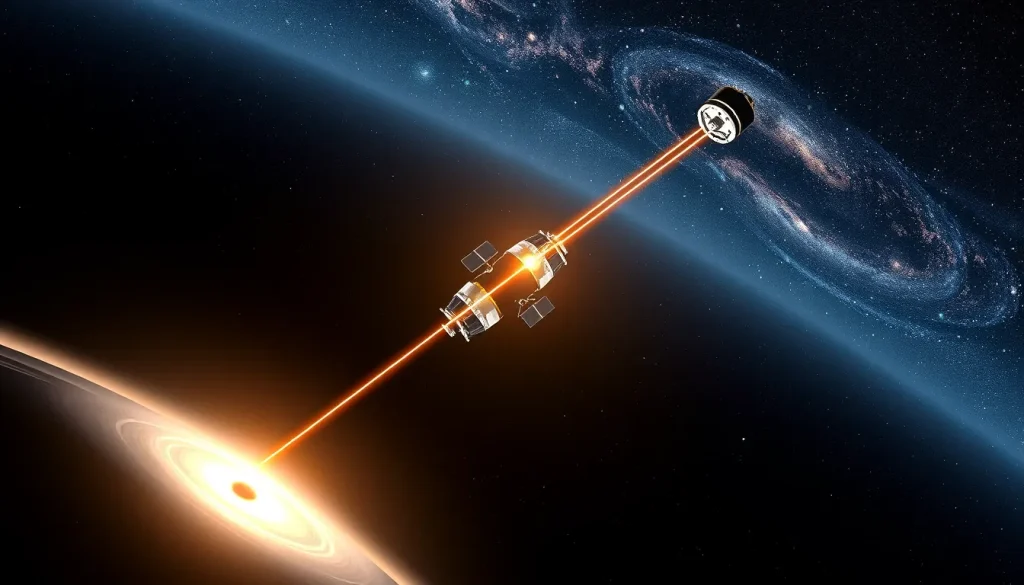
LISA is a space-based gravitational wave observatory consisting of three spacecraft in a heliocentric orbit, forming an equilateral triangle with arm lengths of 2.5 million kilometers. It is designed to detect gravitational waves in the 0.1–10 Hz band, which bridges the gap between ground-based detectors (like LIGO) and higher-frequency space missions (like the proposed TianQin).
Launch
LISA is scheduled for launch in the 2030s as an ESA-led mission with NASA partnership. The mission was adopted by ESA in 2024, with a launch readiness date around 2035.
Telescope/Instrument
Each LISA spacecraft uses a free-falling test mass (a gold-platinum cube) and a laser interferometer to measure the tiny distance changes caused by passing gravitational waves. The technology has been validated by the LISA Pathfinder mission (2015–2017).
Wavelength
LISA probes gravitational waves with frequencies from 0.1 mHz to 1 Hz, corresponding to wavelengths from about 10⁵ to 10⁸ km. This band is ideal for massive black hole mergers (10⁴–10⁷ M☉) and seed black hole binaries (10²–10³ M☉) at high redshift.
Objective
A primary science goal is to detect gravitational waves from the mergers of seed black holes—remnants of Population III stars and direct-collapse black holes. These events are expected to be numerous at redshifts 10–20, providing direct probes of the formation of the first black holes and the growth of structure (Sesana et al., 2009; Kelly et al., 2025).
Major Results
LISA has not yet launched, but its science case is built on extensive theoretical modeling. The 2025 paper by Kelly et al. highlights that direct-collapse black holes will be prominent in LISA’s data stream, with masses, mass ratios, spins, and eccentricities strongly dependent on formation channels. LISA will also measure cosmological parameters by using standard sirens.
Dataset
LISA will produce a continuous data stream from its three laser links, with a planned mission duration of 4 years (extendable to 10). The data will be processed to extract gravitational wave signals, and the catalog of events will be made public.
Legacy
LISA will revolutionize our understanding of the early universe by directly observing the seeds of supermassive black holes. It will complement electromagnetic observations from JWST and future X-ray missions, providing a multi-messenger view of cosmic dawn.
Why It Matters
Detecting gravitational waves from the first black holes is not just about black hole astrophysics—it is a window into the physics of the early universe. The properties of seed black holes encode the conditions of the intergalactic medium, the initial mass function of the first stars, and the mechanisms of structure formation. LISA’s measurements will test the standard Lambda-CDM model at high redshift and may reveal new physics if deviations are found.
Evidence / Sources
The scientific case for LISA is supported by multiple studies. Sesana et al. (2009) showed that mergers of ~100 M☉ seed black holes generate gravitational waves in the 0.1–10 Hz band. Gair et al. (2009) further explored how future detectors, including LISA, could probe seed black hole properties. Kelly et al. (2025) specifically examined direct-collapse black holes and their gravitational wave signatures, emphasizing the importance for LISA’s science.
Related Registry Entries
This article is part of a series on the cosmic timeline and gravitational wave astronomy. Related entries include: The Planck Epoch, Inflation, The Cosmic Microwave Background, Recombination, The Dark Ages, Reionization, and The First Stars.
FAQ
What are seed black holes?
Seed black holes are the initial black holes formed from the collapse of the first stars (Population III) or direct collapse of gas clouds, with masses typically 100–1000 solar masses.
Why can LISA detect them?
LISA is sensitive to gravitational waves from mergers of massive black holes in the mass range that seed black holes occupy, and its low-frequency band allows it to detect events at high redshift.
How does LISA complement JWST?
JWST observes the first galaxies in infrared light, while LISA observes the gravitational waves from the black holes that reside in those galaxies. Together they provide a complete picture of cosmic dawn.
Leave a Reply