Short Answer
Short Answer: The Friedmann equation is a set of equations in physical cosmology that describe the expansion of a homogeneous, isotropic universe. It relates the scale factor (a measure of cosmic size) to the energy density and curvature of space. Omega (Ω) is the ratio of the actual density of the universe to the critical density — the density that makes space flat. If Ω = 1, the universe is flat; if Ω > 1, it is closed; if Ω < 1, it is open.
| Friedmann Equation | |
|---|---|
| Type | Cosmological model |
| Formulation | Derived from Einstein’s field equations (GR) |
| Key variables | Scale factor a(t), Hubble parameter H, density ρ, curvature parameter k |
| Key insight | Cosmic expansion depends on energy content and spatial curvature |
| Omega (Ω) | Ratio of actual density to critical density |
| Used in | ΛCDM model, Big Bang cosmology |
Main Explanation
Definition
The Friedmann equations, first derived by Alexander Friedmann in 1922 and 1924, are a set of equations that govern the expansion of a homogeneous and isotropic universe (the FLRW metric). They follow from Einstein’s field equations of general relativity when applied to a perfect fluid with mass density ρ and pressure p. The equations assume the universe is spatially homogeneous and isotropic, a principle known as the cosmological principle.
How It Works
The central equation relates the Hubble parameter H (the fractional rate of change of the scale factor a) to the energy density ρ and the curvature parameter k. The scale factor a(t) describes how cosmic distances change with time; it is normalized to 1 today. The equation can be written as:

H² = (8πG/3)ρ – kc²/a² + Λc²/3
Here G is Newton’s gravitational constant, c is the speed of light, and Λ is the cosmological constant (often associated with dark energy). The curvature parameter k can be +1 (closed), 0 (flat), or -1 (open). The density ρ includes all forms of energy: matter, radiation, and dark energy.
Equation and Omega
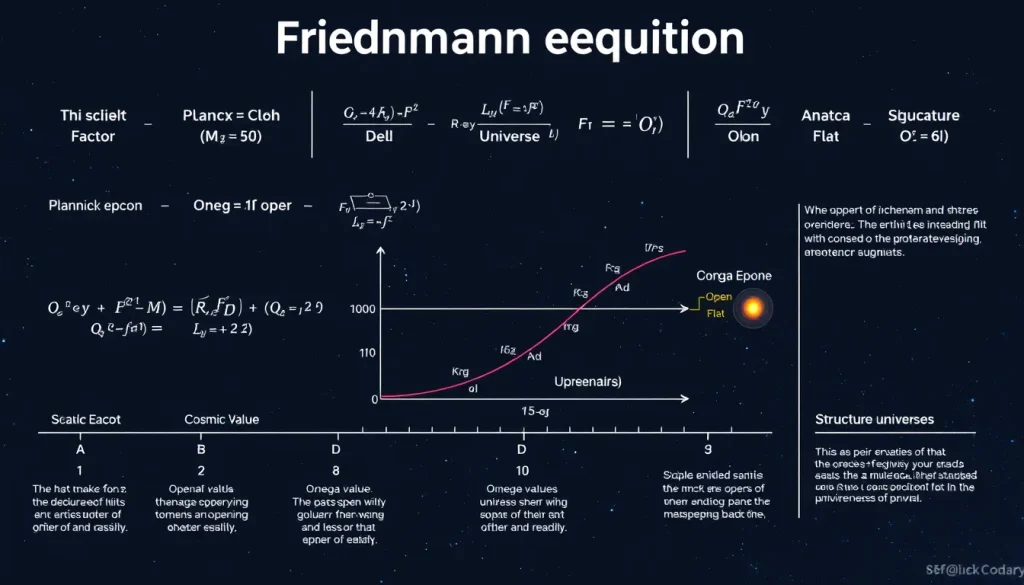
The critical density ρ_c is defined as the density that makes the universe flat (k=0) for a given H. It is given by ρ_c = 3H²/(8πG). Omega (Ω) is then the ratio Ω = ρ/ρ_c. The Friedmann equation can be rewritten in terms of Ω and the curvature term:
Ω – 1 = kc²/(a²H²)
Thus, if Ω = 1, the universe is flat (k=0). If Ω > 1, the universe is closed (positive curvature). If Ω < 1, it is open (negative curvature). In the standard ΛCDM model, the total Ω (matter + dark energy) is very close to 1, indicating a flat universe.
Example: Cosmic Epochs
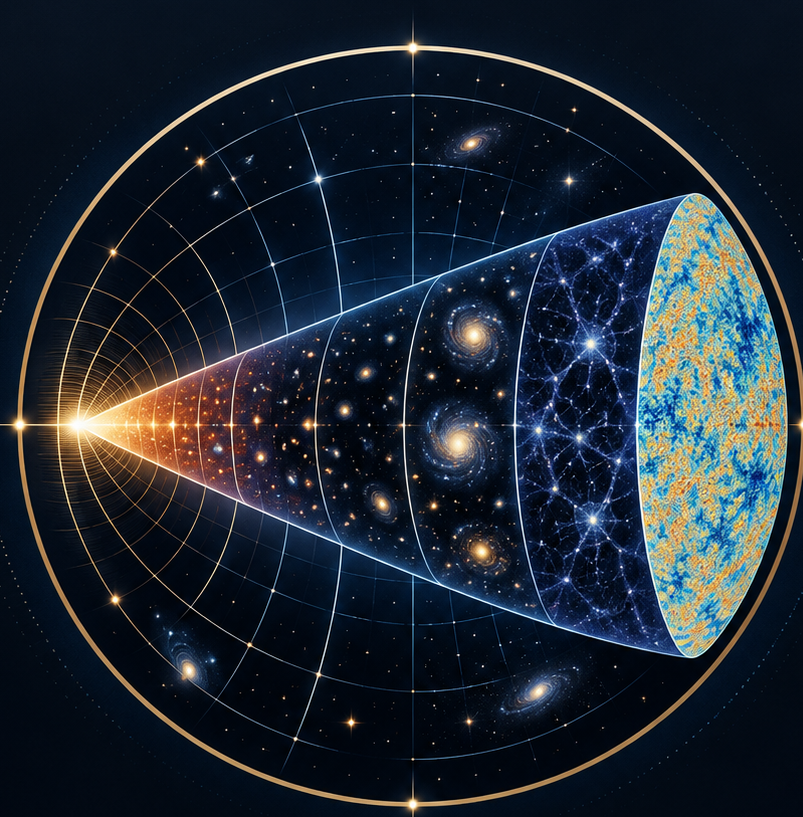
The Friedmann equation governs the entire history of the universe, from the Planck epoch to the present day. By specifying the density contributions (radiation, matter, dark energy) and solving for a(t), we obtain a timeline of cosmic evolution. Below is a summary of key epochs, based on the standard model:
| Epoch | Time after Big Bang | Temperature | Key Events |
|---|---|---|---|
| Planck epoch | < 10⁻⁴³ s | > 10³² K | Quantum gravity effects dominate; no known physics. |
| Grand Unification epoch | 10⁻⁴³ – 10⁻³⁶ s | 10³² – 10²⁸ K | Fundamental forces (except gravity) unify. |
| Inflationary epoch | 10⁻³⁶ – 10⁻³² s | ~10²⁸ K | Exponential expansion; quantum fluctuations seeded structure. |
| Electroweak epoch | 10⁻³² – 10⁻¹² s | 10²⁸ – 10¹⁵ K | Electromagnetic and weak forces separate. |
| Quark epoch | 10⁻¹² – 10⁻⁶ s | 10¹⁵ – 10¹² K | Quarks and gluons form a quark-gluon plasma. |
| Hadron epoch | 10⁻⁶ – 1 s | 10¹² – 10¹⁰ K | Protons and neutrons form; matter-antimatter annihilation. |
| Lepton epoch | 1 – 10 s | 10¹⁰ – 10⁹ K | Leptons dominate; neutrinos decouple. |
| Photon epoch | 10 s – 380,000 yr | 10⁹ – 3000 K | Photons coupled to matter; nucleosynthesis (BBN) occurs. |
| Recombination | ~380,000 yr | ~3000 K | Electrons combine with protons to form neutral hydrogen; photons decouple, producing the CMB. |
| Dark Ages | 380,000 yr – ~150 million yr | 3000 – 50 K | The universe is dark; no stars yet; matter begins to clump. |
| Reionization | ~150 million – 1 billion yr | ~50 – 10 K | First stars and galaxies form; ultraviolet light reionizes hydrogen. |
| Structure Formation | 1 billion yr – present | < 10 K | Galaxies, clusters, and large-scale structure form; dark energy accelerates expansion. |
Observable Consequences
The Friedmann equation predicts the expansion history, which is observed through the Hubble–Lemaître law (redshift–distance relation), the cosmic microwave background (CMB) anisotropies, and the large-scale distribution of galaxies. The CMB, discovered in 1965, is a relic of the photon epoch and its temperature (2.725 K) matches predictions. Measurements by COBE, WMAP, and the Planck satellite have confirmed the near-flatness of the universe (Ω_total ≈ 1) and the existence of dark energy (Ω_Λ ≈ 0.7).
Common Misconceptions
- Omega is not a constant: It evolves with time; the value we quote today is Ω_0.
- Omega does not include only matter: It includes all energy densities: matter, radiation, and dark energy.
- Flat universe does not mean infinite: A flat universe can be infinite or finite but without curvature.
- The Friedmann equation is not just a Newtonian equation: Although a Newtonian derivation exists, it is fundamentally relativistic.
Why It Matters
The Friedmann equation is the backbone of modern cosmology. It connects the observable expansion rate (Hubble parameter) to the energy content of the universe, allowing us to infer the composition of the cosmos (baryonic matter, dark matter, dark energy) and its ultimate fate. The parameter Omega is a key diagnostic: a universe with Ω > 1 will eventually recollapse, while Ω < 1 expands forever; Ω = 1 gives a critical balance. Observations of the CMB and supernovae show that Ω ≈ 1, with dark energy dominating, leading to eternal acceleration.
Evidence / Sources
The Friedmann equations are derived from general relativity and are supported by a wealth of observational data. The sources used for this article include:
- Wikipedia: Friedmann equations — https://en.wikipedia.org/wiki/Friedmann_equations
- Jodrell Bank Centre for Astrophysics: Solving the Friedman Equation — https://www.jb.man.ac.uk/~jpl/cosmo/friedman.html
- HyperPhysics: Friedmann Equation — http://hyperphysics.phy-astr.gsu.edu/hbase/Astro/fried.html
- Ohio State University Course Notes: Cosmic Dynamics — https://www.astronomy.ohio-state.edu/weinberg.21/A5682/notes4.pdf
Related Registry Entries
For further exploration, see the following entries in this encyclopedia:
- Scale Factor — The cosmic scale factor a(t) in the Friedmann equation.
- Critical Density — The density that yields Ω = 1.
- Hubble Parameter — The expansion rate H(t).
- Lambda-CDM Model — The current standard model incorporating dark energy.
FAQ
What does Omega equal in the actual universe?
Observations from the Planck satellite and other missions indicate that the total Omega (matter + dark energy) is very close to 1, with a value of 1.0023 ± 0.0055 (including all forms). The matter density Ω_m ≈ 0.31 and dark energy Ω_Λ ≈ 0.69.
How does the Friedmann equation lead to the Big Bang?
If you run the expansion backward, the scale factor a(t) goes to zero at a finite time in the past, implying infinite density and temperature — the initial singularity, or Big Bang.
Is the Friedmann equation still valid today?
Yes, it remains the foundation of the standard ΛCDM model, though modifications (e.g., inflation) are added to explain initial conditions. The equation itself is not in question.
Leave a Reply