Short Answer
Main Explanation
The Hubble–Lemaître law, commonly known as Hubble’s law, is a foundational observation in cosmology that establishes a direct relationship between the distance of a galaxy from Earth and the speed at which it appears to recede. This relationship is a key piece of evidence for the expansion of the universe and underpins the modern Big Bang model. Named after Edwin Hubble and Georges Lemaître, the law states that galaxies are moving away from us at velocities proportional to their distances, meaning the farther away a galaxy is, the faster it is receding.
Definition
In its simplest form, the Hubble–Lemaître law states that the recessional velocity (v) of a galaxy is directly proportional to its distance (d) from the observer, with the constant of proportionality being the Hubble constant (H_0): (v = H_0 times d). This law is a direct consequence of the uniform expansion of space, as described by the Friedmann equations derived from general relativity. The law was first proposed by Georges Lemaître in 1927 and later confirmed by Edwin Hubble’s observations in 1929, which used Cepheid variables to measure distances to nearby galaxies.
How It Works
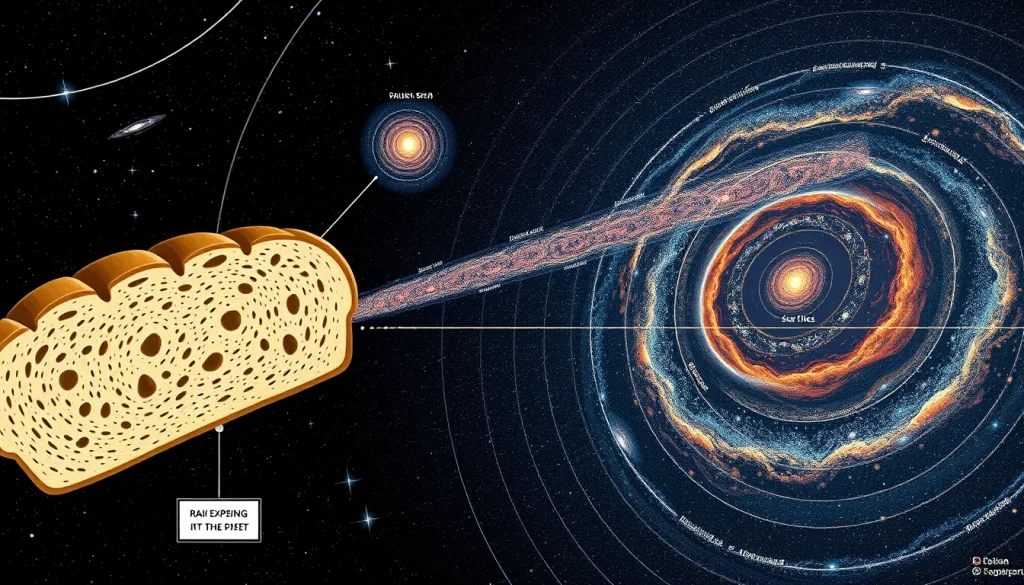
The expansion of the universe is often illustrated with the raisin bread analogy. As the dough rises, every raisin (representing a galaxy) sees all other raisins moving away from it, with more distant raisins moving faster. This is not because the raisins are moving through the dough, but because the space between them is expanding. Similarly, galaxies are not moving through space; rather, the fabric of space itself is stretching, carrying galaxies along. This expansion causes light from distant galaxies to be redshifted—its wavelength stretches as it travels through expanding space—allowing astronomers to measure recessional velocities via redshift. The relationship between redshift and distance was first systematically observed by Edwin Hubble, but the theoretical framework was established by Alexander Friedmann and Georges Lemaître from Einstein’s general relativity.
Equation
The law is expressed as (v = H_0 times d), where (v) is the recessional velocity (often inferred from redshift), (d) is the proper distance to the galaxy, and (H_0) is the Hubble constant, currently measured to be around 70 km/s/Mpc (kilometers per second per megaparsec). The inverse of the Hubble constant gives an estimate of the age of the universe, approximately 13.8 billion years. The Hubble constant is not truly constant over cosmic time; it changes as the universe evolves, but its present-day value is denoted (H_0).
Example
Consider two galaxies: Galaxy A is 100 million light-years away, and Galaxy B is 200 million light-years away. According to the law, Galaxy B will be receding at twice the velocity of Galaxy A. If the Hubble constant is 70 km/s/Mpc, then a galaxy at 1 Mpc (about 3.26 million light-years) recedes at 70 km/s. At 100 Mpc, it recedes at 7,000 km/s. This linear relationship holds for distances where the expansion dominates over local gravitational effects.
Observable Consequences
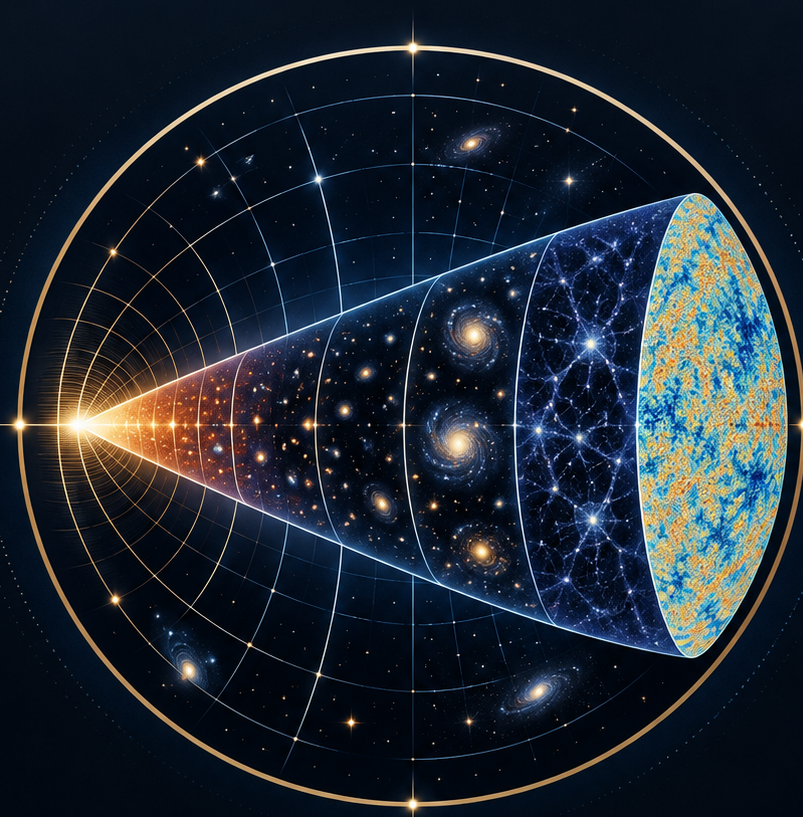
The Hubble–Lemaître law has profound implications. It implies that the universe is expanding, and by running the clock backward, it suggests that all matter and energy were once concentrated in an extremely hot, dense state—the Big Bang. The law also provides the basis for measuring cosmic distances and for understanding the large-scale structure of the universe. Moreover, it leads to the concept of the cosmic microwave background (CMB) radiation, a relic of the early universe. The CMB, discovered in 1965 by Arno Penzias and Robert Wilson, is the afterglow of the photon epoch, released at recombination about 380,000 years after the Big Bang. Missions such as COBE, WMAP, and Planck have mapped the CMB with extraordinary precision, confirming the predictions of the Lambda-CDM model and revealing the seeds of cosmic structure.
Common Misconceptions
A common misconception is that the Earth is at the center of the expansion. In reality, the expansion is homogeneous and isotropic—every observer in any galaxy would see the same pattern of recession. Another misconception is that galaxies are moving through space; rather, space itself is expanding. Additionally, the law does not apply to gravitationally bound systems like the Local Group (which includes the Milky Way and Andromeda), where gravity overrides expansion. Finally, the redshift of distant galaxies is not a Doppler shift due to motion through space, but a cosmological redshift caused by the stretching of space itself.
The Cosmic Epochs
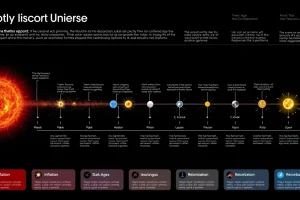
The expansion of the universe, as described by the Hubble–Lemaître law, is intimately connected to its thermal history. The standard Lambda-CDM model divides cosmic evolution into distinct epochs, each characterized by the dominant physical processes and particle content. The following table summarizes the major epochs:
| Epoch | Time After Big Bang | Temperature | Approx. Redshift | Key Events |
|---|---|---|---|---|
| Planck Epoch | 0 to 10-43 s | >1032 K | Unknown | Quantum gravity effects dominate; all forces unified. |
| Grand Unification Epoch | 10-43 to 10-36 s | 1028–1032 K | Extremely high | Strong and electroweak forces separate. |
| Inflationary Epoch | 10-36 to 10-32 s | Dropping rapidly | Extreme | Exponential expansion; quantum fluctuations seeded large-scale structure. |
| Electroweak Epoch | 10-32 to 10-12 s | 1015–1028 K | Very high | Electromagnetic and weak forces separate; particles acquire mass. |
| Quark Epoch | 10-12 to 10-6 s | 1012–1015 K | ~1012 | Quarks and gluons form a quark-gluon plasma. |
| Hadron Epoch | 10-6 to 1 s | 1010–1012 K | ~1010 | Quarks combine to form protons and neutrons; baryogenesis occurs. |
| Lepton Epoch | 1 to 10 s | 109–1010 K | ~109 | Leptons dominate; electron-positron annihilation leaves neutrinos. |
| Photon Epoch | 10 s to 380,000 years | 104–109 K | ~108 to 1000 | Photons dominate; nucleosynthesis forms light elements. |
| Recombination | ~380,000 years | ~3,000 K | ~1100 | Electrons combine with nuclei to form neutral atoms; universe becomes transparent; CMB released. |
| Dark Ages | 380,000 years to ~100 million years | ~3,000 K to ~30 K | 1100 to ~20 | No luminous sources; neutral hydrogen fills the universe. |
| Reionization | ~100 million to ~1 billion years | ~30 K to ~10 K | ~20 to ~6 | First stars and galaxies form; ultraviolet light reionizes hydrogen. |
| Structure Formation | ~1 billion years to present | Dropping to 2.7 K | ~6 to 0 | Galaxies, clusters, and superclusters assemble; dark energy accelerates expansion. |
This timeline is supported by observations such as the cosmic microwave background radiation—discovered by Penzias and Wilson in 1965—which is the remnant of the photon epoch, and detailed measurements from missions like COBE, WMAP, and Planck. The James Webb Space Telescope (JWST) is now probing the era of reionization and structure formation, revealing the first galaxies and providing new insights into the early universe.
Why It Matters
The Hubble–Lemaître law is not just an empirical rule; it is the foundation of modern cosmology. It provides the framework for understanding the age, composition, and fate of the universe. Combined with the cosmic microwave background and large-scale structure surveys, it confirms the Lambda-CDM model, which describes a universe dominated by dark energy and dark matter. The law also enables astronomers to map the expansion history of the universe, leading to the surprising discovery of cosmic acceleration in 1998, which earned the Nobel Prize in Physics in 2011. Moreover, the ongoing measurement of the Hubble constant—with a tension between early-universe and late-universe values—highlights the frontiers of cosmological research and may point to new physics.
Evidence / Sources
The law is supported by extensive observational evidence, including redshift surveys of galaxies, the cosmic distance ladder, and the uniformity of the CMB. The original observations by Edwin Hubble in 1929 used Cepheid variables to measure distances, and subsequent surveys have refined the relationship. Modern measurements of the Hubble constant, however, show a tension between early-universe (CMB-based) and late-universe (distance ladder) methods, an active area of research. Sources for this article include the Wikipedia article on Hubble’s law, Space.com’s explainer, Physics LibreTexts, and HyperPhysics.
Related Registry Entries
This entry is part of a series on the cosmic microwave background and the evolution of the universe. Related entries include: Cosmic Microwave Background, Big Bang Nucleosynthesis, Inflation, Recombination, and Dark Energy.
FAQ
What is the Hubble–Lemaître law?
It states that the recessional velocity of a galaxy is directly proportional to its distance from us, with the Hubble constant as the proportionality factor. This is evidence for the expanding universe.
Why is it called the Hubble–Lemaître law?
It honors both Georges Lemaître, who first derived the idea from general relativity in 1927, and Edwin Hubble, who provided observational confirmation in 1929.
Does the law imply we are at the center of the universe?
No. The expansion is homogeneous and isotropic; any observer in any galaxy would see the same pattern of recession, so there is no preferred center.
How does the law relate to the cosmic microwave background?
The law implies the universe was once hot and dense. The CMB is the cooled remnant of that early hot state, released at recombination, and its properties confirm the expansion history.
Leave a Reply