
Short Answer
Main Explanation
What Is Cosmic Inflation?
Cosmic inflation is a theorized period of extraordinarily rapid exponential expansion that occurred in the earliest instants of the universe, roughly 10⁻³⁶ to 10⁻³² seconds after the Big Bang. During this epoch, the universe expanded by a factor of at least 10²⁶, smoothing out irregularities and flattening spacetime. Inflation elegantly explains several observed features of the cosmos: why the cosmic microwave background (CMB) is so uniform across the sky, why the universe appears spatially flat, and how the seeds of large-scale structure — galaxies and galaxy clusters — originated from quantum fluctuations stretched to cosmic scales.
According to the standard Lambda-CDM (cold dark matter) model, which is the consensus cosmological framework, inflation is not an add-on but a necessary component. It sets the initial conditions for the hot Big Bang that followed. One of the most remarkable predictions of inflation is that it should have generated gravitational waves — ripples in the curvature of spacetime itself.
How Inflation Generates Gravitational Waves
Inflation amplifies quantum fluctuations in the fabric of spacetime. Just as quantum mechanics predicts vacuum fluctuations in particle fields, it also predicts fluctuations in the gravitational field. During inflation, these quantum gravitational fluctuations were stretched to macroscopic scales, becoming classical gravitational waves. This process is analogous to how density fluctuations seeded the formation of galaxies, but gravitational waves represent a distinct tensor-mode perturbation — a stretching and squeezing of space itself (Krauss, Dodelson, & Meyer, 2010).
These primordial gravitational waves form a stochastic background — a random superposition of waves from all directions, spanning a broad range of frequencies. Unlike astrophysical gravitational waves from events like black hole mergers, which are individual, localized bursts, the inflationary background is continuous and permeates the entire universe.
The Cosmic Epochs: A Timeline
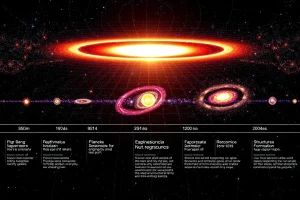
The history of the universe from the Planck epoch to the present day is a story of cooling, expansion, and the progressive emergence of structure. The table below summarizes the major cosmic epochs.
| Epoch | Time | Temperature | Key Events |
|---|---|---|---|
| Planck Epoch | < 10⁻⁴³ s | > 10³² K | Quantum gravity dominates; all four forces unified |
| Grand Unification Epoch | 10⁻⁴³–10⁻³⁶ s | 10²⁸–10³² K | Strong nuclear force separates from electroweak force |
| Inflationary Epoch | 10⁻³⁶–10⁻³² s | ~10²⁷ K | Exponential expansion; quantum fluctuations amplified into gravitational waves and density seeds |
| Electroweak Epoch | 10⁻³²–10⁻¹² s | 10¹⁵–10²⁸ K | Electromagnetic and weak forces separate; Higgs mechanism gives particles mass |
| Quark Epoch | 10⁻¹²–10⁻⁶ s | 10¹²–10¹⁵ K | Quarks and gluons form a quark-gluon plasma; no free hadrons yet |
| Hadron Epoch | 10⁻⁶–1 s | 10¹⁰–10¹² K | Protons and neutrons form; matter-antimatter annihilation |
| Lepton Epoch | 1–10 s | 10⁹–10¹⁰ K | Leptons dominate; neutrinos decouple and stream freely |
| Photon Epoch | 10 s–380,000 yr | 3,000–10⁹ K | Photons dominate; Big Bang nucleosynthesis produces light elements (H, He, Li) |
| Recombination | ~380,000 yr | ~3,000 K | Electrons and protons combine to form neutral hydrogen; CMB released |
| Dark Ages | 380,000–150 million yr | ~20–3,000 K | No luminous sources; universe dark and filled with neutral hydrogen |
| Reionization | 150 million–1 billion yr | ~20–100 K | First stars and galaxies form; ultraviolet light reionizes hydrogen |
| Structure Formation | 1 billion yr–present | < 20 K | Galaxies, clusters, and large-scale structure assemble |
The Cosmic Microwave Background as a Relic
The CMB is the oldest light in the universe, emitted at recombination when the universe cooled enough for electrons and protons to combine into neutral hydrogen. This light has been redshifted by cosmic expansion from visible/ultraviolet wavelengths to microwaves, now observed at a temperature of about 2.725 K. The CMB provides a snapshot of the universe at 380,000 years of age, encoding information about density fluctuations, the curvature of space, and — crucially for inflation — the polarization patterns that may reveal primordial gravitational waves (Matson, 2010).
Key Missions and Instruments
NASA’s COBE mission (1989) first measured the CMB’s blackbody spectrum and detected its large-scale anisotropy. WMAP (2001–2010) mapped the CMB with higher resolution, pinning down cosmological parameters and providing strong support for inflation. The European Space Agency’s Planck mission (2009–2013) achieved even greater precision, measuring the CMB’s temperature and polarization to exquisite accuracy. The James Webb Space Telescope (JWST) now probes the reionization epoch and the formation of the first galaxies, complementing CMB studies by observing the later stages of cosmic history.
Evidence: Gravitational Waves and Inflation
Observation
The observational signature of primordial gravitational waves is a specific pattern in the polarization of the CMB known as B-mode polarization. Unlike E-mode polarization, which arises from density fluctuations, B-modes have a curl-like pattern that can only be produced by tensor perturbations — gravitational waves. In March 2014, the BICEP2 collaboration announced the detection of B-modes that they attributed to primordial gravitational waves from inflation. However, subsequent analysis showed that galactic dust foregrounds could explain a significant portion of the signal, and the claim was retracted (Krauss, 2014).
Prediction
Inflation makes a specific, testable prediction: the existence of a stochastic gravitational wave background with a characteristic spectrum. The amplitude of this background is directly related to the energy scale of inflation, parameterized by the tensor-to-scalar ratio r. The simplest inflationary models predict r in the range of 0.001 to 0.1, which is within reach of next-generation experiments. As Roshan and White (2025) note, any detectable stochastic gravitational wave background from the early universe would shed light on physics beyond the Standard Model.
Measurement
Current and planned experiments seek to detect primordial gravitational waves through two complementary approaches. First, CMB polarization experiments (BICEP/Keck, the Simons Observatory, and future CMB-S4) search for B-mode polarization at degree angular scales. Second, space-based gravitational wave interferometers, such as the Laser Interferometer Space Antenna (LISA) and other proposed observatories, aim to directly detect the stochastic background at lower frequencies (Roshan & White, 2025). Ground-based pulsar timing arrays probe even lower frequencies.
Why It Supports the Model
A confirmed detection of primordial gravitational waves would be transformative. It would confirm that inflation occurred and operated at an energy scale near the Grand Unification scale (~10¹⁶ GeV), far beyond the reach of any conceivable particle accelerator. Moreover, because these waves originate from quantum fluctuations in the gravitational field, their detection would provide the first direct evidence of quantum gravity effects — a bridge between general relativity and quantum mechanics (Krauss, 2014). Krauss and colleagues (2010) emphasize that primordial gravitational waves could provide a new and unique window on the earliest moments of the universe and on new physics at energies many orders of magnitude beyond those accessible at particle accelerators.
Limitations
The primary challenge in detecting primordial gravitational waves through CMB B-modes is foreground contamination. Galactic dust emission and synchrotron radiation can produce polarized signals that mimic the B-mode pattern. Separating these foregrounds from the primordial signal requires multi-frequency observations and careful modeling. Direct detection via space-based interferometers faces different challenges, including instrument noise and the need to distinguish the inflationary background from astrophysical sources.
Alternative Explanations
If a stochastic gravitational wave background is detected, it may not necessarily originate from inflation. Other early-universe processes could generate gravitational waves, including cosmic strings, first-order phase transitions, and reheating dynamics after inflation (Roshan & White, 2025). Distinguishing between these scenarios requires measuring the spectral shape and statistical properties of the background. The frequency spectrum of inflationary gravitational waves is nearly scale-invariant, whereas phase transitions produce a peaked spectrum — a signature that could discriminate between models.
Current Scientific Consensus
The scientific community broadly accepts cosmic inflation as the leading theory of the early universe, supported by observations of the CMB’s flatness, uniformity, and the nearly scale-invariant spectrum of density fluctuations. However, primordial gravitational waves from inflation have not yet been definitively detected. The current upper limits on the tensor-to-scalar ratio (r < 0.03 from BICEP/Keck and Planck data) constrain but do not rule out most inflationary models. As of the 2025 review by Roshan and White, the detection prospects for a stochastic gravitational wave background from inflation remain a central goal of observational cosmology.
Why It Matters
The detection of primordial gravitational waves would mark one of the most significant discoveries in modern physics. It would confirm that gravity itself is subject to quantum fluctuations, providing the first direct evidence for a quantum theory of gravity. It would verify that the universe underwent inflation, explaining why the cosmos is so remarkably uniform yet contains the seeds of all structure. And as Krauss (2014) notes, it could even illuminate connections to other fundamental questions, including the possible existence of other universes within a multiverse framework.
Beyond confirming inflation, primordial gravitational waves offer a unique probe of the universe’s first second — a period that is otherwise opaque to electromagnetic observation. As Roshan and White (2025) emphasize, the universe is transparent to gravitational radiation right back to the end of inflation, making gravitational waves the only direct observational window into this earliest epoch.
Evidence / Sources
The scientific case for primordial gravitational waves from inflation rests on a robust theoretical framework and a growing body of observational constraints. Key sources include the comprehensive review by Roshan and White (2025) in Reviews of Modern Physics, which summarizes detection prospects and the wide scope of primordial events that could lead to a detectable stochastic gravitational wave background. Krauss’s 2014 analysis in Scientific American discusses the implications of the BICEP2 announcement and the transformative potential of a confirmed detection. The earlier work of Krauss, Dodelson, and Meyer (2010) laid out the theoretical framework linking primordial gravitational waves to cosmology and CMB polarization.
Related Registry Entries
- Cosmic Inflation — the theory of exponential expansion in the early universe
- Cosmic Microwave Background — the relic radiation from recombination
- B-Mode Polarization — the CMB polarization pattern produced by gravitational waves
- Planck Epoch — the earliest era of the universe, governed by quantum gravity
- Recombination — the epoch when neutral atoms formed and the CMB was released
- Big Bang Nucleosynthesis — the production of light elements in the first minutes
Last Reviewed: September 5, 2026
FAQ
Have primordial gravitational waves from inflation been definitively detected?
No. The BICEP2 announcement in March 2014 claimed detection of B-mode polarization from primordial gravitational waves, but subsequent analysis showed that galactic dust foregrounds could explain a significant portion of the signal, and the claim was retracted. Current upper limits constrain but do not rule out most inflationary models.
Why are gravitational waves considered the 'smoking gun' for cosmic inflation?
Inflation uniquely predicts a stochastic background of gravitational waves generated by quantum fluctuations in spacetime during the exponential expansion. Unlike density fluctuations, which could in principle have other origins, the specific spectrum and polarization signature of inflationary gravitational waves provide a distinctive test that can confirm inflation occurred.
What is the difference between primordial and astrophysical gravitational waves?
Primordial gravitational waves originate from the early universe, specifically from quantum fluctuations amplified during inflation around 10⁻³⁶ to 10⁻³² seconds after the Big Bang. Astrophysical gravitational waves come from discrete events like black hole or neutron star mergers. Primordial waves form a continuous stochastic background, while astrophysical events produce individual bursts.
How would detecting primordial gravitational waves connect quantum mechanics and gravity?
Primordial gravitational waves are generated by quantum fluctuations in the gravitational field itself during inflation. Detecting them would provide the first direct observational evidence that gravity obeys quantum mechanics, offering a unique window into the long-sought theory of quantum gravity that unifies Einstein's general relativity with quantum physics.
Leave a Reply