Short Answer
Short Answer: The Big Bang is the leading scientific explanation for how the universe began: roughly 13.8 billion years ago, all matter and energy were concentrated in an unimaginably hot, dense state, and it has been expanding and cooling ever since. The cause of the Big Bang itself remains unknown, but cosmic inflation and quantum fluctuations are leading ideas.
| Property | Value |
|---|---|
| Age of universe | 13.8 billion years |
| Initial state | Extremely high temperature and density |
| Expansion | Observed via Hubble–Lemaître law |
| Cosmic microwave background | Relic radiation from ~380,000 years after the Big Bang |
| Consensus model | Lambda-CDM (ΛCDM) |
Main Explanation
The Big Bang model is the widely accepted theory of the universe’s evolution. Its essential feature is the emergence of the universe from a state of extremely high temperature and density—the so-called big bang that occurred 13.8 billion years ago (Britannica, 2026). The model is based on two assumptions: Albert Einstein’s general theory of relativity and the cosmological principle, which states that the universe is homogeneous and isotropic on large scales.
The starting point is a simple observation made by Edwin Hubble in the 1920s: distant galaxies are moving away from us, and the farther away they are, the faster they recede. The universe is expanding. If everything is flying apart now, then in the past everything must have been closer together. Running the expansion backward leads to a state of infinite density and temperature—a singularity—which marks the beginning of space and time (Stephen Hawking, 2026).
However, the Big Bang was not an explosion in a pre-existing space; it was the beginning of space and time themselves. The term “bang” is a metaphor for the rapid expansion that followed. The universe has been expanding and cooling ever since, passing through distinct epochs that shaped its structure.
Cosmic Epochs: From Planck to Structure Formation
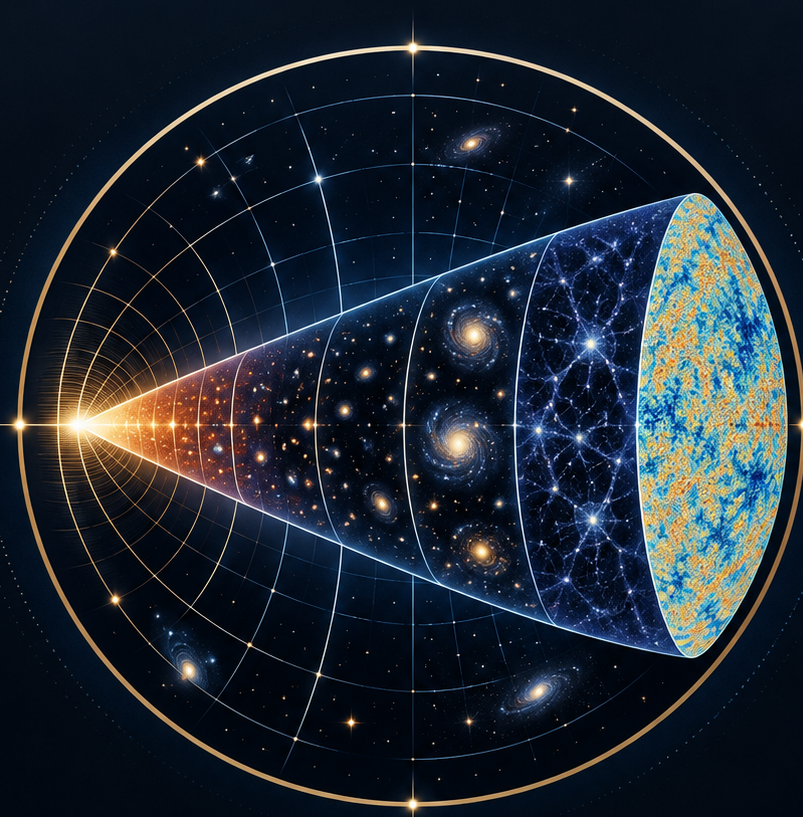
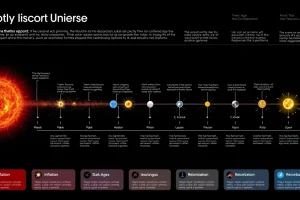
The history of the universe is often divided into epochs, each characterized by the dominant physical processes and particles. The following table summarizes the major epochs:
| Epoch | Time After Big Bang | Temperature | Key Events |
|---|---|---|---|
| Planck Epoch | 0 to 10⁻⁴³ s | ~10³² K | Quantum gravity effects dominate; no known physics. |
| Grand Unification Epoch | 10⁻⁴³ to 10⁻³⁶ s | ~10²⁷ K | Strong and electroweak forces unified; inflation begins. |
| Inflationary Epoch | 10⁻³⁶ to 10⁻³² s | ~10²⁷ K | Exponential expansion; quantum fluctuations seeded structure. |
| Electroweak Epoch | 10⁻³² to 10⁻¹² s | ~10¹⁵ K | Electromagnetic and weak forces separate; particles acquire mass. |
| Quark Epoch | 10⁻¹² to 10⁻⁶ s | ~10¹² K | Quarks and gluons form quark-gluon plasma. |
| Hadron Epoch | 10⁻⁶ to 1 s | ~10¹⁰ K | Protons and neutrons form; matter-antimatter annihilation. |
| Lepton Epoch | 1 to 10 s | ~10⁹ K | Leptons dominate; neutrinos decouple. |
| Photon Epoch | 10 s to 380,000 yr | ~10⁹ to 3000 K | Photons dominate; nucleosynthesis of light elements. |
| Recombination | ~380,000 yr | ~3000 K | Electrons combine with nuclei; CMB released. |
| Dark Ages | 380,000 yr to ~150 million yr | ~3000 to 30 K | No stars yet; universe dark and neutral. |
| Reionization | ~150 million to 1 billion yr | ~30 to 10 K | First stars and galaxies ionize hydrogen. |
| Structure Formation | 1 billion yr to present | ~10 K to 2.7 K | Galaxies, clusters, and large-scale structure form. |
The Role of Inflation
Inflation is a brief period of exponential expansion that occurred about 10⁻³⁶ seconds after the Big Bang. It explains the uniformity of the cosmic microwave background and the large-scale structure of the universe. Quantum fluctuations during inflation were stretched to cosmic scales, providing the seeds for galaxies and clusters (NASA, 2026).
Evidence for the Big Bang
Three key observations support the Big Bang model: the expansion of the universe (Hubble–Lemaître law), the cosmic microwave background (CMB) radiation, and the primordial abundances of light elements (hydrogen, helium, lithium) predicted by Big Bang nucleosynthesis. The CMB is the oldest light we can observe, emitted about 380,000 years after the Big Bang (NASA, 2026).
Question Article
Short Answer
The Big Bang was the beginning of space and time, not an explosion in a pre-existing void. The cause of this event is not known, but cosmic inflation—a period of rapid expansion—is the leading framework for understanding the initial conditions.
What We Know
We know the universe is expanding, and the Big Bang model successfully predicts the CMB, the abundance of light elements, and the large-scale structure. The universe began in a hot, dense state and has been cooling for 13.8 billion years. The first stars were 30 to 300 times more massive than our Sun and millions of times brighter (NASA, 2026).
What We Don’t Know
We do not know what triggered the Big Bang. The Planck epoch is beyond the reach of current physics, and the singularity at t=0 suggests a breakdown of general relativity. The question “what came before?” may be meaningless because time itself began at the Big Bang (Scientific American, 2026).
Evidence
Evidence includes the redshift of distant galaxies, the CMB’s near-perfect blackbody spectrum, and the observed ratios of hydrogen and helium. Missions like COBE, WMAP, and Planck have mapped the CMB with increasing precision, revealing tiny temperature fluctuations that match inflation predictions.
Competing Explanations
Alternatives include the cyclic universe, ekpyrotic models, and the multiverse, but none have the same observational support as the standard ΛCDM model. Some physicists propose that the Big Bang was not a beginning but a transition from a previous phase, but these remain speculative.
Current Research
Current research focuses on cosmic inflation, the nature of dark matter and dark energy, and the search for primordial gravitational waves. The James Webb Space Telescope (JWST) is probing the epoch of reionization and the first galaxies, while missions like SPHEREx aim to map the sky in infrared to study cosmic history.
Why It Matters
Understanding the Big Bang is fundamental to our place in the cosmos. It explains the origin of matter, the formation of stars and galaxies, and the large-scale structure we observe today. It also raises profound questions about the nature of time, space, and the ultimate fate of the universe. The Big Bang model is not just a story of the past; it is the foundation of modern cosmology.
Evidence / Sources
The following sources provide authoritative information on the Big Bang and cosmic evolution:
- Britannica: Big-bang model – https://www.britannica.com/science/big-bang-model
- NASA Science: The Big Bang – https://science.nasa.gov/universe/the-big-bang/
- Stephen Hawking: The Big Bang & the Origin of the Universe – https://stephenhawking.co.uk/science/big-bang-origin-of-the-universe
- Scientific American: What came before the big bang? – https://www.scientificamerican.com/article/what-came-before-the-big-bang-cosmology/
Related Registry Entries
Explore related topics in the cosmic registry:
- Cosmic Microwave Background
- Inflation
- Recombination
- Reionization
- Lambda-CDM Model
FAQ
What caused the Big Bang?
The exact cause is unknown. The leading idea is cosmic inflation, a period of rapid expansion driven by a quantum field, but what triggered inflation itself remains speculative.
Did the Big Bang happen at a single point?
In the standard model, the universe was initially extremely hot and dense, but it was not necessarily a point in a pre-existing space. Space itself began at the Big Bang.
What is the cosmic microwave background?
It is the relic radiation from the recombination epoch, about 380,000 years after the Big Bang, when the universe became transparent. It provides a snapshot of the early universe.
How do we know the universe is expanding?
Edwin Hubble observed that distant galaxies recede faster the farther they are, a relationship known as the Hubble–Lemaître law. This is a direct consequence of the expansion of space.
Leave a Reply