
Short Answer
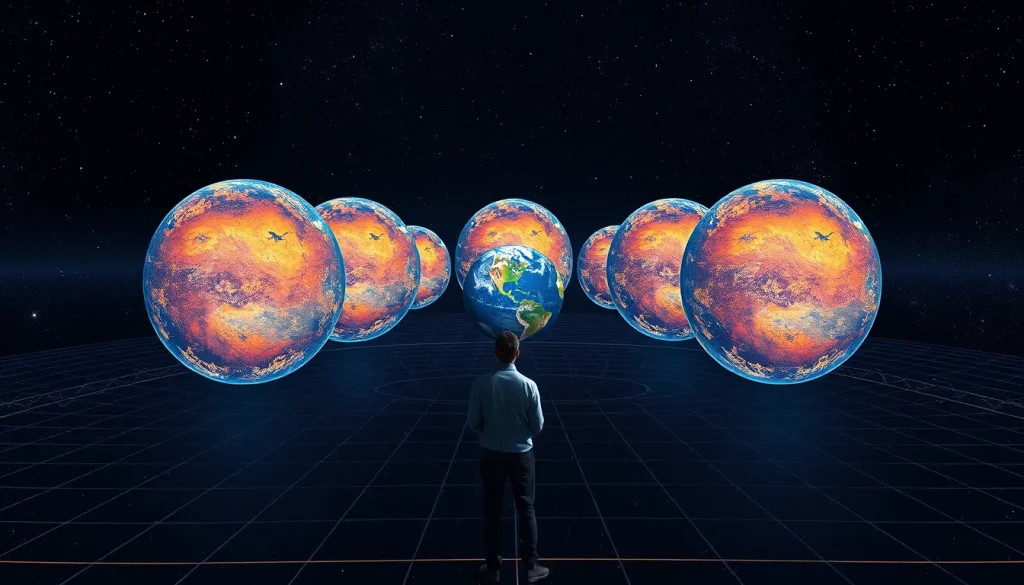
Cosmic variance is the fundamental statistical uncertainty that arises because astronomers can observe only one realization of the universe. Unlike a laboratory experiment, where repeated trials can reduce random error, cosmologists have just one universe to study. This limitation affects everything from the measured positions of cosmic microwave background (CMB) peaks to the abundance of galaxy clusters. In this interactive guide, we explore what cosmic variance is, why it sets a hard limit on cosmological precision, and how it fits into the broader story of the universe’s evolution.
| Key Fact | Detail |
|---|---|
| Definition | Statistical uncertainty due to observing only one realization of the universe |
| Primary Effect | Limits precision of CMB measurements and large-scale structure surveys |
| Related Concept | Sample variance, but cosmic variance is specific to cosmology |
| Can It Be Reduced? | Only by observing other ‘realizations’ (e.g., different last-scattering surfaces) |
| Key Missions | COBE, WMAP, Planck, JWST |
Main Explanation
What Is Cosmic Variance?
Cosmic variance refers to the uncertainty in cosmological measurements that arises because we can only observe one universe—one realization of all possible outcomes allowed by the laws of physics. As noted in the Wikipedia entry on cosmic variance, it is sometimes incorrectly used to mean sample variance, but in cosmology it specifically means the limitation that comes from having a single observable universe. For example, the CMB we see is just one random realization of the primordial density fluctuations. The positions of the acoustic peaks in the CMB power spectrum are therefore subject to cosmic variance: if we could observe many universes, the peaks would shift slightly each time, but we only have one sky to measure.
How It Works
In the standard cosmological model, the universe’s large-scale structure originated from quantum fluctuations during inflation. These fluctuations are random, and their statistical properties are described by a power spectrum. When we measure the CMB or galaxy surveys, we are sampling a finite volume of space. The larger the volume, the more independent modes we can measure, reducing the variance. However, because we are limited to the observable universe—a sphere of radius about 46 billion light-years—there is a maximum number of large-scale modes we can access. The largest modes (low multipoles) have very few realizations, leading to a fundamental uncertainty known as cosmic variance.
Equation
For a given multipole l in the CMB power spectrum, the cosmic variance contribution is approximately:
ΔCl / Cl ≈ √(2 / (2l+1))
This shows that for small l (large angular scales), the fractional uncertainty is large. For l = 2 (the quadrupole), the uncertainty is about 63%.
Example: CMB Acoustic Peaks
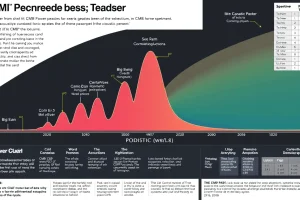
Consider the first acoustic peak in the CMB spectrum, which corresponds to the scale of the sound horizon at recombination. The exact height and position of this peak are determined by the cosmic density parameters. However, because we only have one sky, we can measure the peak amplitude with a precision limited by cosmic variance. Even with a perfect, noiseless experiment, we cannot know the true peak height to better than about 5% for the first peak. This is why cosmologists often quote cosmic variance as a fundamental floor for precision.
Observable Consequences
Cosmic variance affects many measurements:
- CMB power spectrum: Low multipoles (large angular scales) have large cosmic variance, limiting constraints on parameters like the spectral index and curvature.
- Galaxy surveys: The number density of galaxy clusters in a volume is subject to cosmic variance because we only see one patch of the universe.
- Hubble constant: Local measurements of the expansion rate are affected by cosmic variance because our local region may be slightly overdense or underdense relative to the cosmic average.
Common Misconceptions
One misconception is that cosmic variance is the same as sample variance or measurement noise. It is not. Measurement noise can be reduced with better instruments, but cosmic variance is irreducible. Another misconception is that cosmic variance means we can never know the universe’s true parameters. In practice, we can still constrain them, but only to a finite precision set by the size of the observable universe.
The Cosmic Epochs: A Timeline
To understand why cosmic variance matters, it helps to see the universe’s history. The following table outlines the major epochs from the Planck epoch to the present day, based on the standard Lambda-CDM model.
| Epoch | Time After Big Bang | Temperature | Redshift | Key Events |
|---|---|---|---|---|
| Planck Epoch | 0 to 10−43 s | >1032 K | >1032 | Quantum gravity effects dominate; all fundamental forces unified |
| Grand Unification Epoch | 10−43 to 10−36 s | 1028–1032 K | 1028–1032 | Strong force separates from electroweak |
| Inflationary Epoch | 10−36 to 10−32 s | Dropping rapidly | Extreme | Exponential expansion; quantum fluctuations seeded large-scale structure |
| Electroweak Epoch | 10−32 to 10−12 s | 1015–1028 K | 1015–1028 | Weak and electromagnetic forces separate; particles acquire mass |
| Quark Epoch | 10−12 to 10−6 s | 1012–1015 K | 1012–1015 | Quarks and gluons form quark-gluon plasma |
| Hadron Epoch | 10−6 to 1 s | 1010–1012 K | 1010–1012 | Protons and neutrons form; matter-antimatter annihilation |
| Lepton Epoch | 1 to 10 s | 109–1010 K | 109–1010 | Leptons dominate; neutrinos decouple |
| Photon Epoch | 10 s to 380,000 yr | 3,000–109 K | 103–109 | Photons tightly coupled to matter; nucleosynthesis occurs |
| Recombination | 380,000 yr | ~3,000 K | ~1,100 | Electrons combine with protons to form neutral hydrogen; CMB released |
| Dark Ages | 380,000 yr to ~100 million yr | ~60–3,000 K | 10–1,100 | No light sources; universe is dark and neutral |
| Reionization | ~100 million yr to 1 billion yr | ~10–60 K | 6–20 | First stars and galaxies ionize hydrogen |
| Structure Formation | 1 billion yr to present | 2.7 K (now) | 0–6 | Galaxies, clusters, and large-scale structure form |
The Cosmic Microwave Background as a Relic
The CMB is the oldest light in the universe, emitted at recombination. It carries information about the conditions when the universe was just 380,000 years old. The CMB’s temperature fluctuations are the seeds of all subsequent structure. Missions like COBE (1989), WMAP (2001), and Planck (2009) have mapped these fluctuations with increasing precision. However, cosmic variance limits how well we can measure the largest angular scales, because we only have one sky to observe.
Key Missions and Their Contributions
- COBE (1989–1993): Discovered the CMB’s blackbody spectrum and first detected tiny temperature fluctuations.
- WMAP (2001–2010): Produced high-resolution maps of the CMB, pinning down cosmological parameters to percent-level accuracy.
- Planck (2009–2013): Provided even sharper maps and confirmed the Lambda-CDM model with remarkable precision, while also measuring polarization.
- JWST (2021–present): Observes the epoch of reionization and first galaxies, complementing CMB studies by probing later cosmic eras.
Why It Matters
Cosmic variance is not just a technical nuisance; it sets a fundamental limit on what we can learn about the universe from any single observation. It affects our ability to measure the curvature of space, the tilt of the primordial power spectrum, and even the nature of dark energy. Understanding cosmic variance helps cosmologists design surveys that maximize the number of independent modes, and it reminds us that our view of the cosmos is inevitably partial. Yet, as the paper by Kamionkowski and Loeb (1997) suggests, clever methods—such as measuring the CMB polarization toward galaxy clusters—can effectively probe multiple ‘last-scattering surfaces’ and reduce cosmic variance. This ongoing ingenuity is part of what makes cosmology so dynamic.
Evidence / Sources
The following sources provide authoritative grounding for the concepts discussed:
- Wikipedia: Cosmic variance — https://en.wikipedia.org/wiki/Cosmic_variance
- Astrobites: How to Avoid Cosmic Variance in Your Cosmological Survey — https://astrobites.org/2012/11/05/how-to-avoid-cosmic-variance-in-your-cosmological-survey/
- Balbi, A. (2010). The limits of cosmology. arXiv:1001.4016 — https://doi.org/10.48550/arxiv.1001.4016
- Kamionkowski, M., & Loeb, A. (1997). Getting Around Cosmic Variance. arXiv:astro-ph/9703118 — https://ar5iv.labs.arxiv.org/html/astro-ph/9703118
Related Registry Entries
FAQ
Can cosmic variance be reduced by observing more of the universe?
No, because the observable universe is finite. We cannot see beyond the cosmic horizon, so the largest scales have limited independent samples. However, methods like measuring CMB polarization toward galaxy clusters can effectively probe different last-scattering surfaces, as proposed by Kamionkowski and Loeb (1997).
Is cosmic variance the same as measurement error?
No. Measurement error arises from imperfect instruments and can be reduced with better technology. Cosmic variance is a fundamental limit due to having only one realization of the universe. Even with perfect instruments, cosmic variance remains.
How does cosmic variance affect the Hubble constant debate?
Local measurements of the Hubble constant can be affected by cosmic variance because our local region may be slightly overdense or underdense relative to the cosmic average. This can lead to discrepancies between local and early-universe measurements, though other factors also contribute.
Leave a Reply