
Short Answer
Main Explanation
Big Bang nucleosynthesis (BBN) is the process that forged the lightest elements—deuterium, helium-3, helium-4, and lithium-7—during the first three minutes of cosmic history. Among these, deuterium (an isotope of hydrogen with one proton and one neutron) is a uniquely sensitive probe of the conditions in the early universe. Its abundance depends strongly on the density of ordinary (baryonic) matter, making it a cosmic yardstick for measuring the baryon content of the cosmos. The remarkable agreement between the measured primordial deuterium abundance and the predictions of standard BBN is one of the cornerstones of the Big Bang model.
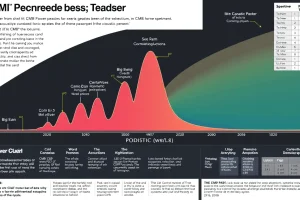
To understand why deuterium is so telling, we must trace the universe’s earliest epochs. The table below summarizes the major phases from the Planck epoch to the present day.
| Epoch | Time After Big Bang | Temperature | Key Events |
|---|---|---|---|
| Planck epoch | < 10⁻⁴³ s | > 10³² K | Quantum gravity effects dominate; no known physics. |
| Grand unification epoch | 10⁻⁴³ – 10⁻³⁶ s | 10²⁸ – 10³² K | Strong and electroweak forces unify; inflation begins. |
| Inflationary epoch | 10⁻³⁶ – 10⁻³² s | ~10²⁷ K | Exponential expansion; seeds of structure form. |
| Electroweak epoch | 10⁻³² – 10⁻¹² s | 10¹⁵ – 10²⁸ K | Electromagnetic and weak forces separate; W/Z bosons created. |
| Quark epoch | 10⁻¹² – 10⁻⁶ s | 10¹² – 10¹⁵ K | Quarks and gluons form a quark–gluon plasma. |
| Hadron epoch | 10⁻⁶ – 1 s | 10¹⁰ – 10¹² K | Protons and neutrons form; matter–antimatter annihilation. |
| Lepton epoch | 1 – 10 s | 10⁹ – 10¹⁰ K | Leptons dominate; neutrinos decouple. |
| Photon epoch | 10 s – 380,000 yr | 3,000 – 10⁹ K | Photons dominate; BBN occurs in the first few minutes. |
| Recombination | ~380,000 yr | ~3,000 K | Electrons combine with nuclei to form neutral atoms; CMB released. |
| Dark Ages | 380,000 yr – ~150 million yr | ~100 – 3,000 K | No stars yet; universe is dark and neutral. |
| Reionization | ~150 million – 1 billion yr | ~10 – 100 K | First stars and galaxies ionize intergalactic hydrogen. |
| Structure formation | 1 billion yr – present | ~2.7 K (now) | Galaxies, clusters, and large-scale structure grow. |
During the photon epoch, roughly 1 second to 3 minutes after the Big Bang, the universe was a hot, dense plasma of protons, neutrons, electrons, and photons. As it cooled to about 10⁹ K, nucleosynthesis began. Proton–neutron fusion produced deuterium, which then quickly fused into helium-4. However, the expansion and cooling halted these reactions before all deuterium could be consumed. The leftover deuterium—about 25 parts per million by mass—is a direct fossil of that early phase.
Evidence from Deuterium
Observation
Primordial deuterium is measured in high-redshift, low-metallicity gas clouds along the line of sight to distant quasars. These damped Lyα systems are nearly pristine, having undergone little chemical processing. The most precise measurements come from the Keck and Very Large Telescope spectrographs. For example, Cooke et al. (2014) reported a deuterium abundance in a system at redshift 3.067 with [Fe/H] = −2.88, based on 13 resolved D I absorption lines and the damping wings of the H I Lyα transition (source: Cooke et al. 2014).
Prediction
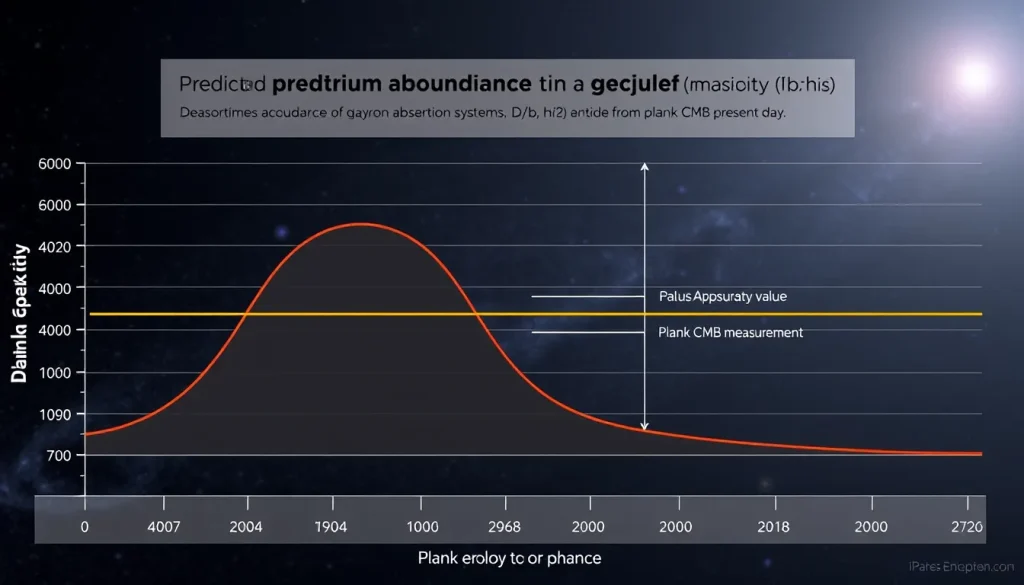
Standard BBN theory predicts the deuterium abundance as a function of the baryon-to-photon ratio, which is set by the cosmic baryon density. The prediction is a steeply falling curve: higher baryon density leads to more efficient fusion and less leftover deuterium. The theoretical framework is robust, relying only on well-known Standard Model physics (source: PDG 2026).
Measurement
The current best estimate of the primordial deuterium abundance is (D/H) = 2.53 × 10⁻⁵ by number, with an uncertainty of about 1%. This value is derived from a weighted average of several high-quality quasar absorption systems (source: Pettini & Cooke 2026).
Why It Supports the Model
The measured deuterium abundance matches the BBN prediction for a baryon density of Ωbh² ≈ 0.022. This value is independently confirmed by the cosmic microwave background (CMB) observations from Planck and WMAP. The concordance between BBN and CMB—two independent probes of the early universe—is a powerful validation of the hot Big Bang model. It also confirms that the universe is composed of only about 5% ordinary matter, with the rest being dark matter and dark energy.
Limitations
Deuterium measurements are challenging because deuterium is easily destroyed in stellar interiors. Thus, the primordial abundance must be observed in the most metal-poor, chemically unevolved gas clouds. Systematic uncertainties arise from contamination by hydrogen, continuum placement, and the assumption that the clouds are unprocessed. Nevertheless, modern high-resolution spectroscopy has reduced these errors to a few percent.
Alternative Explanations
Some non-standard models, such as inhomogeneous BBN or the presence of decaying particles during nucleosynthesis, can alter the predicted deuterium abundance. However, these models must also reproduce the observed helium-4 and lithium-7 abundances, and they face severe constraints. The simplest standard BBN with three neutrino species and a single baryon density remains the best fit to all light-element data.
Current Scientific Consensus
The scientific community overwhelmingly accepts that deuterium abundances confirm the Big Bang. As Steigman (2007) notes, BBN provides a unique probe of the early universe and its predictions are in excellent agreement with observations (source: Steigman 2007). The 2026 Particle Data Group review reiterates that D, ³He, ⁴He, and ⁷Li abundances are in overall agreement with the standard cosmology, spanning nine orders of magnitude in abundance.
Why It Matters
The deuterium abundance is not just a confirmation of the Big Bang—it is a precision tool for cosmology. By pinning down the baryon density, it helps us understand the composition of the universe, the growth of structure, and the physics of the early universe. It also provides constraints on new physics, such as extra neutrino species, varying fundamental constants, or exotic particles. The agreement between BBN and CMB measurements is a triumph of the standard ΛCDM model, and it underscores the deep connection between nuclear physics, particle physics, and cosmology.
Evidence / Sources
- Cooke, R. J., Pettini, M., Jorgenson, R. A., Murphy, M. T., & Steidel, C. C. (2014). Precision Measures of the Primordial Abundance of Deuterium. The Astrophysical Journal, 781(1), 31. https://beta.iopscience.iop.org/article/10.1088/0004-637X/781/1/31
- Steigman, G. (2007). Primordial Nucleosynthesis in the Precision Cosmology Era. Annual Review of Nuclear and Particle Science, 57, 463–491. https://doi.org/10.1146/annurev.nucl.56.080805.140437
- Fields, B. D., Molaro, P., & Sarkar, S. (2025). Big Bang Nucleosynthesis. Particle Data Group Review. https://pdg.lbl.gov/2026/reviews/rpp2026-rev-bbang-nucleosynthesis.pdf
- Pettini, M., & Cooke, R. (2026). Precision cosmology with the lightest elements. Astrophysics and Space Science. https://doi.org/10.1007/s10509-026-04551-x
Related Registry Entries
- Big Bang Nucleosynthesis (BBN)
- Cosmic Microwave Background (CMB)
- Baryon Density
- Primordial Abundance
FAQ
Why is deuterium a better probe than helium for BBN?
Deuterium is more sensitive to the baryon density because its abundance changes steeply with density, whereas helium-4 is only weakly dependent. Also, deuterium is easily destroyed in stars, so its primordial value must be measured in pristine, low-metallicity gas clouds, providing a clean test.
How does deuterium abundance confirm the Big Bang?
The measured primordial deuterium abundance matches the predictions of standard Big Bang nucleosynthesis for a specific baryon density. This density is independently confirmed by cosmic microwave background measurements, providing a consistent picture of the early universe that no other model easily explains.
What would a different deuterium abundance imply?
If the deuterium abundance were significantly higher or lower than predicted, it would indicate new physics, such as extra relativistic particles (e.g., sterile neutrinos), a varying gravitational constant, or inhomogeneous nucleosynthesis. Current data tightly constrain such deviations.


Leave a Reply