
Short Answer
Main Explanation
When we look at the deepest images from telescopes like the James Webb Space Telescope, we are seeing light that has traveled for over 13 billion years. Yet the region from which that light originates is now estimated to be about 46.5 billion light-years away from us. How can this be? The answer lies in the expansion of space itself. As the universe expands, the distance between any two points grows, and the light that left a distant galaxy long ago has been stretched along with the fabric of space. By the time that light reaches us, the source galaxy has moved much farther away than the light’s travel time would suggest. This is why the observable universe’s radius is 46.5 billion light-years, not 13.8 billion light-years [1][2].
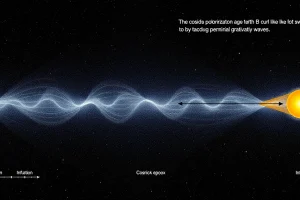
The expansion is not a motion of galaxies through space; rather, space itself is expanding. The speed of light limit applies to objects moving through space, but it does not constrain the expansion rate of space. In the standard cosmological model (ΛCDM), this expansion has been ongoing since the Big Bang, with a period of rapid accelerated expansion called inflation occurring in the first fraction of a second [1][4].
Cosmic Epochs: A Timeline
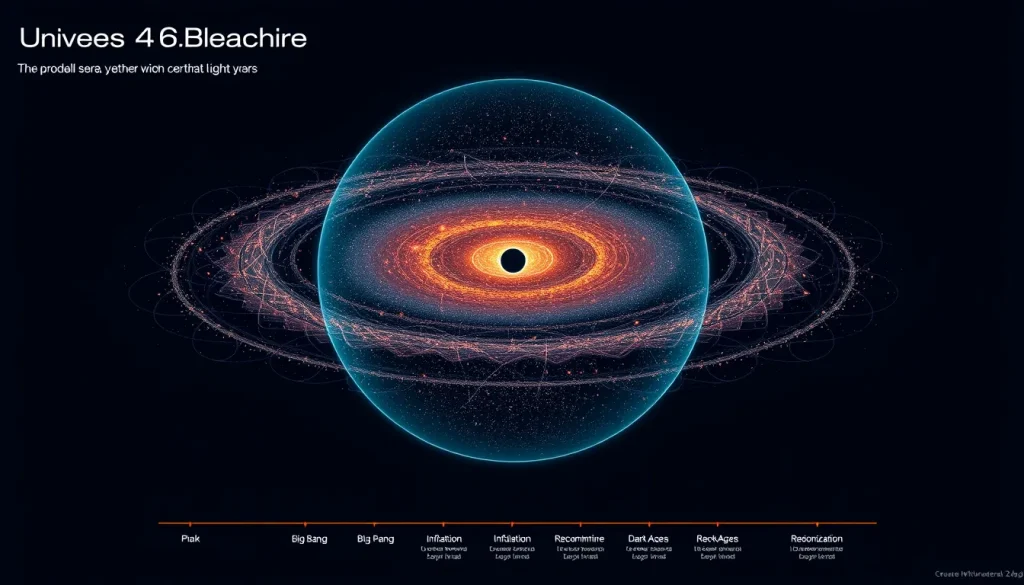
The history of the universe is divided into distinct epochs, each characterized by different physical conditions and processes. The following table summarizes the major epochs, their approximate times, temperatures, and key events.
| Epoch | Time After Big Bang | Temperature | Key Events |
|---|---|---|---|
| Planck Epoch | 0 to 10⁻⁴³ s | >10³² K | Quantum gravity effects dominate; no known physics describes this era. |
| Grand Unification Epoch | 10⁻⁴³ to 10⁻³⁶ s | 10²⁷–10³² K | Strong and electroweak forces unify; inflation may begin. |
| Inflationary Epoch | 10⁻³⁶ to 10⁻³² s | ~10²⁷ K | Exponential expansion; quantum fluctuations seeded large-scale structure. |
| Electroweak Epoch | 10⁻³² to 10⁻¹² s | 10¹⁵–10²⁷ K | Electromagnetic and weak forces separate; W, Z bosons acquire mass. |
| Quark Epoch | 10⁻¹² to 10⁻⁶ s | 10¹²–10¹⁵ K | Quarks and gluons exist in a quark-gluon plasma; no hadrons yet. |
| Hadron Epoch | 10⁻⁶ to 1 s | 10¹⁰–10¹² K | Quarks combine into protons and neutrons; matter-antimatter annihilation. |
| Lepton Epoch | 1 to 10 s | 10⁹–10¹⁰ K | Leptons dominate; neutrinos decouple. |
| Photon Epoch | 10 s to 380,000 yr | 10⁴–10⁹ K | Photons are tightly coupled to matter; primordial nucleosynthesis occurs. |
| Recombination | ~380,000 yr | ~3000 K | Electrons combine with protons to form neutral hydrogen; photons decouple, releasing the cosmic microwave background (CMB). |
| Dark Ages | 380,000 yr to ~150 million yr | ~100 K to 3000 K | No stars yet; universe filled with neutral hydrogen and helium. |
| Reionization | ~150 million yr to ~1 billion yr | ~10–100 K | First stars and galaxies form; their ultraviolet light reionizes hydrogen. |
| Structure Formation | ~1 billion yr to present | ~2.7 K (now) | Galaxies cluster into large-scale structures; dark energy accelerates expansion. |
Each epoch left its imprint on the observable universe. The CMB, discovered by Penzias and Wilson in 1965 and mapped precisely by COBE, WMAP, and Planck, is the relic radiation from recombination. It shows tiny temperature fluctuations that correspond to the seeds of galaxy formation [3].
The first atoms formed during recombination, when the universe cooled enough for electrons to bind to protons, producing neutral hydrogen. This allowed photons to travel freely, creating the CMB. After the Dark Ages, gravity amplified density fluctuations, leading to the first stars and galaxies, which reionized the universe and eventually formed the large-scale structure we see today.
Why It Matters
Understanding why the observable universe is 46.5 billion light-years across is not just a curiosity; it underpins our entire model of cosmology. The expansion of space, the existence of the CMB, and the sequence of cosmic epochs are all consistent with the Big Bang model and the Lambda-CDM paradigm. This framework explains the abundance of light elements, the large-scale distribution of galaxies, and the accelerating expansion driven by dark energy. Moreover, the observable universe’s size defines the limit of what we can ever know—anything beyond that horizon is forever inaccessible to us, making the study of the observable universe the ultimate frontier of empirical science.
Evidence / Sources
The key evidence for the expansion of the universe and the 46.5 billion light-year radius comes from multiple independent observations:
- The cosmic microwave background radiation, measured by COBE, WMAP, and Planck, shows a nearly perfect blackbody spectrum with tiny anisotropies that match inflationary predictions.
- The redshift-distance relation for distant supernovae and galaxies demonstrates that space is expanding, and the rate of expansion has changed over time.
- The large-scale structure of the universe, mapped by galaxy surveys, matches the predictions of ΛCDM with inflation.
- The primordial abundances of hydrogen, helium, and lithium agree with Big Bang nucleosynthesis calculations.
These observations are summarized in the sources cited here: [1] Astronomy.com, [2] Forbes, [3] PBS NOVA, [4] Physics Stack Exchange.
Related Registry Entries
This article is part of a broader registry covering cosmology and the early universe. Related entries include:
- Cosmic Microwave Background
- Inflation
- Recombination
- Dark Ages
- Reionization
- Large-Scale Structure
Last Reviewed / Updated: September 5, 2026
FAQ
How can we see light from 46.5 billion light-years away if the universe is only 13.8 billion years old?
The light we see has traveled for 13.8 billion years, but the space it traversed has expanded during that time. The source of that light is now much farther away because the intervening space has stretched, placing the source at a comoving distance of about 46.5 billion light-years.
Does the expansion of the universe violate the speed of light limit?
No. The speed of light limit applies to objects moving through space. The expansion of space itself is not a motion through space, so it is not subject to that limit. Distant galaxies can recede from us faster than light without violating relativity.
What is the cosmic microwave background and why is it important?
The CMB is the leftover radiation from the recombination epoch when the universe became transparent. It is a near-perfect blackbody with a temperature of about 2.7 K. Its tiny temperature fluctuations provide a snapshot of density fluctuations that seeded galaxy formation, offering strong evidence for the Big Bang and inflation.
Leave a Reply