
Short Answer
Main Explanation
Primordial black holes (PBHs) are black holes that hypothetically formed not from the collapse of massive stars, but from extremely dense pockets of subatomic matter in the first fractions of a second after the Big Bang. First proposed by Yakov Zeldovich and Igor Novikov in 1966 and studied in depth by Stephen Hawking in 1971, PBHs are not limited to the narrow mass range of stellar black holes—they could span from microscopic masses to millions of solar masses. Their existence remains unconfirmed, but they are a leading candidate for at least part of the universe’s dark matter and a probe of the extreme physics that governed the cosmos at its birth.
Understanding primordial black holes requires a journey through the universe’s earliest epochs. From the Planck epoch—when quantum gravity dominated—through cosmic inflation, the formation of the first particles, and the emission of the cosmic microwave background (CMB), each stage shaped the conditions that could have produced PBHs. Modern missions like COBE, WMAP, Planck, and the James Webb Space Telescope (JWST) have mapped this history, offering constraints and hints about these elusive objects.
The Cosmic Epochs
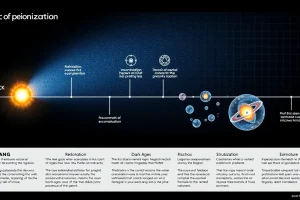
The following table summarizes the major epochs in the history of the universe, from the Planck epoch to the present day. Each epoch is defined by the dominant physical processes and the state of matter and radiation.
| Epoch | Time After Big Bang | Temperature | Approx. Redshift | Key Events |
|---|---|---|---|---|
| Planck Epoch | 0 to 10⁻⁴³ s | >10³² K | >10³² | Quantum gravity effects dominate; all four fundamental forces unified. |
| Grand Unification Epoch | 10⁻⁴³ to 10⁻³⁶ s | 10²⁷–10³² K | 10²⁷–10³² | Strong nuclear force separates from electroweak force; inflation begins. |
| Inflationary Epoch | 10⁻³⁶ to 10⁻³² s | ~10²⁷ K | ~10²⁷ | Exponential expansion of space; quantum fluctuations seeded large-scale structure. |
| Electroweak Epoch | 10⁻³² to 10⁻¹² s | 10¹⁵–10²⁷ K | 10¹⁵–10²⁷ | Electromagnetic and weak forces separate; W and Z bosons acquire mass. |
| Quark Epoch | 10⁻¹² to 10⁻⁶ s | 10¹²–10¹⁵ K | 10¹²–10¹⁵ | Quarks and gluons exist as a quark-gluon plasma; no bound hadrons. |
| Hadron Epoch | 10⁻⁶ to 1 s | 10¹⁰–10¹² K | 10¹⁰–10¹² | Quarks combine into protons and neutrons; matter-antimatter annihilation. |
| Lepton Epoch | 1 to 10 s | 10⁹–10¹⁰ K | 10⁹–10¹⁰ | Leptons dominate; neutrinos decouple; electron-positron annihilation. |
| Photon Epoch | 10 s to 380,000 yr | 3,000–10⁹ K | 1,000–10⁹ | Photons dominate; nucleosynthesis forms light elements (H, He, Li). |
| Recombination | ~380,000 yr | ~3,000 K | ~1,100 | Electrons combine with nuclei to form neutral atoms; CMB released. |
| Dark Ages | 380,000 yr to ~150 million yr | ~3,000 K to ~60 K | 1,100 to ~20 | Universe is dark; no stars yet; neutral hydrogen fills space. |
| Reionization | ~150 million yr to ~1 billion yr | ~60 K to ~30 K | 20 to ~6 | First stars and galaxies form; ultraviolet light reionizes hydrogen. |
| Structure Formation | ~1 billion yr to present | ~30 K to 2.725 K | 6 to 0 | Galaxies cluster; dark matter shapes cosmic web; dark energy accelerates expansion. |
When It Happened
Primordial black holes could have formed during the first fractions of a second after the Big Bang, likely during the radiation-dominated era or even during inflation. The exact timing depends on the mechanism: for example, density fluctuations during inflation might collapse directly into PBHs, while phase transitions or cosmic strings could produce them later.
Temperature
The universe was incredibly hot and dense in its earliest moments. At the Planck epoch, temperatures exceeded 10³² K. By the time of the quark epoch, the temperature had dropped to about 10¹² K. PBH formation would have occurred when the density fluctuations were large enough to overcome pressure, typically during epochs when the equation of state of the universe allowed gravitational collapse.
Approximate Redshift
PBHs could form at redshifts far higher than any observed directly—potentially as high as 10¹² or more, corresponding to times when the universe was less than one second old. Some models also allow for PBH formation during the radiation-dominated era at redshifts around 10⁸ to 10¹⁰.
Dominant Particles/Physics
In the early universe, the dominant physics included quantum gravity, grand unified theories, and later the electroweak interaction. During the quark and hadron epochs, quarks, gluons, and leptons filled space. PBHs would have formed from fluctuations in the energy density, which could have been seeded by inflation or other high-energy processes.
What Happened
If overdense regions exceeded the Chandrasekhar-like limit for their size, they would collapse into black holes. Unlike stellar black holes, PBHs do not require a supernova trigger; they arise from the extreme conditions of the early universe. Their masses could range from the Planck mass (about 2×10⁻⁸ kg) to many solar masses, depending on when and how they formed.
What Came Before
Before PBH formation, the universe underwent cosmic inflation, a period of exponential expansion that smoothed out initial irregularities and stretched quantum fluctuations to cosmic scales. These fluctuations later served as seeds for structure formation and, in some models, for PBH collapse.
What Came Next
After PBHs formed, they would have persisted through the subsequent epochs. Light PBHs (mass less than about 10¹⁵ g) could have evaporated via Hawking radiation by now, while heavier ones remain as dark matter candidates. Their gravitational influence could affect the CMB, gravitational wave background, and the formation of large-scale structure.
Evidence
No primordial black hole has been definitively detected. However, potential evidence includes gravitational wave signals from merging PBHs, microlensing events, distortions in the CMB, and the observed abundance of dark matter. The James Webb Space Telescope’s discovery of unexpectedly massive early galaxies (the ‘little red dots’) has been proposed as possible evidence for PBH seeds, though this remains speculative.
Why It Matters
Primordial black holes are more than a curiosity—they are a bridge between the quantum world of the Big Bang and the large-scale structure of the cosmos. If they exist, they could explain dark matter, account for some gravitational wave events, and provide a natural probe of inflation and high-energy physics. Even if they do not exist, the search for them has driven advances in cosmology and astrophysics, refining our understanding of the universe’s first moments.
Evidence / Sources
The scientific community continues to investigate PBHs through theoretical work and observational campaigns. Key sources include the comprehensive review by Carr et al. (2026) in La Rivista del Nuovo Cimento, NASA’s classification of black hole types, and ongoing analyses of CMB data from Planck and JWST observations. The absence of direct detection places strong constraints on PBH abundance, but the possibility remains open.
Related Registry Entries
This article is part of a series on cosmic history. See also: The Cosmic Microwave Background, Inflation and the Very Early Universe, Recombination and the First Atoms, and Dark Matter Candidates.
FAQ
How do primordial black holes differ from stellar black holes?
Stellar black holes form from the collapse of massive stars after a supernova. Primordial black holes, if they exist, formed from extreme density fluctuations in the early universe, before stars existed, and can have a much wider range of masses.
Could primordial black holes explain dark matter?
Yes, PBHs are a leading dark matter candidate. Their abundance is constrained by observations, but a population of PBHs with masses around 10⁻¹⁶ to 10⁻¹⁰ solar masses could account for a significant fraction of dark matter without conflicting with existing data.
What evidence would confirm primordial black holes?
Direct evidence could come from gravitational wave signals from merging PBHs, microlensing events of distant stars, or specific distortions in the CMB. The James Webb Space Telescope's detection of unexpectedly massive early galaxies has also been proposed as indirect evidence.
Leave a Reply