Short Answer
Main Explanation
The Big Bang theory is the most tested and well-supported cosmological model in the history of science. It is also the most widely misunderstood. It does not describe an explosion in empty space. It does not say the universe began as a pinpoint of matter. And it does not attempt to explain what came “before” the beginning — not because scientists are afraid of the question, but because the concept of “before” may not apply [2].
What the Big Bang theory actually says is this: if you extrapolate the observed expansion of the universe backward in time, the universe was once in an extraordinarily hot, dense state. The farther back you go, the hotter and denser it becomes. The model breaks down at a point — the Planck time, about 10⁻⁴³ seconds — where current physics cannot make reliable predictions. Everything the Big Bang describes happened after that point [2].
The big-bang model is based on two fundamental assumptions. The first is that Albert Einstein’s general theory of relativity correctly describes the gravitational behavior of the cosmos on large scales. The second is the cosmological principle — the idea that the universe is homogeneous and isotropic on large scales, meaning it looks roughly the same in every direction from every location [1].
When astronomers observe distant galaxies, they find that these galaxies are receding from us at speeds proportional to their distance — a relationship known as the Hubble–Lemaître law. This observation implies that the universe is uniformly expanding in all directions. If we extrapolate this expansion backward in time, the universe must have been denser and hotter in the past, eventually reaching a state of extreme temperature and density — the so-called big bang that occurred 13.8 billion years ago [1][3].
The Three Pillars of Evidence
Three observations provide the foundational evidence for the Big Bang theory [3]:
- The Hubble–Lemaître Law: Distant objects are receding from us at a rate proportional to their distance, which occurs when there is uniform expansion in all directions. This implies a history where everything was closer together.
- The Cosmic Microwave Background (CMB): The properties of the CMB radiation show that the universe was once in a hot, dense state and has been cooling ever since. The CMB is a relic of the early universe — a faint glow of radiation left over from the time when the universe first became transparent to light.
- Primordial Abundances: The observed abundances of light elements — hydrogen, helium, and lithium — match predictions from Big Bang nucleosynthesis with remarkable precision.
The Cosmic Epochs: A Timeline of the Universe
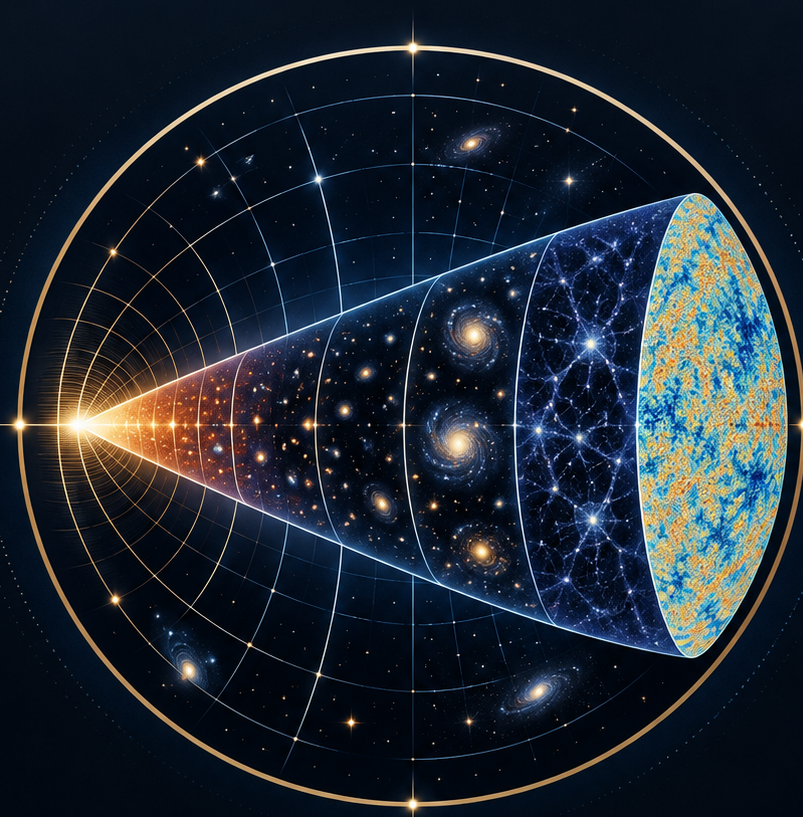
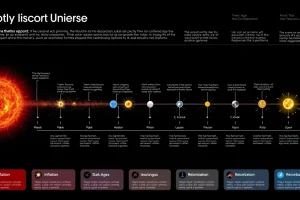
The history of the universe is divided into distinct epochs, each characterized by specific physical processes and dominant particles. The following sections describe each epoch in detail, from the Planck epoch to the formation of large-scale structure.
| Epoch | Time After Big Bang | Temperature | Key Events |
|---|---|---|---|
| Planck Epoch | 0 to 10⁻⁴³ s | >10³² K | Quantum gravity dominates; physics breaks down |
| Grand Unification Epoch | 10⁻⁴³ to 10⁻³⁶ s | 10²⁸–10³² K | Strong force separates from electroweak |
| Inflationary Epoch | 10⁻³⁶ to 10⁻³² s | 10²⁷–10²⁸ K | Exponential expansion; seeds of structure form |
| Electroweak Epoch | 10⁻³² to 10⁻¹² s | 10¹⁵–10²⁷ K | EM and weak forces separate; particles gain mass |
| Quark Epoch | 10⁻¹² to 10⁻⁶ s | 10¹²–10¹⁵ K | Quark-gluon plasma fills the universe |
| Hadron Epoch | 10⁻⁶ to 1 s | 10¹⁰–10¹² K | Protons and neutrons form; matter-antimatter annihilation |
| Lepton Epoch | 1 to 10 s | 10⁹–10¹⁰ K | Leptons dominate; neutrinos decouple |
| Photon Epoch | 10 s to 380,000 yr | 3,000–10⁹ K | Nucleosynthesis; universe is opaque plasma |
| Recombination | ~380,000 yr | ~3,000 K | Atoms form; universe becomes transparent; CMB released |
| Dark Ages | 380,000 to ~150 million yr | ~10–3,000 K | No stars yet; gravity amplifies density fluctuations |
| Reionization | ~150 million to ~1 billion yr | ~10–100 K | First stars and galaxies ionize neutral hydrogen |
| Structure Formation | ~1 billion yr to present | 2.7 K (now) | Galaxies, clusters, and cosmic web form; dark energy dominates |
Planck Epoch
When It Happened: 0 to 10⁻⁴³ seconds after the Big Bang
Temperature: Above 10³² K
Approximate Redshift: Greater than 10³²
Dominant Particles/Physics: Unknown; quantum gravity effects dominate
What Happened: During the Planck epoch, the four fundamental forces of nature — gravity, electromagnetism, the strong nuclear force, and the weak nuclear force — are thought to have been unified into a single force. Current physics cannot reliably describe conditions at this extreme energy scale, as it requires a theory of quantum gravity that has not yet been developed. The model breaks down at this point, and the concept of time itself may not apply [2].
What Came Before: The concept of “before” may not apply, as time itself may have emerged during this epoch.
What Came Next: The Grand Unification Epoch.
Evidence: Direct evidence is unavailable; this epoch is studied through theoretical physics and quantum gravity research.
Grand Unification Epoch
When It Happened: 10⁻⁴³ to 10⁻³⁶ seconds after the Big Bang
Temperature: 10²⁸ to 10³² K
Approximate Redshift: 10²⁸ to 10³²
Dominant Particles/Physics: Grand Unified Theory (GUT) physics; quarks, leptons, and gauge bosons
What Happened: During this epoch, the strong nuclear force separated from the electroweak force, breaking the grand unified symmetry. This separation released enormous energy and may have contributed to the matter-antimatter asymmetry observed in the universe today.
What Came Before: The Planck Epoch.
What Came Next: The Inflationary Epoch.
Evidence: Indirect evidence comes from the observed matter-antimatter asymmetry and the existence of cosmic magnetic fields.
Inflationary Epoch
When It Happened: 10⁻³⁶ to 10⁻³² seconds after the Big Bang
Temperature: 10²⁷ to 10²⁸ K
Approximate Redshift: 10²⁷ to 10²⁸
Dominant Particles/Physics: Inflaton field; scalar field driving exponential expansion
What Happened: The universe underwent a period of exponential expansion, growing by a factor of at least 10²⁶ in size in a fraction of a second. This rapid expansion smoothed out any initial irregularities, explaining the remarkable uniformity of the cosmic microwave background. Quantum fluctuations during inflation seeded the density variations that would later grow into galaxies and large-scale structure.
What Came Before: The Grand Unification Epoch.
What Came Next: The Electroweak Epoch.
Evidence: The near-uniformity of the CMB, the flatness of the universe, and the absence of magnetic monopoles all support the inflationary model.
Electroweak Epoch
When It Happened: 10⁻³² to 10⁻¹² seconds after the Big Bang
Temperature: 10¹⁵ to 10²⁷ K
Approximate Redshift: 10¹⁵ to 10²⁷
Dominant Particles/Physics: Quarks, leptons, W and Z bosons, Higgs boson
What Happened: During this epoch, the electromagnetic and weak nuclear forces separated as the universe cooled. The Higgs mechanism gave mass to elementary particles. Quarks and leptons existed in a hot plasma, and the universe was filled with a dense soup of fundamental particles.
What Came Before: The Inflationary Epoch.
What Came Next: The Quark Epoch.
Evidence: Particle physics experiments at the Large Hadron Collider probe energies relevant to this epoch.
Quark Epoch
When It Happened: 10⁻¹² to 10⁻⁶ seconds after the Big Bang
Temperature: 10¹² to 10¹⁵ K
Approximate Redshift: 10¹² to 10¹⁵
Dominant Particles/Physics: Quarks, gluons, leptons; quark-gluon plasma
What Happened: The universe was filled with a quark-gluon plasma — a hot, dense soup of quarks and gluons that had not yet combined into protons and neutrons. As the universe expanded and cooled, quarks began to combine into hadrons.
What Came Before: The Electroweak Epoch.
What Came Next: The Hadron Epoch.
Evidence: Relativistic heavy-ion collisions at particle accelerators recreate quark-gluon plasma conditions.
Hadron Epoch
When It Happened: 10⁻⁶ to 1 second after the Big Bang
Temperature: 10¹⁰ to 10¹² K
Approximate Redshift: 10¹⁰ to 10¹²
Dominant Particles/Physics: Protons, neutrons, mesons, baryons
What Happened: Quarks combined to form protons and neutrons. As the universe continued to cool, matter and antimatter particles annihilated each other, leaving a small excess of matter — about one part in a billion — that would go on to form all the matter in the universe today.
What Came Before: The Quark Epoch.
What Came Next: The Lepton Epoch.
Evidence: The observed matter-antimatter asymmetry in the universe is a key clue to this epoch.
Lepton Epoch
When It Happened: 1 to 10 seconds after the Big Bang
Temperature: 10⁹ to 10¹⁰ K
Approximate Redshift: 10⁹ to 10¹⁰
Dominant Particles/Physics: Leptons (electrons, positrons, neutrinos), photons
What Happened: Leptons and antileptons dominated the universe’s energy density. As the universe cooled, most leptons and antileptons annihilated, producing photons. Neutrinos decoupled from the rest of matter, creating the cosmic neutrino background that still exists today.
What Came Before: The Hadron Epoch.
What Came Next: The Photon Epoch.
Evidence: The cosmic neutrino background is predicted but has not yet been directly detected.
Photon Epoch
When It Happened: 10 seconds to 380,000 years after the Big Bang
Temperature: 3,000 to 10⁹ K
Approximate Redshift: 1,100 to 10⁹
Dominant Particles/Physics: Photons, electrons, protons, helium nuclei
What Happened: The universe was filled with a hot, opaque plasma of photons, electrons, and atomic nuclei. Photons were constantly scattered by free electrons, making the universe opaque. During this epoch, Big Bang nucleosynthesis occurred — protons and neutrons fused to form helium-4, deuterium, helium-3, and lithium-7 nuclei. About three minutes after the Big Bang, the universe had cooled to about 1 billion °C, allowing fusion to proceed. After about 20 minutes, the universe was no longer hot enough for further fusion [4].
What Came Before: The Lepton Epoch.
What Came Next: Recombination.
Evidence: The observed primordial abundances of light elements match nucleosynthesis predictions.
Recombination
When It Happened: ~380,000 years after the Big Bang
Temperature: ~3,000 K
Approximate Redshift: ~1,100
Dominant Particles/Physics: Hydrogen atoms, helium atoms, photons
What Happened: As the universe cooled to about 3,000 K, electrons combined with protons and helium nuclei to form neutral atoms. This process, called recombination, caused the universe to become transparent to light. The photons released at this time have been traveling through the universe ever since, now observed as the cosmic microwave background radiation.
What Came Before: The Photon Epoch.
What Came Next: The Dark Ages.
Evidence: The CMB is the most direct evidence for recombination. The WMAP and Planck missions have mapped the CMB with extraordinary precision, revealing temperature fluctuations of about one part in 100,000 [3].
Dark Ages
When It Happened: ~380,000 to ~150 million years after the Big Bang
Temperature: ~10 to 3,000 K
Approximate Redshift: ~20 to 1,100
Dominant Particles/Physics: Neutral hydrogen and helium gas, dark matter
What Happened: After recombination, the universe was filled with neutral hydrogen and helium gas. No stars or galaxies had yet formed, and the universe was dark — hence the name “Dark Ages.” Gravity slowly amplified the tiny density fluctuations seeded during inflation, causing matter to clump together. Dark matter played a crucial role, providing the gravitational scaffolding for the formation of structure.
What Came Before: Recombination.
What Came Next: Reionization and the Cosmic Dawn.
Evidence: Observations of the 21-centimeter hydrogen line and gravitational lensing are beginning to probe this era.
Reionization
When It Happened: ~150 million to ~1 billion years after the Big Bang
Temperature: ~10 to 100 K
Approximate Redshift: ~6 to 20
Dominant Particles/Physics: First stars, first galaxies, ionized hydrogen
What Happened: The first stars and galaxies formed, emitting intense ultraviolet radiation that ionized the neutral hydrogen in the surrounding universe. This process, called reionization, transformed the universe from neutral to ionized. The James Webb Space Telescope (JWST) is now observing this era, revealing the first galaxies and their role in reionization.
What Came Before: The Dark Ages.
What Came Next: Structure Formation.
Evidence: JWST observations of high-redshift galaxies and quasar absorption spectra provide evidence for reionization.
Structure Formation
When It Happened: ~1 billion years after the Big Bang to present day
Temperature: 2.7 K (present CMB temperature) to ~100 K
Approximate Redshift: 0 to 6
Dominant Particles/Physics: Galaxies, galaxy clusters, dark matter, dark energy
What Happened: Over billions of years, gravity pulled matter into ever-larger structures. Galaxies formed from the collapse of gas clouds, galaxy clusters formed from the gravitational attraction of galaxies, and superclusters and cosmic filaments emerged on the largest scales. Dark energy, discovered in 1998, is now driving the accelerated expansion of the universe. The current standard model, Lambda-CDM, describes a universe composed of about 5% ordinary matter, 27% dark matter, and 68% dark energy.
What Came Before: Reionization.
What Came Next: The future evolution of the universe remains an open question.
Evidence: Galaxy surveys, CMB measurements, supernova observations, and gravitational lensing all support the Lambda-CDM model.
Why It Matters
The Big Bang theory is not merely a story about the past — it is the foundation of modern cosmology. Understanding the origin and evolution of the universe helps us understand our place in the cosmos. The theory connects the largest scales of the universe (the expansion of space, the distribution of galaxies) with the smallest (the behavior of subatomic particles in the first moments after the Big Bang).
The Big Bang theory also raises profound questions about the nature of time, space, and reality. What happened before the Big Bang? What is dark matter? What is dark energy? These questions drive cutting-edge research in physics and astronomy, from particle accelerators to space telescopes.
Moreover, the Big Bang theory demonstrates the power of the scientific method. A theory proposed in the 1920s has been confirmed by multiple independent lines of evidence, refined over decades, and integrated into a comprehensive model — Lambda-CDM — that explains everything from the abundances of light elements to the large-scale structure of the universe [1][3].
Evidence / Sources
The Big Bang theory is supported by multiple independent lines of evidence:
- Hubble–Lemaître Law: The observation that distant galaxies recede from us at speeds proportional to their distance, implying uniform cosmic expansion [3].
- Cosmic Microwave Background: The faint glow of radiation left over from the early universe, first detected by Penzias and Wilson in 1965 and mapped with extraordinary precision by the COBE, WMAP, and Planck missions [3].
- Primordial Nucleosynthesis: The observed abundances of light elements match predictions from Big Bang nucleosynthesis [4].
- Large-Scale Structure: The distribution of galaxies and galaxy clusters matches predictions from the Lambda-CDM model with inflation.
Related Registry Entries
- Cosmic Microwave Background
- Cosmic Inflation
- Big Bang Nucleosynthesis
- Lambda-CDM Model
- Recombination
- Reionization
Last Reviewed / Updated: September 4, 2026
FAQ
What caused the Big Bang?
The Big Bang theory does not explain what caused the initial expansion. The model describes what happened after the Planck time (about 10⁻⁴³ seconds), when current physics can make reliable predictions. The cause of the Big Bang itself remains an open question in physics.
What came before the Big Bang?
The concept of 'before' may not apply to the Big Bang. Since time itself may have emerged during the Planck epoch, asking what came before is like asking what is north of the North Pole. Current physics cannot address this question.
Is the Big Bang an explosion?
No. The Big Bang was not an explosion in empty space. It was the expansion of space itself. The universe did not expand into anything — space itself expanded, carrying matter and energy with it.
How do we know the Big Bang happened?
Three key lines of evidence support the Big Bang: the Hubble-Lemaître law (distant galaxies receding from us), the cosmic microwave background (relic radiation from the early universe), and primordial nucleosynthesis (predicted abundances of light elements matching observations).
How old is the universe?
The universe is approximately 13.8 billion years old, based on measurements from the Planck mission and other cosmological observations.
Leave a Reply