Short Answer
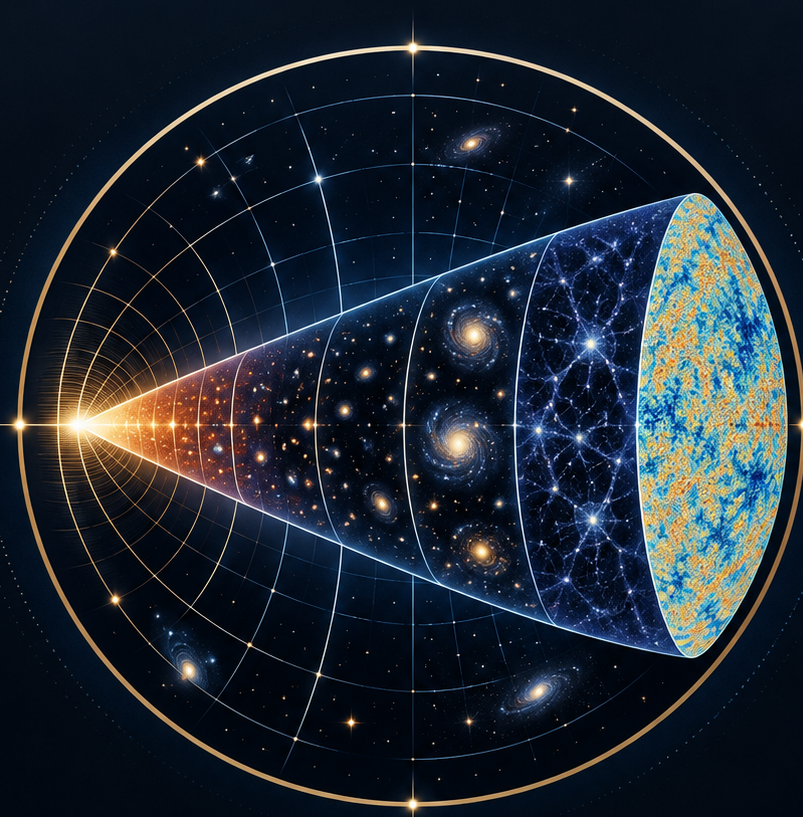
The Big Bang is the most widely accepted explanation for the origin of the universe. It proposes that the universe began approximately 13.8 billion years ago in an extremely hot, dense state, and has been expanding and cooling ever since. This article provides a comprehensive, interactive reference to the sequence of cosmic epochs—from the earliest instant to the present day—explaining what happened before, during, and after the Big Bang, and how we know.
| Key Fact | Value |
|---|---|
| Age of the universe | 13.787 ± 0.02 billion years |
| Initial state | Extremely hot, dense, and rapidly expanding | First light elements | Hydrogen and helium (formed within minutes) |
| Cosmic microwave background | Oldest light observable, relic of recombination |
| Current expansion | Accelerating (dark energy dominant) |
Main Explanation
The Big Bang theory is the cornerstone of modern cosmology. It describes how the universe evolved from a state of extremely high temperature and density into the vast, structured cosmos we observe today. The theory is supported by a wide range of empirical evidence, including the redshift of galaxies, the abundance of light elements, and the cosmic microwave background (CMB) radiation.
According to the standard model, the universe did not explode into a pre-existing space; rather, space itself expanded. This expansion, first observed by Edwin Hubble in the 1920s, is described by the Hubble–Lemaître law, which states that galaxies recede from us at speeds proportional to their distance. Extrapolating this expansion backward in time leads to a state of infinite density and temperature—the initial singularity—though our understanding breaks down at the Planck epoch.
The Big Bang model is not a complete description of the very first moments, but it successfully explains the large-scale structure, the cosmic microwave background, and the primordial abundances of light elements. The current consensus model, Lambda-CDM, incorporates dark energy and cold dark matter to account for the observed acceleration of expansion and the formation of structure.
Cosmic Epochs: A Timeline
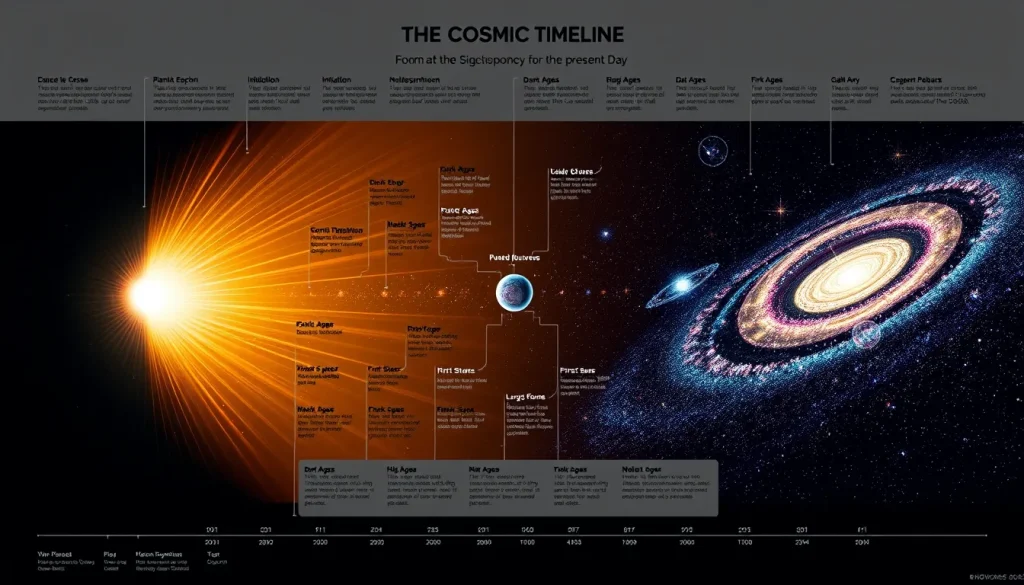
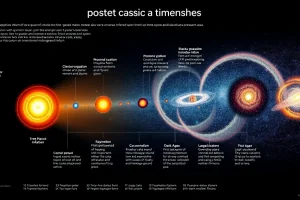
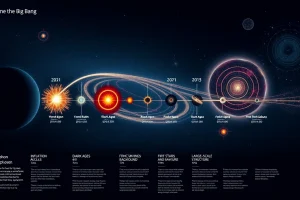
The history of the universe is divided into distinct epochs, each characterized by the dominant physical processes and particles. The following table summarizes the major epochs, and the sections below provide detailed descriptions.
| Epoch | Time After Big Bang | Temperature | Key Events |
|---|---|---|---|
| Planck Epoch | 0 to 10⁻⁴³ s | ~10³² K | Quantum gravity dominates; no current theory |
| Grand Unification Epoch | 10⁻⁴³ to 10⁻³⁶ s | ~10²⁷ K | Fundamental forces unify; inflation begins |
| Inflationary Epoch | 10⁻³⁶ to 10⁻³² s | ~10²⁷ K | Exponential expansion; seeds of structure |
| Electroweak Epoch | 10⁻³² to 10⁻¹² s | ~10¹⁵ K | Electromagnetic and weak forces separate |
| Quark Epoch | 10⁻¹² to 10⁻⁶ s | ~10¹² K | Quarks and gluons form quark-gluon plasma |
| Hadron Epoch | 10⁻⁶ to 1 s | ~10¹² to 10¹⁰ K | Protons and neutrons form; matter-antimatter annihilation |
| Lepton Epoch | 1 to 10 s | ~10¹⁰ to 10⁹ K | Leptons dominate; neutrinos decouple |
| Photon Epoch | 10 s to 380,000 years | ~10⁹ to 3,000 K | Photons dominate; nucleosynthesis occurs |
| Recombination | ~380,000 years | ~3,000 K | Electrons combine with nuclei; CMB released |
| Dark Ages | 380,000 to ~150 million years | ~3,000 to 50 K | No stars; universe dark and neutral |
| Reionization | ~150 million to 1 billion years | ~50 to 10 K | First stars and galaxies ionize hydrogen |
| Structure Formation | 1 billion years to present | ~10 K to 2.7 K | Galaxies, clusters, and large-scale structure form |
Planck Epoch
When It Happened: 0 to 10⁻⁴³ seconds (the Planck time).
Temperature: ~10³² K (Planck temperature).
Approximate Redshift: Infinite (beyond our ability to measure).
Dominant Particles/Physics: Quantum gravity; all four fundamental forces unified.
What Happened: The universe existed in a state of extreme density and temperature, where the effects of quantum gravity were as important as those of particle physics. Our current theories—general relativity and quantum mechanics—break down here, so we have no complete description of this epoch.
What Came Before: Nothing—time itself begins at this point in the standard model.
What Came Next: The Grand Unification Epoch, as the universe cooled and gravity separated from the other forces.
Evidence: No direct evidence; this epoch is inferred from theoretical extrapolation.
Grand Unification Epoch
When It Happened: 10⁻⁴³ to 10⁻³⁶ seconds.
Temperature: ~10²⁷ K.
Approximate Redshift: ~10³² (theoretical).
Dominant Particles/Physics: Grand Unified Theory (GUT) forces; quarks and leptons are interchangeable.
What Happened: The strong nuclear force separated from the electroweak force, releasing energy that drove a brief period of rapid expansion known as inflation. This exponential growth smoothed the universe and seeded the density fluctuations that later grew into galaxies.
What Came Before: The Planck Epoch.
What Came Next: The Inflationary Epoch (overlapping) and then the Electroweak Epoch.
Evidence: Inflation is supported by the observed flatness and uniformity of the universe, and by the pattern of temperature fluctuations in the CMB.
Inflationary Epoch
When It Happened: 10⁻³⁶ to 10⁻³² seconds (though some models extend it).
Temperature: ~10²⁷ K (dropping as space expands).
Approximate Redshift: ~10³² to 10²⁸.
Dominant Particles/Physics: Inflaton field (hypothetical); quantum fluctuations amplified.
What Happened: The universe expanded by a factor of at least 10²⁶ in a tiny fraction of a second. This rapid expansion stretched any initial curvature to near-flatness and magnified quantum fluctuations into macroscopic density variations—the seeds of all cosmic structure.
What Came Before: The Grand Unification Epoch.
What Came Next: The Electroweak Epoch, as inflation ended and the energy of the inflaton field converted into particles and radiation.
Evidence: The near-uniformity of the CMB, the flat geometry of the universe, and the absence of magnetic monopoles are all consistent with inflation.
Electroweak Epoch
When It Happened: 10⁻³² to 10⁻¹² seconds.
Temperature: ~10¹⁵ K.
Approximate Redshift: ~10²⁸ to 10¹⁵.
Dominant Particles/Physics: Electroweak force (unified electromagnetic and weak); Higgs boson gives mass to particles.
What Happened: The electromagnetic and weak nuclear forces separated, and particles acquired mass via the Higgs mechanism. The universe was filled with a hot soup of quarks, leptons, and gauge bosons.
What Came Before: Inflationary Epoch.
What Came Next: The Quark Epoch.
Evidence: Particle physics experiments at the LHC reproduce conditions of this epoch, confirming the electroweak unification.
Quark Epoch
When It Happened: 10⁻¹² to 10⁻⁶ seconds.
Temperature: ~10¹² K.
Approximate Redshift: ~10¹⁵ to 10¹².
Dominant Particles/Physics: Quarks, gluons, leptons; quark-gluon plasma.
What Happened: The universe was a dense, hot plasma of quarks and gluons. As it expanded and cooled, quarks began to combine into hadrons (protons and neutrons) near the end of this epoch.
What Came Before: Electroweak Epoch.
What Came Next: Hadron Epoch.
Evidence: Relativistic heavy-ion collisions at RHIC and LHC recreate quark-gluon plasma, confirming its properties.
Hadron Epoch
When It Happened: 10⁻⁶ to 1 second.
Temperature: ~10¹² to 10¹⁰ K.
Approximate Redshift: ~10¹² to 10¹⁰.
Dominant Particles/Physics: Hadrons (protons, neutrons, mesons); strong nuclear force.
What Happened: Quarks combined into hadrons. A slight excess of matter over antimatter (baryogenesis) led to the annihilation of most matter-antimatter pairs, leaving a small surplus of matter that would form the universe we see today.
What Came Before: Quark Epoch.
What Came Next: Lepton Epoch.
Evidence: The observed matter-antimatter asymmetry is unexplained but required for our existence; experiments search for CP violation.
Lepton Epoch
When It Happened: 1 to 10 seconds.
Temperature: ~10¹⁰ to 10⁹ K.
Approximate Redshift: ~10¹⁰ to 10⁹.
Dominant Particles/Physics: Leptons (electrons, muons, neutrinos); weak interactions.
What Happened: Leptons and antileptons were in thermal equilibrium. As the universe cooled, neutrinos decoupled and began free-streaming, leaving a cosmic neutrino background (analogous to the CMB).
What Came Before: Hadron Epoch.
What Came Next: Photon Epoch.
Evidence: The cosmic neutrino background has not been directly detected, but its effects on the CMB and nucleosynthesis are consistent.
Photon Epoch
When It Happened: 10 seconds to 380,000 years.
Temperature: ~10⁹ to 3,000 K.
Approximate Redshift: ~10⁹ to 1,100.
Dominant Particles/Physics: Photons, electrons, nuclei; electromagnetic interactions.
What Happened: The universe was a hot, opaque plasma of photons, electrons, and nuclei. During the first few minutes, Big Bang nucleosynthesis produced light elements (hydrogen, helium, and trace lithium). The universe remained opaque until recombination.
What Came Before: Lepton Epoch.
What Came Next: Recombination (end of Photon Epoch).
Evidence: The predicted abundances of light elements match observations of primordial gas clouds.
Recombination
When It Happened: ~380,000 years after the Big Bang.
Temperature: ~3,000 K.
Approximate Redshift: ~1,100.
Dominant Particles/Physics: Electrons and nuclei combine to form neutral atoms; photons decouple.
What Happened: As the universe cooled to about 3,000 K, electrons combined with protons and helium nuclei to form neutral hydrogen and helium. Photons, no longer scattered by free electrons, streamed freely—this is the cosmic microwave background (CMB) we observe today.
What Came Before: Photon Epoch.
What Came Next: Dark Ages.
Evidence: The CMB is the oldest light we can observe, and its near-perfect blackbody spectrum and tiny anisotropies provide a wealth of cosmological information.
Dark Ages
When It Happened: 380,000 to ~150 million years.
Temperature: ~3,000 to 50 K.
Approximate Redshift: ~1,100 to 20.
Dominant Particles/Physics: Neutral hydrogen and helium; gravity begins to amplify density fluctuations.
What Happened: The universe was dark and filled with neutral gas. No stars or galaxies had yet formed. Over time, gravitational attraction caused denser regions to collapse, setting the stage for the first stars.
What Came Before: Recombination.
What Came Next: Reionization.
Evidence: Observations of the 21-cm hydrogen line are being pursued to probe this epoch; JWST is beginning to detect early galaxies.
Reionization
When It Happened: ~150 million to 1 billion years.
Temperature: ~50 to 10 K.
Approximate Redshift: ~20 to 6.
Dominant Particles/Physics: First stars and galaxies; ultraviolet radiation ionizes neutral hydrogen.
What Happened: The first stars—likely 30 to 300 times more massive than the Sun—formed and emitted intense ultraviolet radiation, reionizing the surrounding hydrogen. This epoch marks the end of the Dark Ages and the beginning of the cosmic dawn.
What Came Before: Dark Ages.
What Came Next: Structure Formation.
Evidence: The CMB shows a reionization signature; JWST and other telescopes are directly observing galaxies from this era.
Structure Formation
When It Happened: 1 billion years to present.
Temperature: ~10 K to 2.7 K (current CMB temperature).
Approximate Redshift: ~6 to 0.
Dominant Particles/Physics: Dark matter, baryonic matter, dark energy; gravity and cosmic expansion.
What Happened: Galaxies, galaxy clusters, and the large-scale cosmic web formed as dark matter halos attracted baryonic gas. Dark energy began to dominate the expansion rate about 5 billion years ago, causing the expansion to accelerate.
What Came Before: Reionization.
What Came Next: The future—continued expansion, eventual heat death or other scenarios.
Evidence: Galaxy surveys, the CMB, and supernova observations all support the Lambda-CDM model.
Why It Matters
Understanding the Big Bang and the sequence of cosmic epochs is fundamental to our place in the universe. It explains the origin of the light elements, the formation of stars and galaxies, and the large-scale structure we observe. The cosmic microwave background is a direct relic of the early universe, providing a snapshot of the universe when it was only 380,000 years old. Missions like COBE, WMAP, and Planck have measured the CMB with extraordinary precision, confirming the predictions of the Big Bang model and revealing the composition of the universe: about 5% ordinary matter, 27% dark matter, and 68% dark energy.
Moreover, the Big Bang model is the foundation for modern cosmology, guiding research into dark matter, dark energy, and the earliest moments of the universe. It also raises profound questions about the nature of time, space, and the ultimate fate of the cosmos.
Evidence / Sources
The Big Bang theory is supported by multiple independent lines of evidence:
- Cosmic Microwave Background: The CMB is the oldest light we can observe, with a near-perfect blackbody spectrum at 2.725 K. Its tiny temperature fluctuations (anisotropies) match the predictions of inflation and the Lambda-CDM model.
- Abundance of Light Elements: Big Bang nucleosynthesis predicts that about 75% of baryonic matter is hydrogen and 25% is helium, with trace amounts of lithium. Observations of primordial gas clouds confirm these ratios.
- Redshift of Galaxies: The Hubble–Lemaître law shows that galaxies recede from us at speeds proportional to their distance, consistent with an expanding universe.
- Large-Scale Structure: The distribution of galaxies and clusters matches the density fluctuations seeded during inflation and amplified by gravity.
Key missions and instruments include:
- COBE (1989): Measured the CMB spectrum and discovered its anisotropies, earning the Nobel Prize in Physics in 2006.
- WMAP (2001): Produced detailed maps of the CMB, pinning down cosmological parameters.
- Planck (2009): Provided the most precise measurements of the CMB, refining the age of the universe to 13.787 ± 0.02 billion years.
- JWST (2021): Observes the first galaxies and stars, probing the epoch of reionization and the Dark Ages.
Related Registry Entries
Explore related topics in the cosmology registry:
- Cosmic Microwave Background
- Inflation
- Big Bang Nucleosynthesis
- Dark Ages and Reionization
- Large-Scale Structure
Last Reviewed / Updated: September 4, 2026
FAQ
What happened before the Big Bang?
In the standard Big Bang model, time itself begins at the Big Bang. The question of 'before' is not well-defined because our current physics breaks down at the Planck epoch. Some speculative theories, such as cyclic models or quantum gravity approaches, attempt to address this, but there is no observational evidence.
How do we know the Big Bang happened?
The Big Bang is supported by three main lines of evidence: the expansion of the universe (redshift of galaxies), the cosmic microwave background radiation, and the observed abundances of light elements (hydrogen, helium, and lithium) which match predictions from Big Bang nucleosynthesis.
What is the cosmic microwave background?
The CMB is the oldest light in the universe, emitted about 380,000 years after the Big Bang when the universe cooled enough for electrons and protons to combine into neutral atoms, allowing photons to travel freely. It is a near-perfect blackbody at 2.725 K and contains tiny temperature fluctuations that reveal the seeds of cosmic structure.
What is cosmic inflation?
Cosmic inflation is a period of extremely rapid exponential expansion that occurred in the first 10⁻³² seconds after the Big Bang. It explains the uniformity of the CMB, the flatness of the universe, and the origin of density fluctuations that later grew into galaxies and clusters.

Leave a Reply