
Short Answer
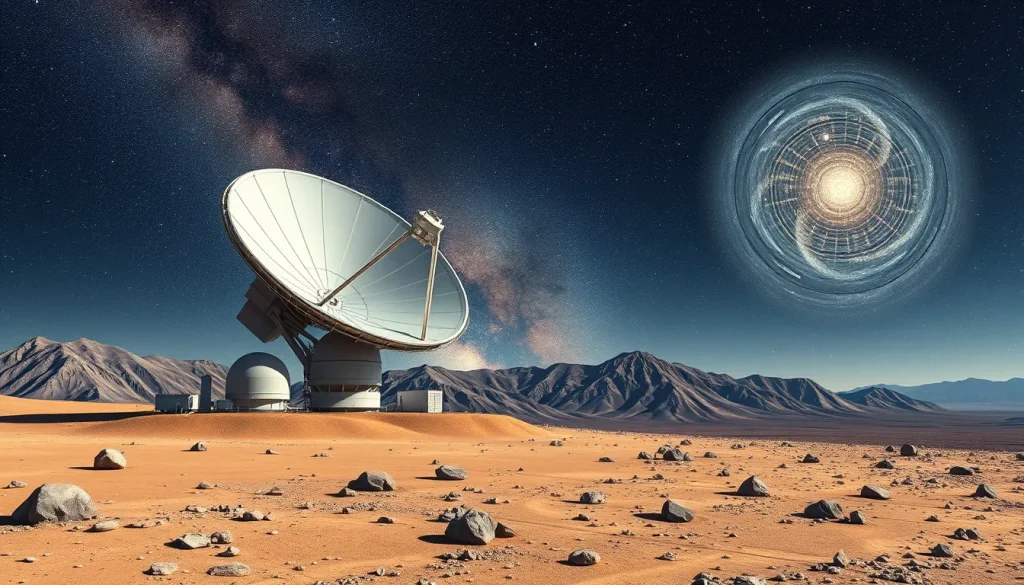
The Atacama Cosmology Telescope (ACT) was a six-meter ground-based telescope located on Cerro Toco in the Atacama Desert of Chile, designed to study the cosmic microwave background (CMB) — the relic radiation from the Big Bang — at arcminute resolution. Operating from 2008 to 2022, ACT produced high-sensitivity maps of the CMB temperature and polarization, enabling precise measurements of cosmological parameters and tests of the standard Lambda-CDM model.
| Location | Cerro Toco, Atacama Desert, Chile |
|---|---|
| Altitude | 5,190 meters (17,030 ft) |
| Diameter | 6 meters |
| Wavelength bands | 28, 41, 90, 150, 220 GHz |
| Status | Decommissioned (final data in 2022) |
| Data archive | NASA LAMBDA |
Main Explanation
The Atacama Cosmology Telescope was a pioneering instrument in the field of observational cosmology. Its primary goal was to study the cosmic microwave background — the afterglow of the Big Bang — with unprecedented resolution and sensitivity. By measuring tiny temperature and polarization fluctuations in the CMB, ACT provided a wealth of information about the universe’s composition, geometry, and evolution.
The Cosmic Microwave Background
The CMB is the oldest light in the universe, emitted about 380,000 years after the Big Bang when the universe cooled enough for protons and electrons to combine into neutral hydrogen. This light has been stretched by the expansion of space, now appearing as microwaves at a temperature of about 2.7 K. ACT observed these microwaves across a wide area of the sky, mapping the subtle anisotropies that reveal the seeds of cosmic structure.
A Timeline of the Universe
ACT’s observations help cosmologists piece together the history of the cosmos, from the earliest moments to the present day. The standard model of cosmology, Lambda-CDM, describes a sequence of epochs:
| Epoch | Time after Big Bang | Temperature | Key Events |
|---|---|---|---|
| Planck epoch | < 10⁻⁴³ s | > 10³² K | Quantum gravity effects dominate; no known physics applies. |
| Grand Unification epoch | 10⁻⁴³ – 10⁻³⁶ s | 10²⁷ – 10³² K | Unified forces begin to separate; inflation may start. |
| Inflationary epoch | 10⁻³⁶ – 10⁻³² s | ~10²⁷ K | Exponential expansion; quantum fluctuations seeded structure. |
| Electroweak epoch | 10⁻³² – 10⁻¹² s | 10¹⁵ – 10²⁷ K | Electromagnetic and weak forces separate; particle production. |
| Quark epoch | 10⁻¹² – 10⁻⁶ s | 10¹² – 10¹⁵ K | Quarks and gluons form quark-gluon plasma. |
| Hadron epoch | 10⁻⁶ – 1 s | 10¹⁰ – 10¹² K | Quarks combine into protons and neutrons; matter-antimatter asymmetry. |
| Lepton epoch | 1 – 10 s | 10⁹ – 10¹⁰ K | Leptons dominate; neutrinos decouple. |
| Photon epoch | 10 s – 380,000 yr | 3,000 – 10⁹ K | Photons dominate; primordial nucleosynthesis forms light elements. |
| Recombination | ~380,000 yr | ~3,000 K | Electrons and protons form neutral hydrogen; CMB released. |
| Dark Ages | 380,000 yr – ~150 million yr | ~30 – 3,000 K | No stars; universe filled with neutral hydrogen and dark matter. |
| Reionization | ~150 million – 1 billion yr | ~10 – 30 K | First stars and galaxies form; ultraviolet light reionizes hydrogen. |
| Structure Formation | 1 billion yr – present | 2.7 K – 30 K | Galaxies cluster; dark energy accelerates expansion. |
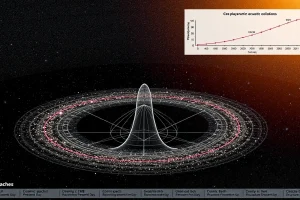
ACT’s measurements of the CMB power spectrum, particularly the acoustic peaks, have pinned down the density of baryonic matter, dark matter, and dark energy, as well as the Hubble constant and the curvature of the universe. Its data have also been used to detect galaxy clusters via the Sunyaev-Zel’dovich effect and to reconstruct the CMB lensing signal, which traces the distribution of dark matter.
Mission
Mission Facts
- Full name: Atacama Cosmology Telescope (ACTpol)
- Location: Cerro Toco, Atacama Desert, Chile
- Altitude: 5,190 m (17,030 ft) — one of the highest ground-based telescopes
- Diameter: 6 meters
- Frequency bands: 28, 41, 90, 150, 220 GHz
- Status: Decommissioned in 2022; data public on NASA LAMBDA
Launch
ACT was not a space mission; it began operations in 2008 on the ground. Its first-generation receiver, the Millimeter Bolometric Array Camera (MBAC), mapped CMB temperature anisotropies over about 1,000 square degrees from 2008 to 2010. Later upgrades (ACTpol) added polarization sensitivity.
Telescope/Instrument
The telescope was a six-meter off-axis Gregorian design, optimized for low-noise, high-resolution observations at millimeter wavelengths. It used cryogenic bolometer arrays to detect the faint CMB signal.
Wavelength
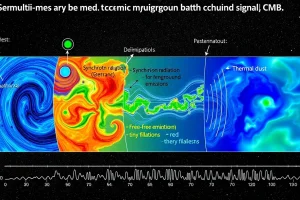
ACT observed at five frequency bands centered at 28, 41, 90, 150, and 220 GHz, corresponding to wavelengths from about 1 cm to 1 mm. These bands allow separation of CMB emission from foreground galactic dust and synchrotron radiation.
Objective
The primary objectives were to measure CMB temperature and polarization anisotropies at arcminute scales, detect galaxy clusters via the thermal Sunyaev-Zel’dovich effect, reconstruct the CMB lensing potential, and constrain cosmological parameters including the neutrino mass and the presence of primordial gravitational waves (B-modes).
Major Results
- High-precision maps of CMB temperature and polarization.
- Measurements of the CMB power spectrum that refined the Lambda-CDM model.
- Detection of hundreds of galaxy clusters through the tSZ effect.
- Reconstruction of CMB lensing, providing constraints on dark matter distribution.
- Joint analysis with Planck data improved estimates of the Hubble constant and other parameters.
Dataset
ACT data are publicly available through the NASA LAMBDA archive. The latest data release (DR6) includes three papers from 2025 covering CMB maps, power spectra, and extensions to Lambda-CDM.
Legacy
ACT’s legacy lies in its precise measurements that complement space missions like COBE, WMAP, and Planck. Its high-resolution maps continue to be used for cosmological analyses, and its techniques inform next-generation experiments such as the Simons Observatory and CMB-S4.
Why It Matters
ACT matters because it helped transform cosmology from a field of speculation into a precision science. By mapping the CMB with arcminute resolution, ACT provided independent cross-checks of space-based observations and extended our view of the early universe. Its data have been crucial for measuring the universe’s age, composition, and geometry, and for testing the inflationary paradigm. Understanding the CMB is essential for tracing the universe’s evolution from the Planck epoch to the formation of galaxies — a story that ACT has helped tell with remarkable clarity.
Evidence / Sources
- Princeton University: Atacama Cosmology Telescope (act.princeton.edu) — official project page.
- NASA LAMBDA: Atacama Cosmology Telescope Overview (lambda.gsfc.nasa.gov/product/act/index.html).
- Wikipedia: Atacama Cosmology Telescope — technical specifications and history.
Related Registry Entries
- Cosmic Microwave Background
- Lambda-CDM Model
- Planck Mission
- CMB Acoustic Peaks
Last reviewed: September 5, 2026
FAQ
What did the Atacama Cosmology Telescope measure?
ACT measured the cosmic microwave background radiation with high sensitivity and resolution, mapping temperature and polarization anisotropies, detecting galaxy clusters via the Sunyaev-Zel'dovich effect, and reconstructing the lensing of the CMB by dark matter.
Is ACT still operating?
No. ACT took its final data in 2022 and has been decommissioned. Its data are publicly available through the NASA LAMBDA archive.
How does ACT complement space missions like Planck?
ACT's high-resolution, ground-based observations provided complementary measurements to space telescopes like Planck, allowing cross-checks and improved constraints on cosmological parameters, especially at smaller angular scales.
What are the key cosmic epochs covered by ACT's observations?
ACT's measurements of the CMB probe the universe from the photon epoch (after Big Bang nucleosynthesis) through recombination and the dark ages, and its cluster and lensing data inform structure formation and the later epochs.
Leave a Reply