
Short Answer
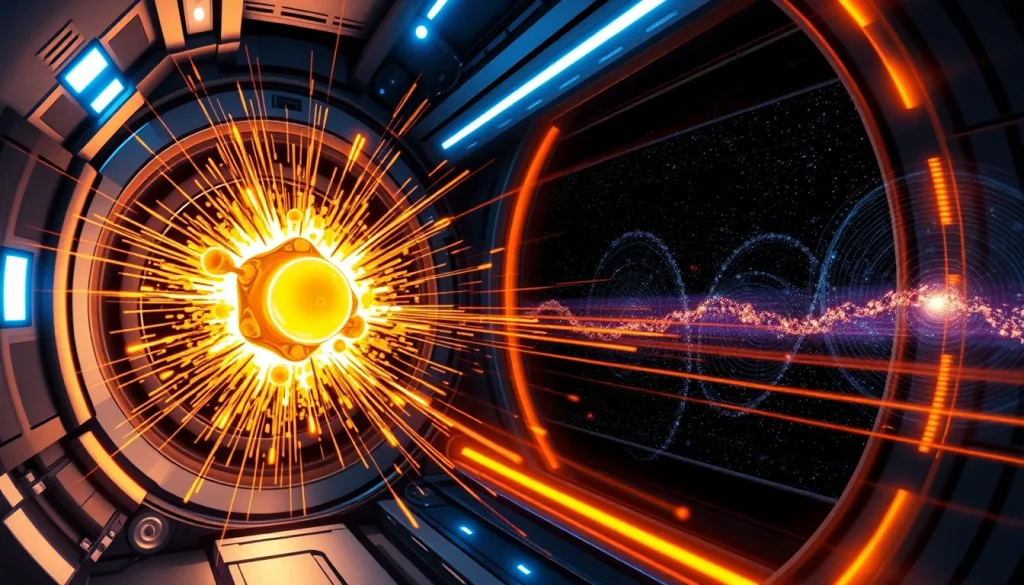
Short Answer: Particle accelerators such as the Large Hadron Collider (LHC) and the Relativistic Heavy Ion Collider (RHIC) recreate the early universe by colliding heavy atomic nuclei at nearly the speed of light. These collisions melt protons and neutrons into a quark-gluon plasma—a state of matter that existed about one microsecond after the Big Bang. By studying this plasma, physicists test our understanding of the strong force and the evolution of the cosmos.
| Property | Value |
|---|---|
| Collider | LHC (CERN), RHIC (Brookhaven) |
| Colliding Particles | Lead nuclei (LHC), Gold nuclei (RHIC) |
| Peak Temperature | ~3.3 trillion Kelvin (RHIC measurement) |
| Epoch Recreated | Quark epoch (≈10⁻¹² to 10⁻⁶ seconds after Big Bang) |
| Key Discovery | Quark-gluon plasma behaves as a nearly perfect liquid |
Main Explanation
The universe began in an extraordinarily hot, dense state and has been expanding and cooling ever since. The standard cosmological model, Lambda-CDM, describes this evolution through a series of distinct epochs. Particle accelerators allow us to reproduce the conditions of the earliest moments, providing a direct laboratory test of the physics that governed the infant cosmos.
How Accelerators Recreate the Early Universe
When heavy ions—such as gold or lead nuclei—are accelerated to relativistic speeds and smashed together, the immense energy of the collision is converted into a fireball of fundamental particles. In this fireball, the boundaries between individual protons and neutrons dissolve, releasing the quarks and gluons that normally exist only in bound states. The result is a quark-gluon plasma, the same medium that filled the universe when it was about one microsecond old (Phys.org, 2020).
At RHIC, scientists measure the temperature of this plasma at about 3.3 trillion Kelvin—the hottest matter ever created on Earth (Scientific American, 2025). This temperature is far higher than the core of the Sun and corresponds to the conditions of the quark epoch, when quarks and gluons roamed freely before combining into protons and neutrons.
The Cosmic Epochs: A Timeline
| Epoch | Time After Big Bang | Temperature | Key Events |
|---|---|---|---|
| Planck Epoch | 0 to 10⁻⁴³ s | >10³² K | All four forces unified; quantum gravity dominates. |
| Grand Unification Epoch | 10⁻⁴³ to 10⁻³⁶ s | 10²⁷–10³² K | Strong force separates from electroweak force. |
| Inflationary Epoch | 10⁻³⁶ to 10⁻³² s | ~10²⁷ K | Exponential expansion; seeds of structure formed. |
| Electroweak Epoch | 10⁻³² to 10⁻¹² s | 10¹⁵–10²⁷ K | Electromagnetic and weak forces separate; Higgs mechanism gives mass. |
| Quark Epoch | 10⁻¹² to 10⁻⁶ s | 10¹²–10¹⁵ K | Quark-gluon plasma fills the universe. |
| Hadron Epoch | 10⁻⁶ to 1 s | 10¹⁰–10¹² K | Quarks combine into protons and neutrons; matter-antimatter annihilation. |
| Lepton Epoch | 1 to 10 s | 10⁹–10¹⁰ K | Leptons dominate; neutrinos decouple. |
| Photon Epoch | 10 s to 380,000 yr | 10⁴–10⁹ K | Photons dominate; nuclei form (BBN). |
| Recombination | 380,000 yr | ~3000 K | Electrons combine with nuclei; CMB released. |
| Dark Ages | 380,000 yr to ~150 million yr | <3000 K | No stars yet; universe is dark and neutral. |
| Reionization | 150 million to 1 billion yr | ~10–100 K | First stars and galaxies ionize hydrogen. |
| Structure Formation | >1 billion yr | ~2.7 K now | Galaxies, clusters, and large-scale structure form. |
From Quark-Gluon Plasma to Atoms
Within the first microsecond, the quark-gluon plasma cooled enough for quarks to bind into protons and neutrons—a process called hadronization. The subsequent epoch of nucleosynthesis, which occurred a few minutes later, produced the lightest elements (hydrogen, helium, and traces of lithium) through nuclear fusion. The abundances of these primordial elements are a key prediction of the Big Bang model and have been confirmed by observations (Phys.org, 2020).
About 380,000 years after the Big Bang, the universe had cooled to roughly 3000 K. At this point, electrons combined with protons to form neutral hydrogen atoms—an event called recombination. This allowed photons to travel freely, producing the cosmic microwave background (CMB) that we observe today. The CMB is a relic of this early epoch and carries an almost perfect blackbody spectrum at 2.725 K.
Key Instruments and Missions
Space missions have mapped the CMB with increasing precision. COBE (1989) confirmed the CMB’s blackbody spectrum and detected tiny temperature fluctuations. WMAP (2001) measured the anisotropy spectrum, pinning down cosmological parameters. Planck (2009) provided even more precise maps, supporting the Lambda-CDM model and constraining inflation. The James Webb Space Telescope (JWST) now probes the era of reionization, revealing the first galaxies that ended the cosmic dark ages.
On Earth, particle accelerators complement these observations. The LHC’s heavy-ion program and RHIC’s collisions recreate the quark-gluon plasma, allowing physicists to study the strong force under extreme conditions. The discovery that this plasma behaves as a nearly perfect liquid—with very low viscosity—has challenged theoretical models and deepened our understanding of the early universe (Scientific American, 2023).
Why It Matters
Recreating the early universe in particle accelerators bridges the gap between cosmology and particle physics. It tests the fundamental theories that govern matter at extreme energies, providing empirical evidence for the conditions that shaped our cosmos. By understanding the quark-gluon plasma, we gain insight into the strong force, the origin of mass, and the processes that led to the formation of all visible matter. Moreover, these experiments help refine the timeline of cosmic evolution, from the Planck epoch to the present, and validate the standard cosmological model.
Evidence / Sources
The information in this article is based on peer-reviewed research and authoritative science communication sources. Key references include:
- Phys.org (2020) – “Recreating Big Bang matter on Earth” – discusses LHC heavy-ion collisions and quark-gluon plasma.
- Scientific American (2025) – “Scientists Create 3.3 Trillion Degree Particle Soup” – reports RHIC temperature measurement.
- Scientific American (2023) – “Tiny Bubbles of Primordial Soup Re-create Early Universe” – describes sPHENIX detector and RHIC experiments.
- Big Think – “How particle accelerators recreate the Universe’s first moments” – provides accessible overview.
Related Registry Entries
Explore more encyclopedia entries on cosmic epochs and key concepts:
FAQ
What exactly do particle accelerators recreate from the early universe?
They recreate the quark-gluon plasma, a state of matter that existed about one microsecond after the Big Bang. By colliding heavy ions at near-light speeds, the energy is sufficient to 'melt' protons and neutrons into their constituent quarks and gluons.
How hot is the matter created in these collisions?
At RHIC, the quark-gluon plasma reaches about 3.3 trillion Kelvin, the hottest temperature ever achieved on Earth. This is comparable to the conditions of the quark epoch in the early universe.
What have these experiments taught us about the early universe?
They have shown that the quark-gluon plasma behaves as a nearly perfect liquid with extremely low viscosity, challenging earlier expectations of a gas-like state. This informs our understanding of the strong force and the evolution of matter in the first microseconds.
Leave a Reply