
Short Answer
Main Explanation
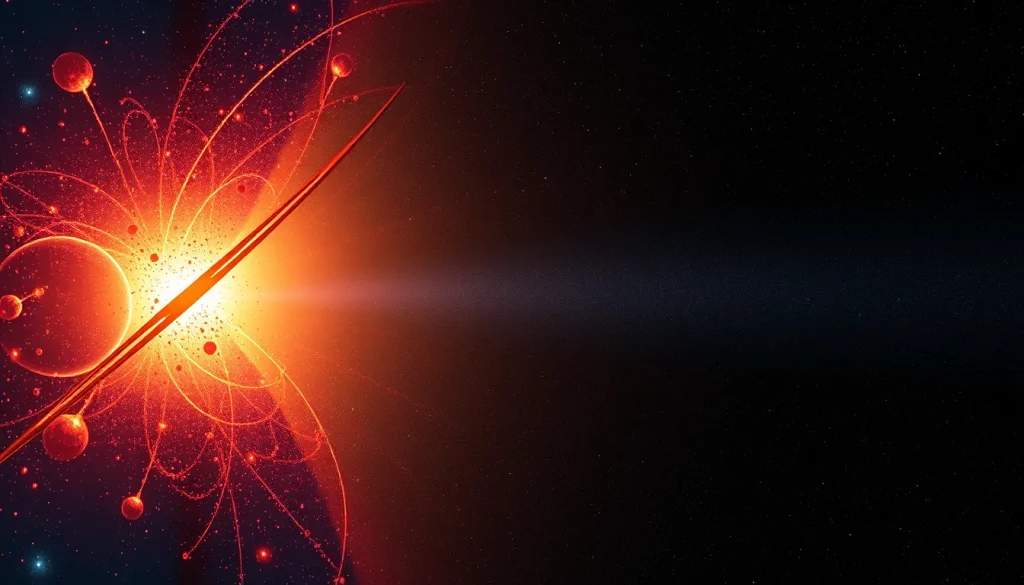
The recombination epoch is a critical turning point in cosmic history. Roughly 380,000 years after the Big Bang, the universe had expanded and cooled enough for electrons and protons to combine into neutral hydrogen and helium atoms. Before this moment, the universe was a hot, dense plasma that scattered light efficiently, making it opaque. After recombination, photons could travel freely across space, and the universe became transparent. Those same photons are detected today as the cosmic microwave background (CMB), a relic of that early era.
This epoch is not an isolated event but part of a continuous sequence of cosmic evolution. To understand it fully, we must place it within the broader timeline of the universe, from the Planck epoch to the present day.
When It Happened
Recombination occurred approximately 380,000 years after the Big Bang. This timing is derived from precise measurements of the CMB and the standard model of cosmology (ΛCDM). The exact moment depends on the density of baryonic matter and the expansion rate, but the consensus value is well established.
Temperature
At recombination, the universe had cooled to about 3,000 kelvin (K). This temperature corresponds to the energy scale at which hydrogen atoms can form and remain stable against the intense radiation field. For comparison, the CMB today has a temperature of about 2.7 K, a factor of roughly 1,100 lower due to cosmic expansion.
Approximate Redshift
The redshift of recombination is approximately z ≈ 1,100. This means that the light we see from that era has been stretched by a factor of 1,100 as space expanded. The CMB photons we observe today originated at this redshift, carrying information about the physical conditions of that time.
Dominant Particles/Physics
Before recombination, the universe was filled with a plasma of free electrons, protons, helium nuclei, and photons. The dominant physics was quantum electrodynamics and the interplay between radiation and matter. As the temperature dropped, electrons and protons combined to form neutral hydrogen, and helium had already formed earlier during Big Bang nucleosynthesis. After recombination, neutral atoms dominated, and the universe became transparent to radiation.
What Happened
During recombination, free electrons were captured by protons to form neutral hydrogen atoms. This process released photons, but more importantly, it removed the free electrons that were scattering light. As the density of free electrons plummeted, the mean free path of photons increased dramatically, and the universe transitioned from opaque to transparent. The photons that were last scattered at this moment became the CMB, which we observe as a nearly uniform glow in all directions.
What Came Before
Before recombination, the universe passed through several earlier epochs: the Planck epoch (t < 10⁻⁴³ s), the Grand Unification epoch, the Inflationary epoch (around 10⁻³⁶ to 10⁻³² s), the Electroweak epoch, the Quark epoch, the Hadron epoch, the Lepton epoch, and the Photon epoch. During the Photon epoch, the universe was a hot plasma of photons, electrons, and nuclei, with photons constantly scattering off free electrons. This is why the universe was opaque.
What Came Next
After recombination, the universe entered the Dark Ages, a period when no stars or galaxies had yet formed. The neutral hydrogen that filled space was invisible to most telescopes, but it would later be reionized by the first stars and galaxies. The epoch of reionization began roughly 150 million to 1 billion years after the Big Bang, when ultraviolet light from the first stars stripped electrons from hydrogen again. This was followed by the gradual assembly of galaxies and the large-scale structure we see today.
Evidence
The primary evidence for recombination comes from the cosmic microwave background. The CMB is a near-perfect blackbody spectrum with a temperature of 2.725 K, matching the predictions of recombination. The anisotropies (tiny temperature fluctuations) in the CMB, first measured by COBE, then mapped in detail by WMAP and Planck, encode information about the conditions at recombination. The acoustic peaks in the CMB power spectrum are consistent with the standard model and provide precise values for cosmological parameters. Additionally, the observed abundance of light elements (hydrogen, helium, lithium) from Big Bang nucleosynthesis supports the timeline.
Timeline of Cosmic Epochs
| Epoch | Time After Big Bang | Redshift | Key Events |
|---|---|---|---|
| Planck Epoch | < 10⁻⁴³ s | > 10³² | Quantum gravity effects dominate |
| Grand Unification Epoch | 10⁻⁴³ – 10⁻³⁶ s | ~10²⁸ | Unified forces begin to separate |
| Inflationary Epoch | 10⁻³⁶ – 10⁻³² s | ~10²⁷ | Exponential expansion, seeds of structure |
| Electroweak Epoch | 10⁻³² – 10⁻¹² s | ~10¹⁵ | Electromagnetic and weak forces separate |
| Quark Epoch | 10⁻¹² – 10⁻⁶ s | ~10¹² | Quarks and gluons form plasma |
| Hadron Epoch | 10⁻⁶ – 1 s | ~10¹⁰ | Protons and neutrons form |
| Lepton Epoch | 1 – 10 s | ~10⁹ | Leptons dominate, neutrinos decouple |
| Photon Epoch | 10 s – 380,000 yr | ~10⁹ – 1100 | Photons coupled to matter, universe opaque |
| Recombination | ~380,000 yr | ~1100 | Neutral atoms form, universe becomes transparent |
| Dark Ages | 380,000 – ~150 million yr | 1100 – 20 | No stars, neutral hydrogen fills space |
| Reionization | ~150 million – 1 billion yr | 20 – 6 | First stars and galaxies reionize hydrogen |
| Structure Formation | 1 billion yr – present | 6 – 0 | Galaxies, clusters, and large-scale structure evolve |
Why It Matters
The recombination epoch is not just a historical curiosity; it is the origin of the cosmic microwave background, our most powerful probe of the early universe. The CMB provides a snapshot of the universe when it was only 380,000 years old, revealing the initial conditions that later grew into galaxies and clusters. By studying the CMB, cosmologists have measured the geometry, composition, and age of the universe with remarkable precision, confirming the ΛCDM model. Recombination also marks the boundary between the opaque and transparent universe, allowing light to travel freely and enabling us to see back to this era. Without recombination, the universe would remain a fog, and we would have no direct observational access to the first moments of cosmic history.
Evidence / Sources
The evidence for recombination and the cosmic timeline comes from multiple independent observations. The CMB was first detected by Penzias and Wilson in 1965, and its blackbody spectrum was confirmed by COBE in the 1990s. Later, WMAP (2001–2010) and Planck (2009–2013) mapped the CMB anisotropies with exquisite precision, providing the parameters that define the standard model. The James Webb Space Telescope (JWST) is now probing the epoch of reionization and the first galaxies, complementing the CMB data. The abundance of light elements predicted by Big Bang nucleosynthesis also supports the timeline, as does the large-scale structure observed by galaxy surveys.
Related Registry Entries
- Cosmic Microwave Background
- Inflation
- Dark Ages
- Reionization
- Big Bang Nucleosynthesis
- Large-Scale Structure
Last Reviewed: September 5, 2026
FAQ
Why was the universe opaque before recombination?
Before recombination, the universe was filled with a hot plasma of free electrons and protons. Photons constantly scattered off these free electrons, preventing them from traveling any significant distance. This made the universe opaque, like a dense fog.
What is the cosmic microwave background?
The cosmic microwave background (CMB) is the afterglow of the Big Bang, consisting of photons that were released when the universe became transparent at recombination. These photons have been redshifted by the expansion of space and are now observed as a faint microwave glow at a temperature of 2.725 K.
How do we know recombination happened about 380,000 years after the Big Bang?
The timing is derived from the standard model of cosmology and precise measurements of the CMB. The pattern of acoustic peaks in the CMB power spectrum, measured by WMAP and Planck, allows cosmologists to determine the age of the universe and the epoch of recombination with high accuracy.
What came after the recombination epoch?
After recombination, the universe entered the Dark Ages, a period with no stars or galaxies. Eventually, the first stars formed and began reionizing the neutral hydrogen, leading to the epoch of reionization and the subsequent formation of galaxies and large-scale structure.
Leave a Reply