
Short Answer
Main Explanation
The first stars, often called Population III stars, formed when the universe was still chemically pristine. According to NASA Science, they are thought to have emerged as early as 100 million years after the Big Bang, when dense regions of hydrogen and helium collapsed under their own gravity. Once central temperatures and pressures became high enough, hydrogen fusion ignited, releasing the first starlight. These objects were fundamentally different from stars like the Sun: they contained no elements heavier than lithium, because the Big Bang produced only hydrogen, helium, and trace amounts of lithium. Without heavy elements to cool collapsing gas efficiently, the first stars are widely expected to have been very massive, very hot, and very bright, but also short-lived, ending as supernovae or collapsing directly into black holes.
Observing these first stars directly is extraordinarily difficult. Their light has traveled for more than 13 billion years, so cosmic expansion has stretched it from visible and ultraviolet wavelengths into the infrared. They are also intrinsically faint at such distances, and their brief lifetimes mean only a small number are shining at any given moment. The James Webb Space Telescope (JWST), launched in December 2021 and operational since summer 2022, is the first observatory with the infrared sensitivity and resolution to seriously hunt for them, often using gravitational lensing by massive galaxy clusters to magnify their light.
The Cosmic Epochs That Set the Stage
To understand why the first stars are so elusive, it helps to see where they fit in the universe’s timeline. The standard Lambda-CDM model describes a sequence of epochs from the Planck era to the present.
| Epoch | Time After Big Bang | Approximate Redshift | Key Events |
|---|---|---|---|
| Planck epoch | <10⁻⁴³ s | — | All four fundamental forces possibly unified; quantum gravity dominates. |
| Grand Unification epoch | 10⁻⁴³–10⁻³⁶ s | — | Strong force separates from electroweak force; possible baryogenesis. |
| Inflationary epoch | 10⁻³⁶–10⁻³² s | — | Exponential expansion stretches quantum fluctuations to cosmic scales. |
| Electroweak epoch | 10⁻³²–10⁻¹² s | — | Weak force separates from electromagnetism; Higgs field gives mass. |
| Quark epoch | 10⁻¹²–10⁻⁶ s | — | Universe is a hot quark-gluon plasma. |
| Hadron epoch | 10⁻⁶–1 s | — | Quarks bind into protons and neutrons. |
| Lepton epoch | 1–10 s | — | Leptons and antileptons dominate; neutrinos decouple. |
| Photon epoch | 10 s–380,000 yr | — | Nucleosynthesis creates helium and trace lithium; photons dominate energy density. |
| Recombination | ~380,000 yr | ~1100 | Electrons combine with nuclei; universe becomes transparent; CMB released. |
| Dark Ages | 380,000 yr–~100 million yr | ~1100–~30 | No stars; neutral hydrogen fills the cosmos. |
| Reionization | ~100 million–1 billion yr | ~30–~6 | First stars and galaxies ionize intergalactic hydrogen. |
| Structure Formation | ~100 million yr–present | <~30 | Stars, galaxies, clusters, and large-scale structure assemble. |
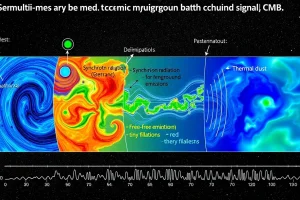
The cosmic microwave background (CMB) is the relic radiation from recombination. Missions such as COBE, WMAP, and Planck measured its near-perfect blackbody spectrum and tiny temperature anisotropies, which encode the seeds of all later structure. The first stars formed at the end of the Dark Ages, inside the first small dark matter halos, and their ultraviolet radiation began reionizing the universe.
What Are the Challenges of Observing the First Stars?
Short Answer
The first stars are extremely difficult to observe because they are at enormous distances, their light is redshifted into the infrared, they are intrinsically faint, they lived for only a few million years, and they formed before the universe was enriched with heavy elements, making their spectral signatures hard to identify. Direct detection has not yet been confirmed, but JWST and gravitational lensing are bringing astronomers closer than ever.
What We Know
Population III stars formed from pristine hydrogen and helium, with no carbon, oxygen, or iron. Theoretical models and simulations indicate that without metal-line cooling, the gas clouds that formed them could only cool through molecular hydrogen, leading to much higher masses than typical present-day stars. They were probably tens to hundreds of times the mass of the Sun, with surface temperatures far hotter than the Sun, and they emitted mostly ultraviolet radiation. Because they were so massive, they burned through their fuel quickly and exploded as supernovae or collapsed into black holes within a few million years. These explosions dispersed the first heavy elements into the intergalactic medium, setting the stage for later generations of stars and galaxies.
Observationally, the current record holder for the most distant individual star is Earendel, located in the Sunrise Arc, a highly magnified and distorted galaxy from the early universe. Earendel was detected with the help of gravitational lensing by a foreground galaxy cluster, which amplified its light enough for JWST and Hubble to see it. This demonstrates that individual stars at cosmological distances can be observed, but Earendel is not a Population III star; it is a later-generation star that already contains some heavy elements.
What We Don’t Know
Despite decades of theoretical work, no Population III star has been unambiguously identified. Key unknowns include the exact mass distribution of the first stars, whether some low-mass Population III stars could have survived to the present day, how efficiently they formed in the first dark matter halos, and how many of them ended as supernovae versus direct-collapse black holes. The fraction of reionization driven by the first stars versus the first galaxies is also uncertain. Direct detection would provide a crucial test of star formation theory in the metal-free regime.
Evidence
The main evidence for the first stars is indirect. The CMB anisotropies measured by COBE, WMAP, and Planck show the initial density fluctuations from which the first structures grew. Observations of the most distant galaxies and quasars reveal that the universe was already enriched with heavy elements less than a billion years after the Big Bang, implying that an earlier generation of stars must have produced them. The reionization of intergalactic hydrogen, inferred from the spectra of high-redshift quasars and the polarization of the CMB, also points to an early source of ultraviolet photons. Direct evidence, however, remains elusive.
Competing Explanations
The standard picture is that the first stars were very massive, but some simulations suggest that fragmentation in primordial gas clouds could have produced a broader mass range, including stars only a few times the mass of the Sun. Another possibility is that some primordial gas clouds collapsed directly into massive black holes without forming a normal star first. These scenarios are not mutually exclusive, but they predict different observational signatures, such as the abundance of low-metallicity stars in the Milky Way and the rate of high-redshift supernovae. The consensus remains that Population III stars were typically much more massive than the Sun, but the exact distribution is an open question.
Current Research
JWST is conducting deep surveys of the early universe, including fields magnified by galaxy clusters, to search for the first stars and galaxies. Near-infrared spectroscopy can reveal the absence of metal lines, a potential signature of Population III stars, but such observations are extremely challenging because the objects are faint and their light is contaminated by foreground galaxies. Future missions and extremely large ground-based telescopes may provide the sensitivity needed to detect the first supernovae or the integrated light of the first stellar populations. Gravitational lensing remains one of the most promising tools, as it can boost the flux of an individual star by factors of thousands.
Why It Matters
Finding the first stars would close a major gap in our understanding of cosmic history. These objects ended the Dark Ages, produced the first heavy elements, and likely played a key role in reionizing the universe. Their properties test the Lambda-CDM model at the smallest scales, where dark matter halos first became massive enough to host star formation. Observing them would also connect the pristine conditions of the early universe, revealed by the CMB, to the enriched cosmos we see today. The challenge is not just technical; it is a fundamental test of how structure emerged from the nearly uniform Big Bang.
Evidence / Sources
- NASA Science, ‘What Were the First Stars Like?’ — explains that the first stars formed as early as 100 million years after the Big Bang from hydrogen and helium, were probably massive and hot, and that direct observation may be possible with JWST. https://science.nasa.gov/mission/webb/science-overview/science-explainers/what-were-the-first-stars-like/
- Scientific American, ‘JWST could finally spot the very first stars in the universe’ (January 20, 2026) — describes Earendel as the current record holder for most distant star, located in the Sunrise Arc, and discusses JWST’s potential to detect Population III stars through gravitational lensing. https://www.scientificamerican.com/article/jwst-could-finally-spot-the-very-first-stars-in-the-universe/
- Annual Reviews, ‘The First Stars: Formation, Properties, and Impact’ (Klessen & Glover, 2023) — a comprehensive review of Population III star formation, properties, and their role in cosmic evolution. https://www.annualreviews.org/content/journals/10.1146/annurev-astro-071221-053453
- arXiv, ‘How can we finally see the first light? Status and perspectives in the search for Population III stars’ (Venditti et al., 2026) — a status report on observational strategies and challenges for detecting the first stars. https://arxiv.org/html/2607.00167v2
Related Registry Entries
- Cosmic Microwave Background
- Dark Ages
- Reionization
- Population III Stars
- Redshift
- Gravitational Lensing
- Lambda-CDM Model
- James Webb Space Telescope
FAQ
Why are the first stars so hard to observe directly?
They are extremely distant, so their light is very faint and redshifted into the infrared. They also lived for only a few million years, making them rare at any given time, and they lack metal lines that would make their spectra easier to identify.
What were the first stars made of?
The first stars formed from the pristine gas left over from the Big Bang, which consisted almost entirely of hydrogen and helium, with only trace amounts of lithium. There were no heavier elements like carbon, oxygen, or iron.
Has a Population III star ever been observed?
No unambiguous Population III star has been confirmed. The most distant individual star detected so far is Earendel, but it is a later-generation star that already contains some heavy elements. JWST and gravitational lensing are the most promising tools for finding the first stars.
How does the cosmic microwave background relate to the first stars?
The CMB is the relic radiation from recombination, when the universe became transparent about 380,000 years after the Big Bang. Its tiny temperature fluctuations are the seeds from which the first stars and galaxies later formed, so it provides the initial conditions for Population III star formation.
Leave a Reply