
Short Answer
Main Explanation
The cosmic microwave background (CMB) is the oldest light in the universe, a relic of the hot, dense state that existed about 380,000 years after the Big Bang. Its spectrum is a near-perfect blackbody with a temperature of 2.7255 K, as measured by COBE and later missions. But the CMB is not perfectly uniform. It contains tiny temperature fluctuations at the level of one part in 100,000, and one much larger pattern: the dipole anisotropy.
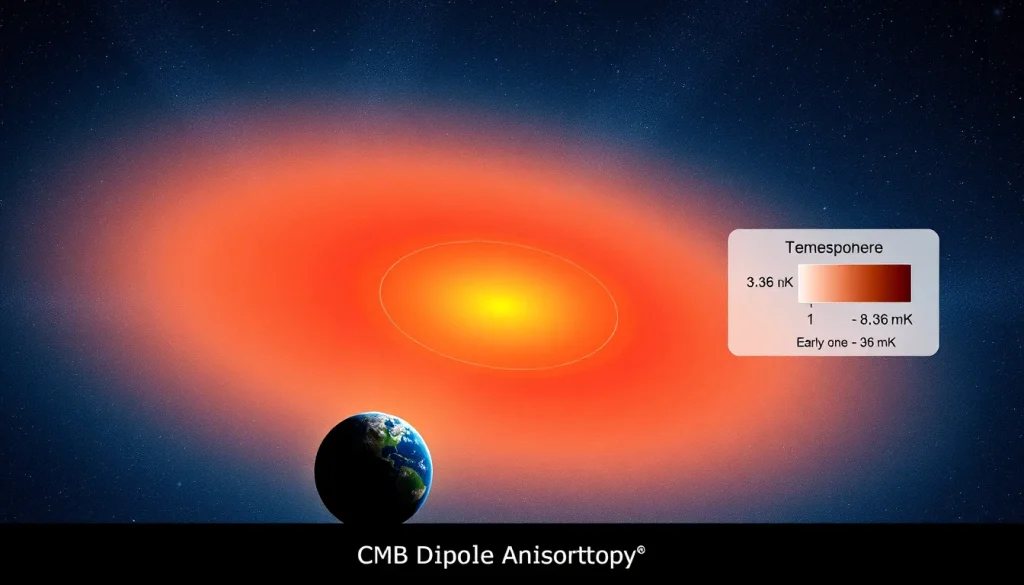
The dipole anisotropy is a systematic variation in the CMB temperature across the sky, with one hemisphere slightly warmer and the opposite hemisphere slightly cooler. The amplitude is about 3.36 millikelvin (mK), roughly a thousand times larger than the smaller-scale anisotropies. This pattern is not intrinsic to the early universe; it arises from our own motion. As the Solar System, the Milky Way, and the Local Group move through space, we see the CMB slightly blueshifted in the direction of motion and slightly redshifted in the opposite direction. This Doppler effect creates the dipole pattern.
The Cosmic Microwave Background as a Relic
The CMB was emitted during the epoch of recombination, when protons and electrons combined to form neutral hydrogen and photons decoupled from matter. Before that, the universe was a hot, opaque plasma. After recombination, the universe became transparent, and those photons have been traveling ever since, cooling as space expanded. The CMB we observe today is a snapshot of the universe at that moment, and its properties encode a wealth of information about the early universe.
The Dipole Anisotropy: A Measure of Our Motion
The dipole anisotropy was first detected in the 1960s, but the precise measurement came from the COBE satellite. Using the Differential Microwave Radiometers (DMR), COBE determined the dipole amplitude to be 3.365 ± 0.027 mK toward direction (l,b) = (264.4° ± 0.3°, 48.4° ± 0.5°) in the first year of data. The four-year analysis refined this to 3.358 ± 0.001 ± 0.023 mK in the direction (l,b) = (264.31° ± 0.04°, 48.4° ± 0.5°). This implies that the Local Group is moving at 627 ± 22 km/s relative to the CMB rest frame.
The Cosmic Timeline
The universe has gone through a series of distinct epochs, each governed by different physical processes. The following table summarizes the major epochs from the Planck epoch to the present day.
| Epoch | Time After Big Bang | Temperature | Key Events |
|---|---|---|---|
| Planck epoch | < 10⁻⁴³ s | > 10³² K | Quantum gravity effects dominate; all forces unified. |
| Grand Unification epoch | 10⁻⁴³ – 10⁻³⁶ s | 10³² – 10²⁸ K | Strong force separates from electroweak force. |
| Inflationary epoch | 10⁻³⁶ – 10⁻³² s | ~10²⁸ K | Exponential expansion; seeds of structure formed. |
| Electroweak epoch | 10⁻³² – 10⁻¹² s | 10²⁸ – 10¹⁵ K | Electromagnetic and weak forces separate. |
| Quark epoch | 10⁻¹² – 10⁻⁶ s | 10¹⁵ – 10¹² K | Quarks and gluons exist in a quark-gluon plasma. |
| Hadron epoch | 10⁻⁶ – 1 s | 10¹² – 10¹⁰ K | Protons and neutrons form; matter-antimatter annihilation. |
| Lepton epoch | 1 – 10 s | 10¹⁰ – 10⁹ K | Leptons dominate; neutrinos decouple. |
| Photon epoch | 10 s – 380,000 yr | 10⁹ – 3000 K | Photons dominate; nucleosynthesis occurs. |
| Recombination | ~380,000 yr | ~3000 K | Electrons combine with protons; CMB released. |
| Dark Ages | 380,000 yr – ~150 million yr | 3000 – 60 K | No stars yet; universe dark and neutral. |
| Reionization | ~150 million – 1 billion yr | ~60 – 20 K | First stars and galaxies ionize hydrogen. |
| Structure Formation | 1 billion yr – present | < 20 K | Galaxies, clusters, and large-scale structure form. |
From Recombination to Structure Formation
After recombination, the universe entered the Dark Ages. The first stars and galaxies formed from small density fluctuations, which were imprinted in the CMB as temperature anisotropies. These fluctuations grew under gravity, with dark matter providing the scaffolding. The first stars, likely massive and short-lived, emitted ultraviolet light that reionized the neutral hydrogen, leading to the epoch of reionization. Over billions of years, galaxies merged and clustered, forming the large-scale structure we see today. The CMB dipole anisotropy, while caused by our motion, is a reminder that we are not at rest in the universe; we are moving through the cosmic web.
Concept: Dipole Anisotropy
Definition
The dipole anisotropy is the largest-scale temperature variation in the CMB, characterized by a sinusoidal pattern with a peak in one direction and a trough in the opposite direction. It is caused by the Doppler shift of the CMB photons due to the observer’s peculiar velocity relative to the CMB rest frame.
How It Works
If an observer moves with velocity v relative to the CMB, photons arriving from the direction of motion are blueshifted (higher energy, higher temperature), while photons from the opposite direction are redshifted (lower energy, lower temperature). The observed temperature T(θ) follows T(θ) = T₀ (1 + β cos θ), where β = v/c, θ is the angle from the direction of motion, and T₀ is the mean CMB temperature. For small velocities, this is a dipole pattern.
Equation
The dipole amplitude ΔT is related to the observer’s speed by ΔT/T₀ = v/c. For the measured dipole of 3.358 mK and T₀ = 2.7255 K, this gives v ≈ 369 km/s for the Solar System relative to the CMB. However, the Local Group velocity is larger (627 km/s) because the Sun orbits the Milky Way, and the Milky Way moves within the Local Group.
Example
Imagine standing in a rainstorm with no wind. The rain falls uniformly. If you start walking, you feel more raindrops hitting your face than your back. Similarly, our motion through the CMB makes the photons ahead of us appear slightly more energetic, creating a warm spot, and those behind us appear less energetic, creating a cool spot.
Observable Consequences
The dipole anisotropy must be subtracted from CMB maps to study the intrinsic anisotropies that reveal the universe’s structure. It also provides a direct measurement of our peculiar velocity, which can be compared with the gravitational pull of large-scale structure. The dipole direction is used to define the CMB rest frame, a fundamental reference for cosmology.
Common Misconceptions
One misconception is that the dipole anisotropy is a primordial feature of the CMB. In fact, it is a local effect due to our motion. Another is that the dipole is caused by the expansion of the universe; it is not. The expansion is isotropic on large scales, but our peculiar motion creates the dipole. Finally, the dipole is not the same as the small-scale anisotropies that correspond to density fluctuations; it is orders of magnitude larger.
Why It Matters
The dipole anisotropy is not just a nuisance to be removed; it is a valuable cosmological probe. It tells us our velocity relative to the CMB, which is the closest thing to a universal rest frame. This velocity is a result of the gravitational attraction of matter around us, and measuring it helps map the distribution of dark matter. The dipole also tests the cosmological principle, which states that the universe is homogeneous and isotropic on large scales. If the dipole were not consistent with a simple Doppler shift, it could indicate new physics. Moreover, understanding the dipole is essential for interpreting CMB data from missions like COBE, WMAP, and Planck, which have mapped the CMB with extraordinary precision.
Evidence / Sources
The dipole anisotropy was first detected in the 1960s, but the definitive measurement came from the COBE DMR instrument. The first-year results gave a dipole amplitude of 3.365 ± 0.027 mK toward (l,b) = (264.4°, 48.4°). The four-year analysis refined this to 3.358 ± 0.001 ± 0.023 mK. These measurements are consistent with a Doppler-shifted Planck function, confirming the interpretation. The CMB temperature itself is measured to be 2.7255 K, as reported in the Particle Data Group review. The velocity of the Local Group relative to the CMB is 627 ± 22 km/s, a value that has been corroborated by later missions.
Related Registry Entries
This article is part of a series on the cosmic microwave background and the evolution of the universe. Related entries include:
- The Cosmic Microwave Background: A Relic of the Big Bang
- Cosmic Inflation: The First Fraction of a Second
- Recombination and the Last Scattering Surface
- Large-Scale Structure: The Cosmic Web
FAQ
What causes the dipole anisotropy in the CMB?
The dipole anisotropy is caused by the Doppler shift of CMB photons due to the motion of the observer (Earth, Sun, Milky Way, Local Group) relative to the CMB rest frame. The direction of motion appears warmer, the opposite direction cooler.
How is the dipole anisotropy measured?
It is measured by mapping the CMB temperature across the sky and fitting a dipole pattern. The COBE DMR instrument provided the first precise measurement, with amplitude 3.358 mK and direction (l,b) = (264.31°, 48.4°).
Why is the dipole anisotropy important for cosmology?
It provides a measurement of our peculiar velocity, tests the cosmological principle, and must be subtracted to study the intrinsic CMB anisotropies that reveal the universe's structure and composition.
Is the dipole anisotropy a primordial feature of the universe?
No. It is a local effect due to our motion. The primordial anisotropies are much smaller (about 18 microkelvin) and are caused by density fluctuations in the early universe.

Leave a Reply