Short Answer
Main Explanation
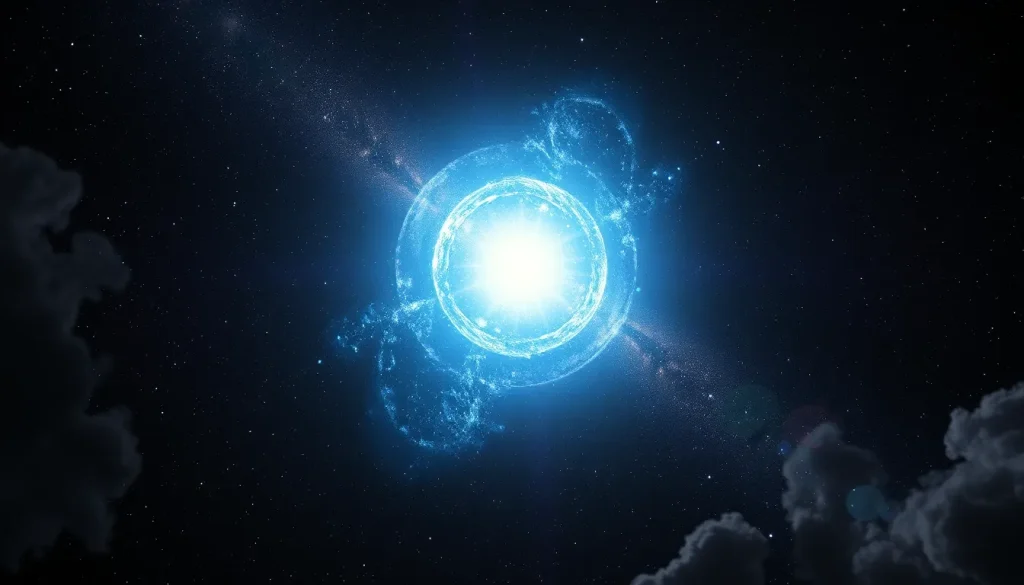
Population III stars are the first generation of stars to form in the universe, emerging from the primordial gas of hydrogen and helium left over from the Big Bang. Unlike later stars, they contained no heavier elements (metals) and are thought to have been extremely massive, hot, and short-lived. Their formation marked the end of the cosmic Dark Ages and initiated the process of reionization that transformed the early universe.
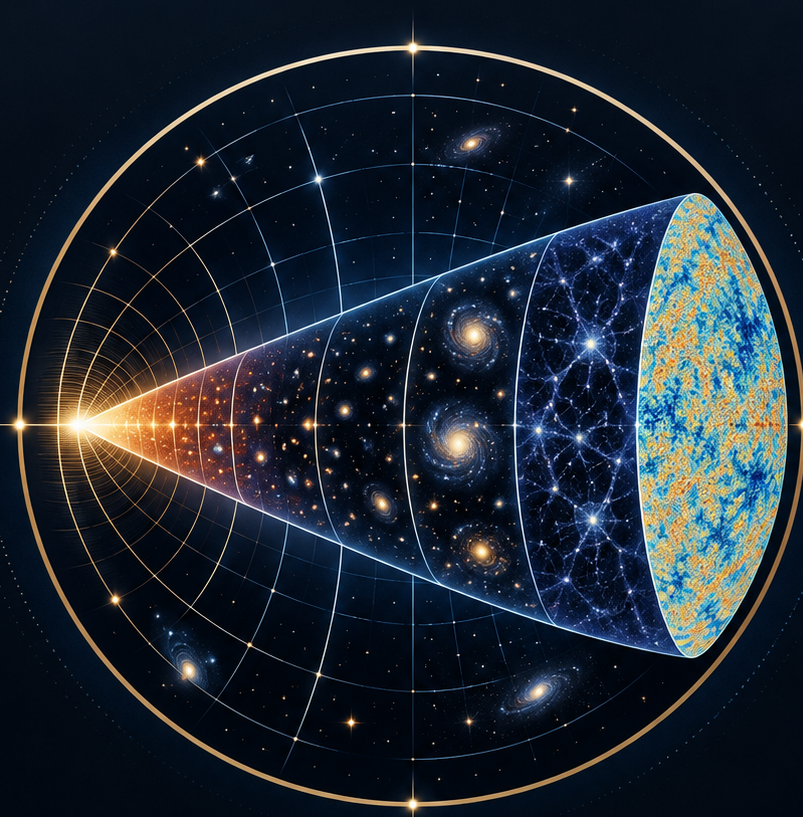
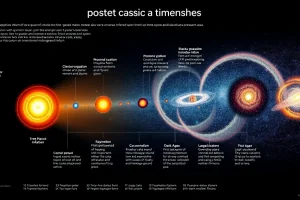
The universe began with the Big Bang, evolving through a series of epochs from the Planck epoch (the earliest moment) through inflation, nucleosynthesis, recombination, and the formation of the first stars and galaxies. The table below summarizes the major epochs.
| Epoch | Time After Big Bang | Temperature | Key Events |
|---|---|---|---|
| Planck epoch | 0 to 10^-43 s | ~10^32 K | Quantum gravity effects dominate |
| Grand Unification epoch | 10^-43 to 10^-36 s | ~10^29 K | Strong and electroweak forces unify |
| Inflationary epoch | 10^-36 to 10^-32 s | ~10^28 K | Exponential expansion of space |
| Electroweak epoch | 10^-32 to 10^-12 s | ~10^15 K | Electromagnetic and weak forces separate |
| Quark epoch | 10^-12 to 10^-6 s | ~10^15 to 10^12 K | Quarks and gluons form plasma |
| Hadron epoch | 10^-6 to 1 s | ~10^12 to 10^10 K | Protons and neutrons form |
| Lepton epoch | 1 s to 10 s | ~10^10 to 10^9 K | Leptons dominate, neutrinos decouple |
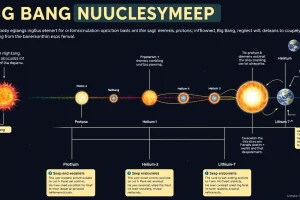
| Photon epoch | 10 s to 380,000 years | ~10^9 to 3,000 K | Photons dominate, nucleosynthesis occurs |
| Recombination | ~380,000 years | ~3,000 K | Atoms form, CMB released |
| Dark Ages | 380,000 years to ~100 million years | ~3,000 K to ~50 K | No stars, neutral hydrogen |
| Reionization | ~100 million to ~1 billion years | ~50 K to ~20 K | First stars and galaxies ionize gas |
| Structure Formation | ~1 billion years to present | ~20 K to 2.7 K | Galaxies, clusters, and large-scale structure form |
The first stars, Population III, formed during the Reionization epoch, roughly 100 million years after the Big Bang, according to NASA Science [1]. They were made almost entirely of hydrogen and helium, with trace amounts of lithium [1]. Their formation was driven by gravitational collapse of dense primordial gas clouds.
What We Know
Population III stars are predicted to have been extremely massive, with estimates ranging from tens to hundreds of solar masses. Their high mass led to very high temperatures and luminosities, making them much hotter and brighter than the Sun [1]. Because they lacked metals, they had a different fusion process, and they likely ended their lives in pair-instability supernovae or direct collapse to black holes [1]. Their radiation is thought to have reionized the neutral hydrogen in the early universe, contributing to the epoch of reionization.
What We Don’t Know
No Population III stars have been directly observed. Their exact mass distribution, lifetimes, and the details of their formation remain uncertain. The James Webb Space Telescope (JWST) is currently searching for them, but as of now, they remain elusive.
Evidence
Evidence for Population III stars comes from indirect observations, such as the chemical abundance patterns in extremely metal-poor stars in the Milky Way, which show enrichment from the first supernovae. The cosmic microwave background (CMB) also provides constraints on reionization. Additionally, the detection of high-redshift galaxies with JWST may reveal signatures of Population III stars.
Competing Explanations
Some models suggest that the first stars might have been less massive, or that they formed in clusters. Others propose that dark matter annihilation could have influenced their formation. However, the standard Lambda-CDM model with Population III stars as massive stars remains the consensus.
Current Research
JWST is actively observing the early universe to find Population III stars or their signatures. The observatory’s infrared capabilities are designed to detect the light from the first galaxies and potentially the first stars. Additionally, theoretical simulations are refining predictions of their properties.
Why It Matters
Population III stars are key to understanding the evolution of the universe. They produced the first heavy elements, enriched the intergalactic medium, and initiated reionization. Their existence bridges the gap between the simple early universe and the complex cosmos we see today.
Evidence / Sources
Key sources include NASA Science’s explainer on the first stars [1], the Annual Review of Astronomy and Astrophysics article by Klessen and Glover [2], and the Wikipedia article on stellar populations [3]. The arXiv preprint by Glover and Klessen provides further detail [4].
Related Registry Entries
Related entries include: The Big Bang, Cosmic Microwave Background, Reionization, Dark Ages, JWST.
FAQ
What are Population III stars?
Population III stars are the first generation of stars, formed from the primordial hydrogen and helium created in the Big Bang. They contained no metals (elements heavier than helium) and are thought to have been extremely massive and hot.
Why haven't we directly observed Population III stars?
They formed very early in the universe's history and were likely short-lived. Their light has been redshifted into the infrared, and they may have been obscured by dust or have exploded long ago. The James Webb Space Telescope is currently searching for their signatures.
How did Population III stars affect the early universe?
Their intense ultraviolet radiation ionized the neutral hydrogen around them, contributing to the epoch of reionization. They also produced the first heavy elements through supernovae, enriching the gas for future generations of stars.
Leave a Reply