Short Answer
Short Answer: The scale factor a is a dimensionless parameter that describes the relative expansion of the universe. By convention, its present value is set to 1; at earlier times it was smaller, meaning distances between galaxies were shorter. It is a fundamental quantity in the Friedmann equations that govern the universe’s expansion.
| Property | Value |
|---|---|
| Symbol | a |
| Type | Dimensionless scale factor |
| Current value | 1 (by convention) |
| Normalization | Arbitrary; typically set so a(tnow) = 1 |
| Role | Describes cosmic expansion in Friedmann equations |
| Related to | Redshift: a = 1/(1+z) |
Main Explanation
The scale factor is a cornerstone of modern cosmology. It appears in the Friedmann–Lemaître–Robertson–Walker (FLRW) metric, which describes a homogeneous and isotropic universe. The metric is written as:
−c²dτ² = −c²dt² + a(t)² dΣ²
where dΣ is the spatial part independent of time. The function a(t) captures how distances between comoving observers (those moving with the cosmic flow) change over time. Its absolute value is arbitrary—only ratios matter. Thus cosmologists set a = 1 today, so that a value of 0.5 means the universe was half its current linear size.
The scale factor is directly related to redshift z by a = 1/(1+z). Light emitted at an earlier time with scale factor a is observed today with a redshift that reveals how much the universe has expanded since emission.
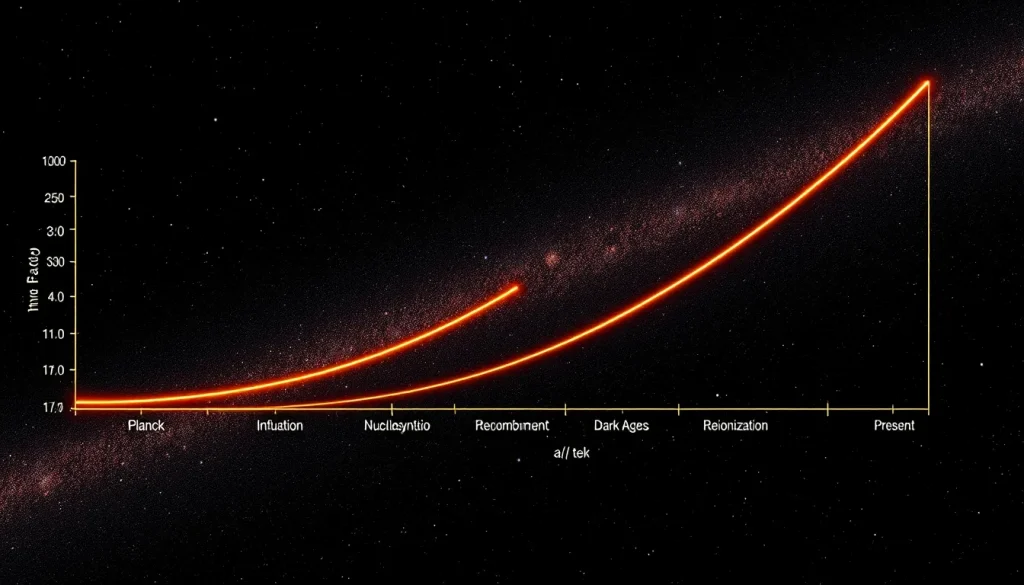
In the standard ΛCDM model, the evolution of a(t) is governed by the Friedmann equation, which balances the energy densities of radiation, matter, and dark energy. Because these components dilute differently with expansion—radiation as a−4, matter as a−3, and dark energy approximately constant—the universe has transitioned through distinct eras. Early on, radiation dominated; later, matter; and since about 4 billion years ago, dark energy has become dominant, accelerating the expansion.
The Cosmic Epochs
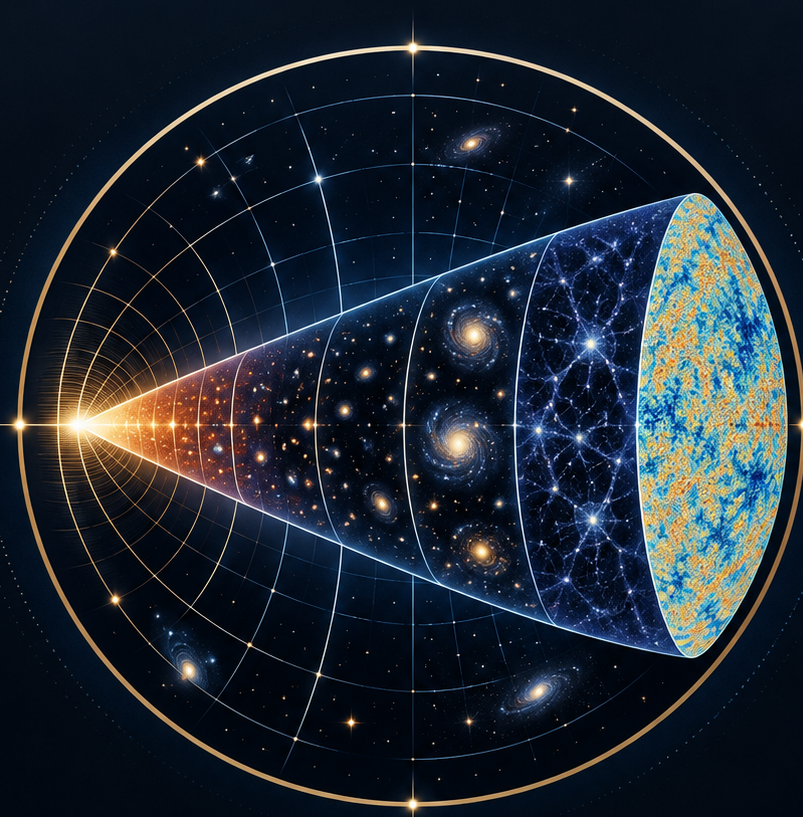
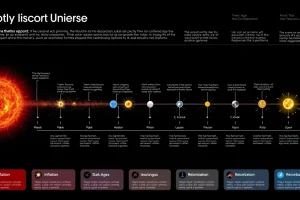
The scale factor allows us to organize the history of the universe into a sequence of epochs, each characterized by its dominant physics and contents. The following timeline summarizes the standard model.
| Epoch | Time after Big Bang | Approx. Redshift | Key Events |
|---|---|---|---|
| Planck epoch | 0 to 10−43 s | >1032 | Quantum gravity effects; all forces unified. |
| Grand Unification epoch | 10−43 to 10−36 s | ~1028 | Strong force separates from electroweak; possible inflation begins. |
| Inflationary epoch | 10−36 to 10−32 s | ~1026 | Exponential expansion; quantum fluctuations seeded large-scale structure. |
| Electroweak epoch | 10−32 to 10−12 s | ~1015 | Electromagnetic and weak forces separate; W, Z bosons get mass. |
| Quark epoch | 10−12 to 10−6 s | ~1012 | Quarks and gluons form quark–gluon plasma. |
| Hadron epoch | 10−6 to 1 s | ~1010 | Quarks combine into hadrons; protons and neutrons form. |
| Lepton epoch | 1 s to 10 s | ~109 | Leptons (electrons, neutrinos) dominate; neutrinos decouple. |
| Photon epoch | 10 s to 380,000 yr | ~108 to 1000 | Photons dominate; Big Bang nucleosynthesis creates light elements. |
| Recombination | ~380,000 yr | ~1100 | Electrons combine with protons to form neutral hydrogen; universe becomes transparent; CMB released. |
| Dark Ages | 380,000 yr to ~150 million yr | ~1000 to 20 | No stars; neutral hydrogen pervades; gravitational collapse begins. |
| Reionization | ~150 million yr to 1 billion yr | ~20 to 6 | First stars and galaxies ionize neutral hydrogen; universe becomes transparent to UV again. |
| Structure Formation | 1 billion yr to present | <6 | Galaxies, clusters, and large-scale structure form; dark energy accelerates expansion. |
Planck Epoch
At the very beginning, the universe was a quantum gravitational realm where the four fundamental forces were unified. Our current physics cannot describe this era because it requires a theory of quantum gravity. The scale factor was vanishingly small, and the temperature exceeded the Planck energy (~1019 GeV).
Grand Unification Epoch
As the universe cooled, the strong nuclear force separated from the electroweak interaction. This symmetry breaking may have triggered inflationary expansion. The exact details are speculative, but inflation is strongly supported by observations of the cosmic microwave background (CMB).
Inflationary Epoch
Inflation was a period of exponential expansion driven by a scalar field. It solved the horizon and flatness problems and amplified quantum fluctuations into the seeds of cosmic structure. The scale factor grew by a factor of at least 1026 in a tiny fraction of a second.
Electroweak Epoch
At around 10−12 seconds, the electromagnetic and weak forces separated, giving mass to the W and Z bosons. This era is accessible to particle accelerators like the LHC, which recreate similar energies.
Quark and Hadron Epochs
During the quark epoch, the universe was a hot soup of quarks and gluons. As it cooled, quarks combined into hadrons (protons and neutrons). The slight asymmetry between matter and antimatter left a tiny excess of matter, which survives today.
Lepton Epoch
Leptons—electrons, muons, and neutrinos—dominated the energy density. Neutrinos decoupled from the rest of matter, creating a cosmic neutrino background that we have yet to directly detect but infer from the CMB.
Photon Epoch and Nucleosynthesis
The photon epoch saw the universe filled with a dense plasma of photons, electrons, and nuclei. Big Bang nucleosynthesis (BBN) produced helium-4, deuterium, and lithium with abundances that match observations. The scale factor continued to grow, cooling the plasma.
Recombination and the CMB
About 380,000 years after the Big Bang, the temperature dropped to ~3000 K, allowing electrons and protons to combine into neutral hydrogen. Photons decoupled and have been traveling ever since, forming the cosmic microwave background. This relic radiation, first detected by Penzias and Wilson, is a direct snapshot of the universe at that epoch. Missions like COBE, WMAP, and Planck have mapped its temperature anisotropies with exquisite precision, confirming the predictions of inflation and ΛCDM.
Dark Ages and Reionization
After recombination, the universe entered the Dark Ages—a period with no stars. Over time, gravity amplified density fluctuations, and the first stars and galaxies formed around 150 million years later. Their ultraviolet light reionized the neutral hydrogen, a phase called reionization. The James Webb Space Telescope (JWST) is now probing this era, revealing galaxies that existed just a few hundred million years after the Big Bang.
Structure Formation and Dark Energy
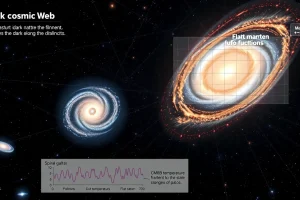
Galaxies assembled into clusters and superclusters, forming the cosmic web. Meanwhile, dark energy became dominant about 4 billion years ago, causing the expansion to accelerate. The scale factor now grows exponentially, and distant galaxies recede faster and faster.
Why It Matters
The scale factor is more than a mathematical convenience; it underpins our entire understanding of cosmic evolution. It connects redshift to distance, allows us to calculate the age of the universe, and provides a framework for interpreting observations from the CMB, supernovae, and galaxy surveys. Without it, we could not quantify the expansion of space or test the ΛCDM model. Moreover, the scale factor’s evolution reveals the composition of the universe—radiation, matter, and dark energy—and how each has shaped the cosmos we see today.
Evidence / Sources
The concept of the scale factor is standard in cosmology and is detailed in the Wikipedia article on the scale factor. The normalization to 1 today is explained in Physics Stack Exchange. The cosmic epochs and the standard Big Bang model are summarized in the Particle Data Group review of Big-Bang cosmology (revised August 2025).
Related Registry Entries
- Cosmic Microwave Background
- Inflation
- Recombination
- Dark Energy
- Redshift
FAQ
Why is the scale factor set to 1 today?
The absolute value of the scale factor is arbitrary because only ratios matter for physical predictions. Setting it to 1 today simplifies calculations and allows easy comparison of past sizes: a=0.5 means the universe was half its current size.
How does the scale factor relate to the age of the universe?
The scale factor as a function of time is derived from the Friedmann equations. By integrating 1/ȧ over time, cosmologists can compute the age of the universe, which is approximately 13.8 billion years in the ΛCDM model.
What is the scale factor at the time of the cosmic microwave background emission?
At recombination, about 380,000 years after the Big Bang, the scale factor was roughly 0.001, meaning the universe was about a thousandth of its current size. This corresponds to a redshift of about 1100.

Leave a Reply