Short Answer
Main Explanation
The discovery that the universe’s expansion is accelerating is one of the most profound findings in modern cosmology. It emerged from decades of work measuring distances to faraway supernovae, and it transformed our understanding of the cosmos’s fate. To appreciate this breakthrough, we must first understand the cosmic framework—the epochs and events that shaped the universe from its birth to the present day.
The Cosmic Epochs
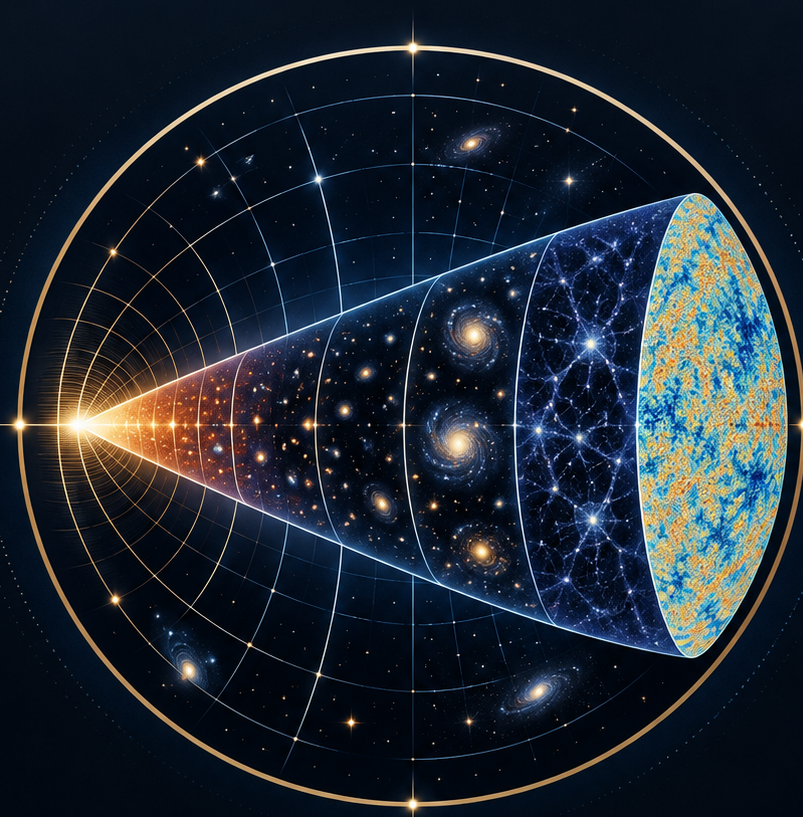
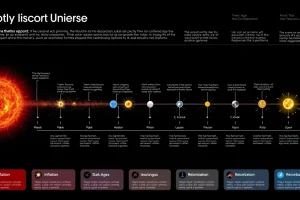
The standard Big Bang model describes a universe that began as an extremely hot, dense singularity about 13.8 billion years ago. The earliest moments are divided into epochs characterized by the dominant physical processes:
- Planck epoch (0 to ~10⁻⁴³ s): All four fundamental forces were unified; quantum gravity dominated.
- Grand Unification epoch (~10⁻⁴³ to 10⁻³⁶ s): The strong force separated from the electroweak force.
- Inflationary epoch (~10⁻³⁶ to 10⁻³² s): A period of exponential expansion, smoothing and flattening the universe.
- Electroweak epoch (~10⁻³² to 10⁻¹² s): The electromagnetic and weak forces separated.
- Quark epoch (~10⁻¹² to 10⁻⁶ s): Quarks and gluons formed a quark-gluon plasma.
- Hadron epoch (~10⁻⁶ s to 1 s): Quarks combined into protons and neutrons.
- Lepton epoch (~1 s to 10 s): Leptons dominated; electron-positron annihilation occurred.
- Photon epoch (~10 s to 380,000 years): The universe was a plasma of photons, electrons, and nuclei.
- Recombination (~380,000 years): Electrons combined with protons to form neutral hydrogen; the cosmic microwave background (CMB) was released.
- Dark Ages (~380,000 to 150 million years): The universe was dark, with no stars yet.
- Reionization (~150 million to 1 billion years): The first stars and galaxies ionized neutral hydrogen.
- Structure Formation (1 billion years to present): Gravity assembled galaxies, clusters, and superclusters.
The cosmic microwave background is a relic of the photon epoch, a snapshot of the universe when it became transparent. Missions like COBE (1989), WMAP (2001), and Planck (2009) mapped its temperature fluctuations with increasing precision, confirming the predictions of inflation and the ΛCDM model.
The Supernova Revolution
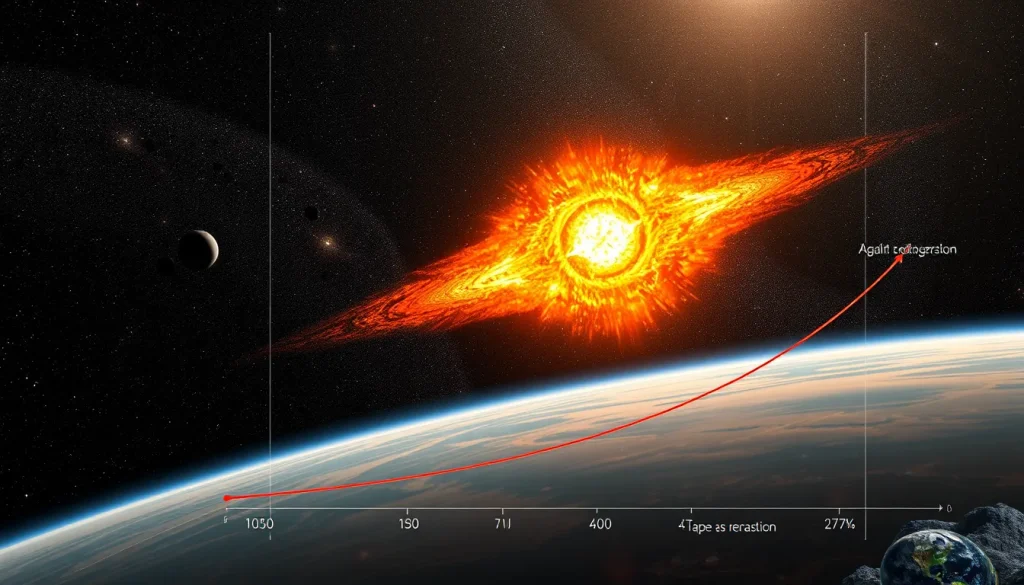
In the early 1990s, two teams—the Supernova Cosmology Project led by Saul Perlmutter and the High-Z Supernova Search Team led by Brian Schmidt and Adam Riess—set out to measure the deceleration of the universe. They used Type Ia supernovae, which occur when a white dwarf in a binary system accretes matter and reaches a critical mass, triggering a thermonuclear explosion. Because these explosions have a nearly uniform peak luminosity, they act as standard candles: by comparing their apparent brightness to their known intrinsic brightness, astronomers can determine their distance.
The teams measured redshifts (the stretching of light due to cosmic expansion) and distances for dozens of distant Type Ia supernovae. They expected to find that the expansion was slowing down due to gravity. Instead, they found that the most distant supernovae were dimmer than predicted—they were farther away than a decelerating universe would allow. The only way to explain this was that the expansion was speeding up.
Both teams announced their results in 1998, and the finding was later confirmed by independent observations. The 2011 Nobel Prize in Physics was awarded to Perlmutter, Schmidt, and Riess for this discovery.
Evidence
Observation
Astronomers observed dozens of Type Ia supernovae at redshifts up to z ≈ 1, measuring their apparent brightness and spectral redshifts. The data showed a clear deviation from the expected Hubble law for a decelerating universe.
Prediction
The standard Friedmann equations, derived from general relativity, predict that the expansion of a matter-dominated universe should decelerate due to gravitational attraction. The supernova data contradicted this prediction.
Measurement
By fitting the distance–redshift relation, astronomers derived the cosmological parameters. The best-fit model included a cosmological constant (Λ) with a positive energy density, leading to accelerated expansion.
Why It Supports the Model
The supernova results are consistent with the ΛCDM model, which also explains the CMB anisotropies, baryon acoustic oscillations, and the large-scale distribution of galaxies. The accelerated expansion requires a dark energy component that makes up about 70% of the universe’s energy density.
Limitations
Type Ia supernovae are not perfectly uniform; corrections based on light-curve shape and color are needed. There are also potential systematic effects from dust, evolution, and selection biases. However, multiple independent analyses have confirmed the original result.
Alternative Explanations
Some alternatives to dark energy include modified gravity theories (e.g., f(R) gravity) or a time-varying cosmological constant. However, none of these fully explain all observations, and dark energy remains the simplest and best-supported explanation.
Current Scientific Consensus
The overwhelming consensus among cosmologists is that the universe’s expansion is accelerating, driven by dark energy. This is a cornerstone of the ΛCDM model, which is supported by a wide range of observations.
Why It Matters
The discovery of accelerating expansion has profound implications for the fate of the universe. It implies that the universe will expand forever, with galaxies moving farther apart at an ever-increasing rate. It also raises fundamental questions about the nature of dark energy, which remains one of the biggest mysteries in physics. Understanding dark energy could require a new theory of gravity or a deeper understanding of quantum mechanics.
Moreover, the supernova result highlighted the importance of Type Ia supernovae as cosmological probes and spurred the development of next-generation surveys like the Dark Energy Survey and the James Webb Space Telescope (JWST), which are investigating the nature of dark energy and the early universe.
Evidence / Sources
- Perlmutter, S. (2011). Nobel Lecture: Measuring the Acceleration of the Cosmic Expansion Using Supernovae. NobelPrize.org
- Perlmutter, S. (2003). Supernovae, Dark Energy, and the Accelerating Universe. Physics Today. physicstoday.aip.org
- Astronomy.com (2026). How did astronomers discover that the expansion of the universe was accelerating? astronomy.com
- Riess, A. G. et al. (1998). Observational Evidence from Supernovae for an Accelerating Universe and a Cosmological Constant. Astronomical Journal, 116, 1009. iopscience.iop.org
Related Registry Entries
FAQ
What are Type Ia supernovae and why are they used as standard candles?
Type Ia supernovae are thermonuclear explosions of white dwarf stars that have reached the Chandrasekhar limit. Because they explode with a nearly uniform peak luminosity, their apparent brightness can be used to infer their distance.
How did the supernova observations prove acceleration?
By comparing the distances and redshifts of distant Type Ia supernovae, astronomers found that they were dimmer (farther) than expected in a decelerating universe. This could only be explained if the expansion had been speeding up over time.
What is dark energy?
Dark energy is a hypothetical form of energy that permeates space and drives the accelerated expansion. In the ΛCDM model, it is represented by the cosmological constant (Λ), which has a constant energy density.
How do Type Ia supernovae relate to the cosmic microwave background?
Both are independent probes of cosmology. The CMB provides a snapshot of the early universe, while supernovae probe the recent expansion history. Together, they constrain the parameters of the ΛCDM model.
Leave a Reply