
Short Answer
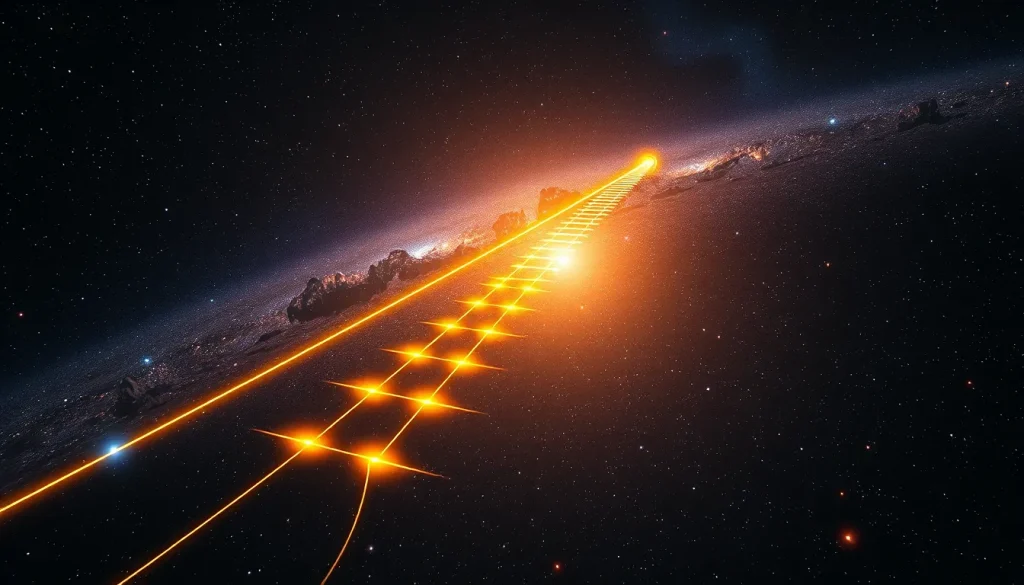
Short Answer: The cosmic distance ladder (also known as the extragalactic distance scale) is the succession of methods by which astronomers determine distances to celestial objects. Because no single technique can measure distances at all scales, astronomers chain together multiple methods — each calibrated by the one before — to reach from nearby stars to the edge of the observable universe. The ladder is fundamental to measuring the expansion rate of the universe (the Hubble constant) and understanding its evolution from the Planck epoch to the present day.
At a Glance
| Type | Measurement framework |
| First Rung | Stellar parallax |
| Key Standard Candles | Cepheid variables, RR Lyrae stars, Type Ia supernovae |
| Direct Measurement Range | ~1,000 parsecs (3×10¹⁶ km) |
| Maximum Reach | Edge of the observable universe |
| Primary Application | Measuring the Hubble constant |
| Current Challenge | The “Hubble tension” — discrepancy between local and early-universe measurements |
Main Explanation
The cosmic distance ladder is one of astronomy’s most essential tools. It is called a ladder for good reason — each rung, or measurement technique, relies upon the previous step for calibration. The greater the distance measured, the more steps astronomers have used to get there (UWA background sheet).
The first rung is stellar parallax, the only “direct” method astronomers have to measure distance outside the Solar System. As the Earth orbits the Sun, nearby stars appear to shift slightly in position relative to more distant stars. By measuring this shift — the parallax angle — between two points of Earth’s orbit that are a known distance apart, astronomers can calculate the distance to a nearby star using trigonometry (UWA background sheet).
Beyond parallax’s range of about a thousand parsecs, astronomers rely on standard candles — astronomical objects with a known luminosity. By comparing an object’s apparent brightness to its intrinsic luminosity, astronomers can determine its distance. Cepheid variable stars, whose pulsation periods correlate with their intrinsic brightness, extend the ladder to nearby galaxies. Type Ia supernovae, which explode with remarkably consistent peak luminosities, push measurements to billions of light-years (Wikipedia).
Each rung of the ladder builds on the previous one. Once astronomers measure the distance to a galaxy using one rung, they can calibrate the next rung using objects within that galaxy. This cascading calibration allows the ladder to reach ever farther into the cosmos (Astronomy.com).
The cosmic distance ladder is not merely an exercise in measuring faraway objects — it is the foundation of modern cosmology. By measuring distances to galaxies and their recession velocities, astronomers derived the Hubble–Lemaître law, which states that galaxies recede from us at speeds proportional to their distances. This expansion of space is the cornerstone of the Big Bang model and underpins our understanding of the universe’s age, composition, and ultimate fate.
The Cosmic Distance Ladder: Core Concepts
Definition
The cosmic distance ladder (also known as the extragalactic distance scale) is the succession of methods by which astronomers determine distances to celestial objects. A direct distance measurement of an astronomical object is possible only for those objects that are “close enough” — within about a thousand parsecs — to Earth. The techniques for determining distances to more distant objects are all based on various measured correlations between methods that work at close distances and methods that work at larger distances. Several methods rely on a standard candle, an astronomical object that has a known luminosity (Wikipedia).
How It Works
The ladder operates through a process of cascading calibration. Stellar parallax provides direct geometric distances to nearby stars. These stars calibrate the period-luminosity relationship of Cepheid variables, which can then be observed in nearby galaxies. Cepheids in those galaxies calibrate the peak luminosity of Type Ia supernovae, which can be seen at cosmological distances. Each rung extends the reach of the ladder by an order of magnitude or more. The ladder analogy arises because no single technique can measure distances at all ranges encountered in the universe (Wikipedia).
Equation
The parallax distance is given by d = 1/p, where d is the distance in parsecs and p is the parallax angle in arcseconds. For standard candles, the distance modulus equation relates apparent magnitude (m), absolute magnitude (M), and distance (d) in parsecs:
m − M = 5 log₁₀(d) − 5
This equation allows astronomers to compute distances once both the apparent and absolute magnitudes are known.
Example
Consider a Cepheid variable in a nearby galaxy with a pulsation period of 10 days. From the calibrated period-luminosity relationship, astronomers know its absolute magnitude is about −4. If its apparent magnitude is measured as 21, the distance modulus equation gives d = 10((21 − (−4) + 5)/5) ≈ 106 parsecs, or about 1 megaparsec. This example illustrates how a single rung of the ladder can bridge the gap from the Milky Way to external galaxies.
Observable Consequences
The distance ladder enables measurements of the Hubble constant, the rate at which the universe expands. This value underpins our understanding of the universe’s age, size, and composition. It also enables mapping of the large-scale structure of the universe, the study of dark matter and dark energy, and the calibration of the cosmic distance scale used in the standard Lambda-CDM cosmological model.
Common Misconceptions
A common misconception is that the cosmic distance ladder is a single method. In reality, it is a chain of interconnected techniques, each calibrated by the previous one. Another misconception is that all rungs are equally precise — in fact, uncertainties compound as you climb the ladder, making the highest rungs the least certain. Finally, some believe the ladder gives perfectly unambiguous distances; in reality, systematic errors and calibration uncertainties are ongoing areas of active research, as exemplified by the Hubble tension.
Why It Matters
The cosmic distance ladder is the backbone of observational cosmology. It allows us to measure the expansion rate of the universe, which in turn tells us about its age, composition, and ultimate fate. The Hubble constant derived from the distance ladder is a critical input to the standard Lambda-CDM model of cosmology.
The distance ladder also connects to every major epoch of cosmic history. From the Planck epoch — the first 10−43 seconds after the Big Bang — through inflation, the formation of the first elements, recombination (when the cosmic microwave background was released), the Dark Ages, reionization, and the formation of stars and galaxies, the distance ladder provides the measurements that anchor our understanding of cosmic evolution.
| Epoch | Time After Big Bang | Key Events |
|---|---|---|
| Planck epoch | 0 to 10−43 s | Quantum gravity era; all four fundamental forces unified |
| Grand Unification epoch | 10−43 to 10−36 s | Strong force separates from electroweak force |
| Inflationary epoch | 10−36 to 10−32 s | Exponential expansion of space; quantum fluctuations seeded structure |
| Electroweak epoch | 10−32 to 10−12 s | Electroweak force separates into electromagnetic and weak forces |
| Quark epoch | 10−12 to 10−6 s | Quarks and gluons exist in a quark-gluon plasma |
| Hadron epoch | 10−6 to 1 s | Quarks combine to form hadrons (protons, neutrons) |
| Lepton epoch | 1 s to 10 s | Leptons dominate; electron-positron annihilation |
| Photon epoch | 10 s to 380,000 years | Photons dominate; Big Bang nucleosynthesis of light elements |
| Recombination | ~380,000 years | Electrons and protons combine; cosmic microwave background released |
| Dark Ages | 380,000 to ~150 million years | No stars yet; neutral hydrogen fills the universe |
| Reionization | ~150 million to ~1 billion years | First stars and galaxies ionize neutral hydrogen |
| Structure Formation | ~1 billion years to present | Galaxies cluster; large-scale cosmic web forms |
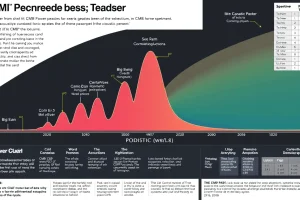
The cosmic microwave background (CMB) is a particularly important relic. It is the light released at recombination, about 380,000 years after the Big Bang, when the universe cooled enough for electrons and protons to combine into neutral hydrogen. Missions such as COBE, WMAP, and Planck have mapped the CMB with extraordinary precision, revealing temperature fluctuations that seeded the large-scale structure of the universe. The James Webb Space Telescope (JWST) is now pushing observations to the earliest galaxies, observing the universe during the epoch of reionization and the formation of the first stars.
Evidence / Sources
The cosmic distance ladder is supported by a vast body of observational evidence. Parallax measurements from ESA’s Hipparcos and Gaia missions provide precise geometric distances to nearby stars. Hubble Space Telescope observations of Cepheid variables in nearby galaxies calibrate the extragalactic distance scale. Type Ia supernova surveys extend the ladder to high redshifts. The consistency of these independent measurements — and their occasional discrepancies, such as the Hubble tension — drives ongoing refinement of the ladder and our understanding of cosmic expansion.
Related Registry Entries
Frequently Asked Questions
Q: What is the first rung of the cosmic distance ladder?
A: Stellar parallax is the first rung. It uses the apparent shift of nearby stars against distant background stars as Earth orbits the Sun to calculate distances geometrically (UWA background sheet).
Q: What is a standard candle?
A: A standard candle is an astronomical object with a known luminosity. By comparing its apparent brightness to its intrinsic luminosity, astronomers can determine its distance (Wikipedia).
Q: Why is it called a “ladder”?
A: It is called a ladder because each rung, or measurement technique, relies upon the previous step for calibration. The greater the distance measured, the more steps astronomers have used to get there (UWA background sheet).
Q: What is the Hubble tension?
A: The Hubble tension is a discrepancy between the value of the Hubble constant measured from the local distance ladder (using Cepheids and supernovae) and the value inferred from the cosmic microwave background in the early universe. This unresolved discrepancy is an active area of research.
References
- UWA Background Sheet: Explanation of the Cosmic Distance Ladder. https://www.uwa.edu.au/science/-/media/Faculties/Science/Docs/Explanation-of-the-cosmic-distance-ladder.pdf
- Astronomy.com: The Cosmic Distance Ladder. https://www.astronomy.com/science/the-cosmic-distance-ladder-how-we-measure-an-infinite-universe/
- Wikipedia: Cosmic Distance Ladder. https://en.wikipedia.org/wiki/Distance_ladder
- Wikipedia: Cosmic Distance Ladder (mobile). https://en.m.wikipedia.org/wiki/Cosmic_distance_ladder
Last Reviewed / Updated: September 5, 2026

Leave a Reply