Short Answer
Main Explanation
The Lambda-Cold Dark Matter (ΛCDM) model is the current standard model of Big Bang cosmology. It describes a universe that is homogeneous and isotropic on large scales, expanding according to general relativity, and composed of ordinary matter, cold dark matter, and a cosmological constant (Λ) associated with dark energy. With just six free parameters, it accounts for the cosmic microwave background, the large-scale structure of galaxies, the abundances of light elements, and the accelerated expansion of the universe.
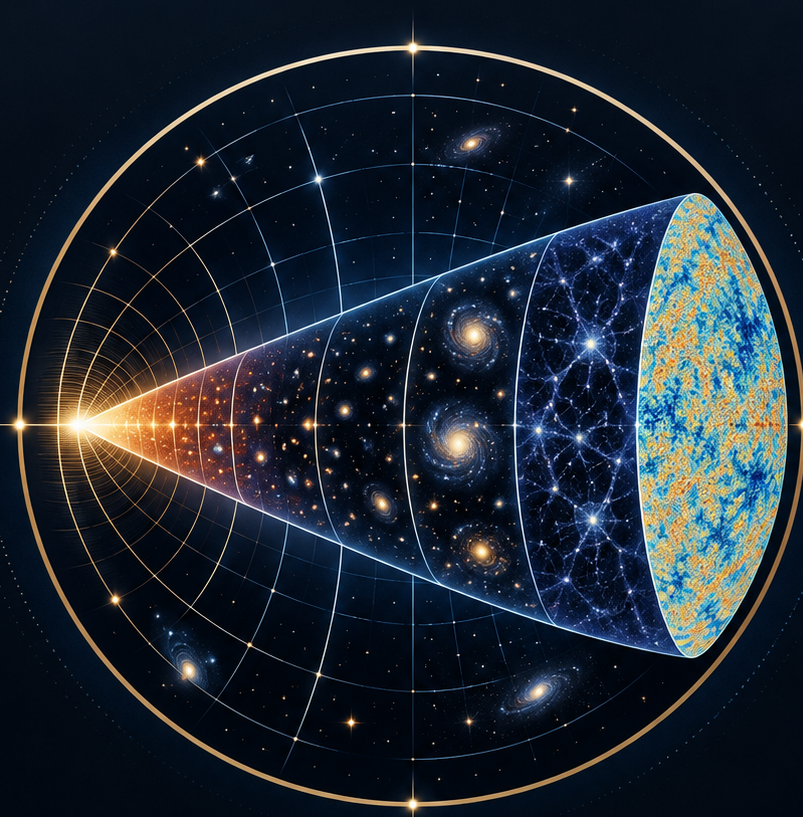
The model emerged in the late 1990s as a concordance cosmology, unifying previously disparate observations. It assumes the validity of the cosmological principle and general relativity on cosmological scales. The universe began in a hot, dense state—the Big Bang—followed by a period of exponential expansion known as inflation. Subsequently, the universe cooled, nucleosynthesis produced light elements, and the cosmic microwave background was released at recombination. Over billions of years, dark matter gravitationally gathered ordinary matter, leading to the formation of stars, galaxies, and large-scale structure.
The Cosmic Epochs
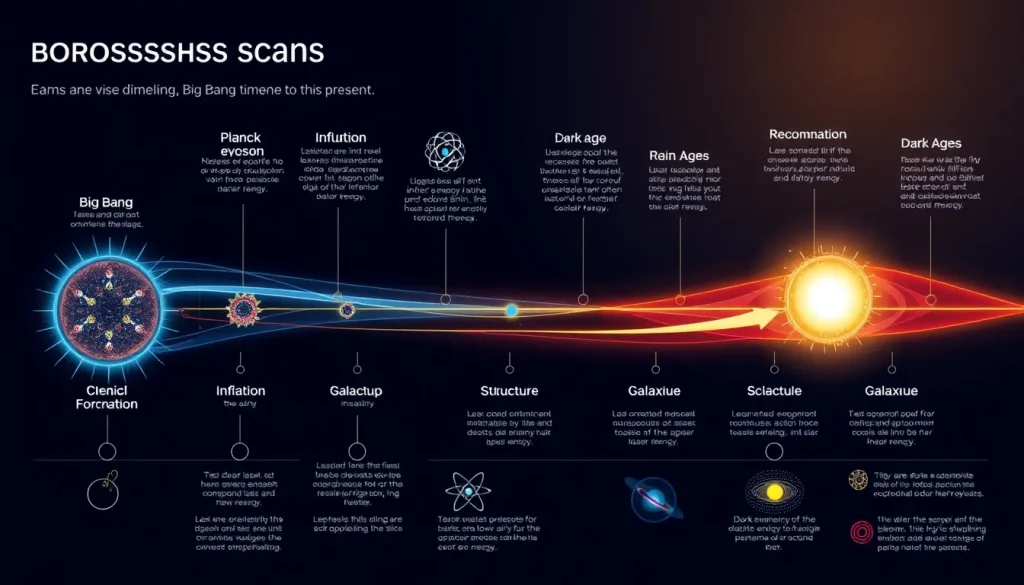
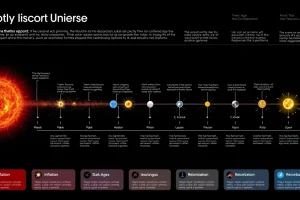
The history of the universe is divided into distinct epochs, each characterized by the dominant physical processes and particle content. The following table summarizes the major epochs from the Planck epoch to the present.
| Epoch | Time After Big Bang | Temperature | Redshift | Key Events |
|---|---|---|---|---|
| Planck epoch | 0 to 10^-43 s | >10^32 K | >10^32 | Quantum gravity effects dominate; no current theory. |
| Grand Unification epoch | 10^-43 to 10^-36 s | 10^32 to 10^28 K | 10^32 to 10^28 | Strong and electroweak forces unify; inflation begins. |
| Inflationary epoch | 10^-36 to 10^-32 s | ~10^28 K | ~10^28 | Exponential expansion; quantum fluctuations seeded structure. |
| Electroweak epoch | 10^-32 to 10^-12 s | 10^28 to 10^15 K | 10^28 to 10^15 | Electromagnetic and weak forces separate; particles acquire mass. |
| Quark epoch | 10^-12 to 10^-6 s | 10^15 to 10^12 K | 10^15 to 10^12 | Quarks and gluons form quark-gluon plasma. |
| Hadron epoch | 10^-6 to 1 s | 10^12 to 10^10 K | 10^12 to 10^10 | Quarks combine into hadrons; protons and neutrons form. |
| Lepton epoch | 1 to 10 s | 10^10 to 10^9 K | 10^10 to 10^9 | Leptons dominate; neutrinos decouple. |
| Photon epoch | 10 s to 380,000 yr | 10^9 to 3000 K | 10^9 to 1100 | Photons dominate; nucleosynthesis occurs; matter and radiation decouple. |
| Recombination | ~380,000 yr | ~3000 K | ~1100 | Electrons combine with nuclei to form neutral atoms; CMB released. |
| Dark Ages | 380,000 yr to ~150 million yr | 3000 to ~60 K | 1100 to ~20 | No luminous sources; universe is dark and neutral. |
| Reionization | ~150 million to ~1 billion yr | ~60 to ~20 K | 20 to 6 | First stars and galaxies ionize intergalactic medium. |
| Structure Formation | ~1 billion yr to present | ~20 K to 2.7 K | 6 to 0 | Galaxies, clusters, and large-scale structure form; dark energy accelerates expansion. |
From Planck to Inflation
The Planck epoch is the earliest period, lasting up to 10^-43 seconds after the Big Bang, when quantum gravitational effects were significant. Our current physics cannot describe this era. The Grand Unification epoch followed, during which the strong and electroweak forces were unified. At the end of this epoch, inflation began—a period of exponential expansion that stretched the universe from subatomic scales to macroscopic sizes, smoothing out initial irregularities and seeding the density fluctuations that later grew into galaxies.
Nucleosynthesis and the First Atoms
During the photon epoch, the universe was hot enough for nuclear reactions. Big Bang nucleosynthesis produced light elements such as hydrogen, helium, and lithium, matching observed abundances. As the universe cooled to about 3000 K, electrons combined with protons and helium nuclei to form neutral atoms—a process called recombination. This released the cosmic microwave background (CMB), a relic radiation that we observe today with a temperature of 2.7 K. The CMB provides a snapshot of the universe at 380,000 years old.
Dark Ages and Reionization
After recombination, the universe entered the Dark Ages—a period with no luminous sources. Gravity slowly amplified the tiny density fluctuations left by inflation. Around 150 million years later, the first stars and galaxies formed, emitting ultraviolet radiation that reionized the neutral hydrogen. This epoch of reionization marks the end of the Dark Ages and the beginning of structure formation.
Structure Formation and Dark Energy
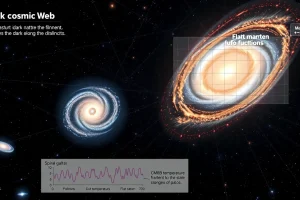
Over billions of years, dark matter’s gravitational pull gathered ordinary matter into filaments, clusters, and galaxies. The large-scale structure we observe today—sheets, voids, and clusters—matches ΛCDM predictions. In the late 1990s, observations of distant supernovae revealed that the expansion of the universe is accelerating, attributed to dark energy, represented by the cosmological constant Λ. This acceleration dominates the universe’s recent evolution.
Why It Matters
ΛCDM is the foundation of modern cosmology. It provides a quantitative framework that connects the earliest moments of the universe to the present day. Its predictions have been confirmed by missions such as COBE, WMAP, and Planck, which measured the CMB with extraordinary precision. The model also guides research into dark matter and dark energy, which together constitute about 95% of the universe’s energy density. Understanding ΛCDM is essential for interpreting observations from telescopes like JWST and for addressing open questions such as the Hubble tension.
Evidence / Sources
The ΛCDM model is supported by multiple independent observations:
- Cosmic Microwave Background: The CMB’s temperature anisotropies, measured by COBE, WMAP, and Planck, match ΛCDM predictions with remarkable accuracy.
- Large-Scale Structure: The distribution of galaxies and baryon acoustic oscillations (BAO) align with the model’s predictions.
- Light Element Abundances: Big Bang nucleosynthesis predictions for hydrogen, helium, and lithium match observed primordial abundances.
- Accelerating Expansion: Distant supernovae reveal an accelerating expansion, consistent with a cosmological constant.
For further reading, see the references below.
Related Registry Entries
Explore related topics in the cosmology registry:
Last reviewed: September 4, 2026
FAQ
What is ΛCDM?
ΛCDM is the standard model of cosmology, describing a universe with a cosmological constant (Λ), cold dark matter, and ordinary matter. It successfully explains the CMB, large-scale structure, light element abundances, and accelerated expansion.
What are the main epochs of the universe?
The main epochs include the Planck epoch, Grand Unification epoch, Inflationary epoch, Electroweak epoch, Quark epoch, Hadron epoch, Lepton epoch, Photon epoch, Recombination, Dark Ages, Reionization, and Structure Formation.
What evidence supports ΛCDM?
Key evidence includes the cosmic microwave background anisotropies, baryon acoustic oscillations, primordial light element abundances, and the accelerating expansion observed via distant supernovae.

Leave a Reply