
Short Answer
Main Explanation
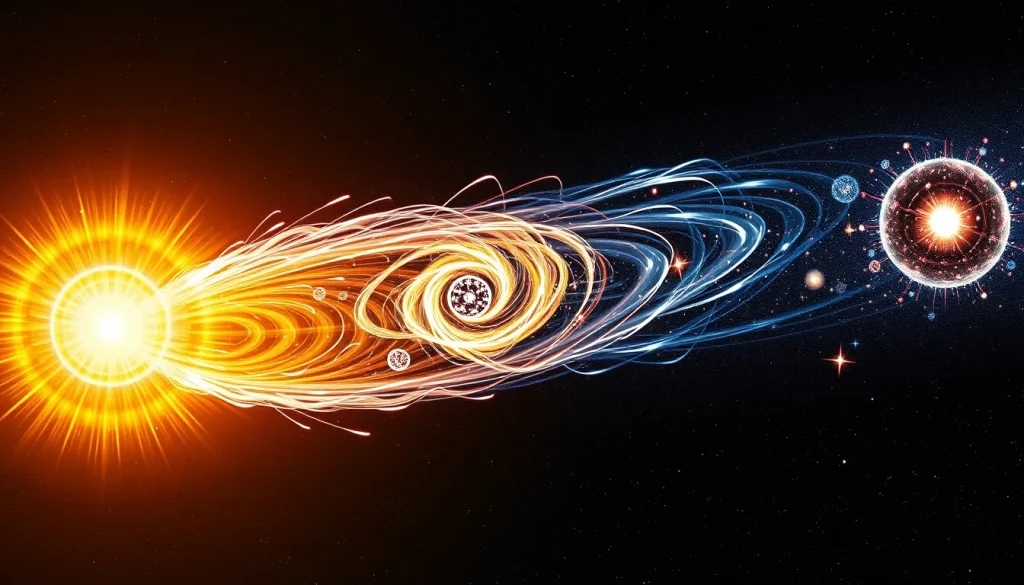
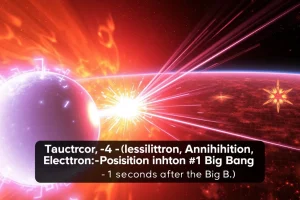
The universe began in a state of extreme heat and density, and the laws of physics as we know them were progressively established as it expanded and cooled. Among the most profound mysteries is why matter survived at all. If the Big Bang had produced equal amounts of matter and antimatter, they would have annihilated completely, leaving a universe filled only with radiation. Instead, a tiny surplus of matter—about one part in a billion—remained, and that surplus forms everything we see today: stars, galaxies, planets, and ourselves.
This surplus is called the baryon asymmetry or matter–antimatter asymmetry. The process that generated it is baryogenesis. The observed ratio of baryons to photons is approximately 6×10⁻¹⁰, meaning that for every billion photons, there is one baryon. Neither the Standard Model of particle physics nor general relativity explains why this asymmetry exists, so cosmologists invoke physics beyond the Standard Model—often tied to grand unified theories or supersymmetry.
The Sakharov Conditions
In 1967, Andrei Sakharov identified three necessary conditions for any interaction to generate baryon asymmetry:
- Baryon number violation: The process must create more baryons than antibaryons.
- C and CP violation: The laws of physics must treat particles and antiparticles differently, and also distinguish left from right, to allow a net baryon number to develop.
- Departure from thermal equilibrium: The reactions must occur out of equilibrium, otherwise the reverse process would erase any asymmetry.
The Standard Model contains processes that violate baryon number (via sphalerons) and does exhibit CP violation, but the amount is far too small to explain the observed asymmetry. Moreover, the electroweak phase transition in the Standard Model is not strongly first-order, so the required out-of-equilibrium conditions are not met. Thus, new physics is required.
Cosmic Epochs and the Timeline
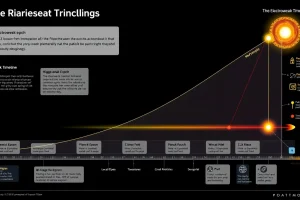
The universe’s evolution is divided into distinct epochs, each characterized by the dominant particles and forces. Baryogenesis likely occurred during or shortly after the electroweak epoch, when the fundamental forces took their present forms. Below is a table of the major epochs from the Planck epoch to the present.
| Epoch | Time after Big Bang | Temperature | Key Events |
|---|---|---|---|
| Planck epoch | 0 to ~10⁻⁴³ s | >10³² K | Quantum gravity dominates; no current theory |
| Grand Unification epoch | 10⁻⁴³ to 10⁻³⁶ s | 10³² to 10²⁷ K | Strong and electroweak forces unified; possible baryogenesis |
| Inflationary epoch | 10⁻³⁶ to 10⁻³² s | Dropping rapidly | Exponential expansion; seeds for structure |
| Electroweak epoch | 10⁻³² to 10⁻¹² s | 10²⁷ to 10¹⁵ K | Electromagnetic and weak forces separate; sphaleron processes |
| Quark epoch | 10⁻¹² to 10⁻⁶ s | 10¹⁵ to 10¹² K | Quarks and gluons in quark-gluon plasma |
| Hadron epoch | 10⁻⁶ to 1 s | 10¹² to 10¹⁰ K | Protons and neutrons form; baryon asymmetry locked in |
| Lepton epoch | 1 to 10 s | 10¹⁰ to 10⁹ K | Leptons and antileptons dominate; neutrinos decouple |
| Photon epoch | 10 s to ~380,000 yr | 10⁹ to 3000 K | Photons dominate; nucleosynthesis forms light elements |
| Recombination | ~380,000 yr | ~3000 K | Electrons combine with nuclei; photons decouple → CMB |
| Dark Ages | ~380,000 to ~150 million yr | 3000 to ~60 K | No stars yet; hydrogen gas fills space |
| Reionization | ~150 million to ~1 billion yr | ~60 to ~20 K | First stars and galaxies ionize hydrogen |
| Structure Formation | ~1 billion yr to present | ~20 K to 2.7 K | Galaxies, clusters, and large-scale structure form |
How Baryogenesis Fits into This Timeline
Baryogenesis must occur before the hadron epoch, because after that point the baryon number is essentially fixed. The most studied scenarios are:
- Electroweak baryogenesis: Occurs during the electroweak phase transition, using sphaleron processes. Requires new physics to make the transition strongly first-order.
- GUT baryogenesis: Occurs during the Grand Unification epoch, when X and Y bosons decay with CP violation.
- Leptogenesis: A neutrino-related process that generates a lepton asymmetry, which is then converted to baryon asymmetry via sphalerons.
None of these has been confirmed. The Large Hadron Collider has not found evidence for supersymmetry or other beyond-Standard-Model physics that would enable these mechanisms, so the mystery remains open.
Why It Matters
Baryogenesis is not just an obscure detail of early-universe physics—it is the reason we exist. Without the tiny excess of matter over antimatter, the universe would contain only radiation, and no atoms, stars, or life would ever have formed. Understanding baryogenesis is also a window into physics at energy scales far beyond what we can probe directly in accelerators. It connects cosmology with particle physics and may reveal new symmetries or particles that shape the universe at its most fundamental level.
Evidence / Sources
Direct evidence for the baryon asymmetry comes from primordial nucleosynthesis (the abundances of light elements) and the cosmic microwave background (CMB) anisotropies, which together pin down the baryon density. The CMB, first detected by COBE and mapped precisely by WMAP and Planck, provides the most accurate measurement of the baryon-to-photon ratio. The absence of annihilation radiation from matter–antimatter boundaries at large scales also supports a matter-dominated universe. However, no experiment has yet observed the specific baryon-number-violating processes required by baryogenesis.
Related Registry Entries
- Cosmic Microwave Background
- Big Bang Nucleosynthesis
- Inflation
- Lambda-CDM Model
FAQ
What is baryogenesis?
Baryogenesis is the hypothetical process that created the observed imbalance between matter and antimatter in the early universe, producing a tiny excess of baryons over antibaryons.
Why is there more matter than antimatter?
The exact reason is unknown. Baryogenesis requires new physics beyond the Standard Model, such as CP violation and baryon number violation, to generate the asymmetry.
How do we know the universe is matter-dominated?
We observe that cosmic rays are overwhelmingly matter, no gamma-ray emission from matter-antimatter annihilation is seen at cluster scales, and primordial nucleosynthesis and the CMB require a baryon excess.
Leave a Reply