
Short Answer
Main Explanation
CMB lensing is the gravitational deflection of cosmic microwave background photons by the large-scale distribution of matter between the last-scattering surface and today. Just as a glass lens bends light, massive structures such as galaxy clusters and dark matter halos subtly remap the pattern of CMB temperature and polarization anisotropies. This effect, predicted by general relativity and measured with high significance by Planck, turns the CMB into a backlight for the universe’s dark matter.
When the CMB was released at recombination about 380,000 years after the Big Bang, photons began traveling freely. Along the way, they passed through the evolving web of dark matter and baryons. The gravitational potential of that web deflects the photon paths by a small angle, typically a few arcminutes. The deflection is described by the gradient of a lensing potential, which is a weighted projection of the matter density along the line of sight.
How CMB Lensing Works
The key quantity is the lensing potential ψ(n̂), where n̂ is a direction on the sky. The deflection angle is α = ∇ψ. The lensing potential is related to the gravitational potential Φ by an integral over comoving distance χ:
ψ(n̂) = -2 ∫ dχ (χs – χ)/(χs χ) Φ(χ n̂, η0 – χ)
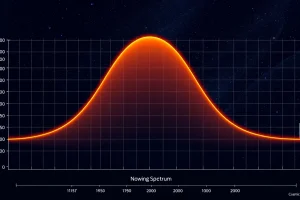
Here χs is the distance to the last-scattering surface. Because dark matter dominates the matter density, the lensing potential is effectively a map of the projected dark matter distribution. Lensing remaps the observed temperature: Tlensed(n̂) = Tunlensed(n̂ + α). This remapping smooths the acoustic peaks, transfers power from large to small angular scales, and converts some E-mode polarization into B-mode polarization.
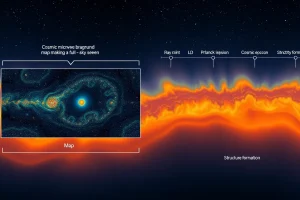
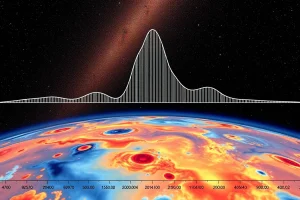
Observations cannot see the unlensed CMB directly, but the statistical signature of lensing can be reconstructed by using the fact that lensing couples previously independent Fourier modes of the CMB. The Planck 2015 data produced an all-sky map of the lensing potential, shown by the Kavli Institute for Cosmology, revealing the integrated dark matter distribution across the sky.
What CMB Lensing Reveals About Dark Matter
Because photons are deflected by all matter, not just luminous matter, CMB lensing is a direct probe of the total matter distribution, including dark matter. The reconstructed lensing potential map traces dark matter halos, filaments, and voids. High-resolution CMB lensing measurements, such as those discussed by Nguyễn, Sehgal, and Madhavacheril in Physical Review D, can measure the small-scale matter power spectrum, which is sensitive to the nature of dark matter, the sum of neutrino masses, and the growth of cosmic structure.
CMB lensing also helps break degeneracies in cosmological parameter estimation. For example, it constrains the amplitude of matter fluctuations (σ8) and the matter density Ωm, independently of galaxy surveys. Because lensing is sensitive to the gravitational potential, it provides a clean test of general relativity on cosmological scales.
Observable Consequences
- Changes in CMB power spectra: Lensing smooths the acoustic peaks and adds power to the damping tail.
- Non-Gaussianity: Lensing introduces a characteristic four-point function that can be used for reconstruction.
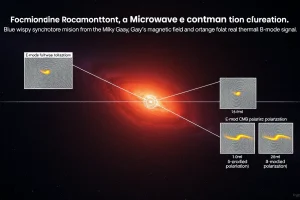
- B-mode polarization: Lensing converts E-modes into B-modes, creating a signal that must be subtracted to search for primordial gravitational waves from inflation.
- Cluster mass reconstruction: Lensing can be used to estimate masses of galaxy clusters and calibrate scaling relations.
Common Misconceptions
- CMB lensing is not a direct image of dark matter. It is a statistical reconstruction of the projected gravitational potential; individual dark matter clumps are not resolved except in the most massive clusters.
- Lensing B-modes are not primordial B-modes. The lensing B-mode signal is a foreground for inflationary gravitational waves and must be carefully modeled or ‘delensed.’
- The effect is not large. Deflections are typically a few arcminutes, and the lensing signal is a small correction to the CMB power spectra, though it is now detected at very high significance.
Cosmic Context: From Recombination to Structure Formation
CMB lensing is sensitive to the entire matter distribution between the last-scattering surface and today. The relevant cosmic epochs include:
| Epoch | Approximate Time / Redshift | Key Physics |
|---|---|---|
| Recombination | ~380,000 years; z ≈ 1100 | Hydrogen forms; CMB released |
| Dark Ages | z ≈ 1100 to 20 | Neutral hydrogen; no stars |
| Reionization | z ≈ 20 to 6 | First stars and galaxies ionize gas |
| Structure Formation | z < 6 to today | Dark matter halos, galaxies, clusters grow |
The lensing signal accumulates over all these epochs, with the largest contribution coming from structures at intermediate redshifts where the lensing kernel peaks.
Why It Matters
CMB lensing connects the pristine early universe to the late-time universe. It provides a map of dark matter that is independent of assumptions about galaxy formation or baryonic physics. It sharpens constraints on dark energy, neutrino mass, and the growth of structure. It is also essential for future CMB experiments aiming to detect primordial B-modes, because the lensing B-mode signal must be removed. Upcoming high-resolution surveys, including ACT, Simons Observatory, and CMB-S4, will use CMB lensing to measure the matter power spectrum with unprecedented precision.
Evidence / Sources
The lensing signal was first detected in cross-correlation with galaxy surveys and later directly in CMB data. The Planck satellite’s 2015 data release produced a full-sky lensing potential map. Key references include:
- Kavli Institute for Cosmology, Cambridge: CMB lensing
- Lewis & Challinor, ‘Weak Gravitational Lensing of the CMB’ (2006)
- Physics Reports 429, 1 (2006)
- Nguyễn, Sehgal, Madhavacheril, Phys. Rev. D 99, 023502 (2019)
Related Registry Entries
FAQ
What is CMB lensing?
CMB lensing is the gravitational bending of cosmic microwave background photons by the large-scale distribution of matter, including dark matter, between the last-scattering surface and Earth. It subtly remaps the CMB temperature and polarization anisotropies.
How does CMB lensing reveal dark matter?
Because dark matter dominates the total matter density, the reconstructed lensing potential is effectively a map of the projected dark matter distribution. It traces halos, filaments, and voids without relying on light from galaxies.
Which missions have measured CMB lensing?
The Planck satellite produced a high-significance all-sky lensing map from its 2015 data. Ground-based experiments like ACT and the South Pole Telescope have also detected lensing, and future surveys such as Simons Observatory and CMB-S4 will improve precision.
Why is CMB lensing important for cosmology?
It provides an independent probe of dark matter and the growth of structure, helps break parameter degeneracies, constrains neutrino masses, and must be modeled to detect primordial gravitational waves from inflation.
Leave a Reply