
Short Answer
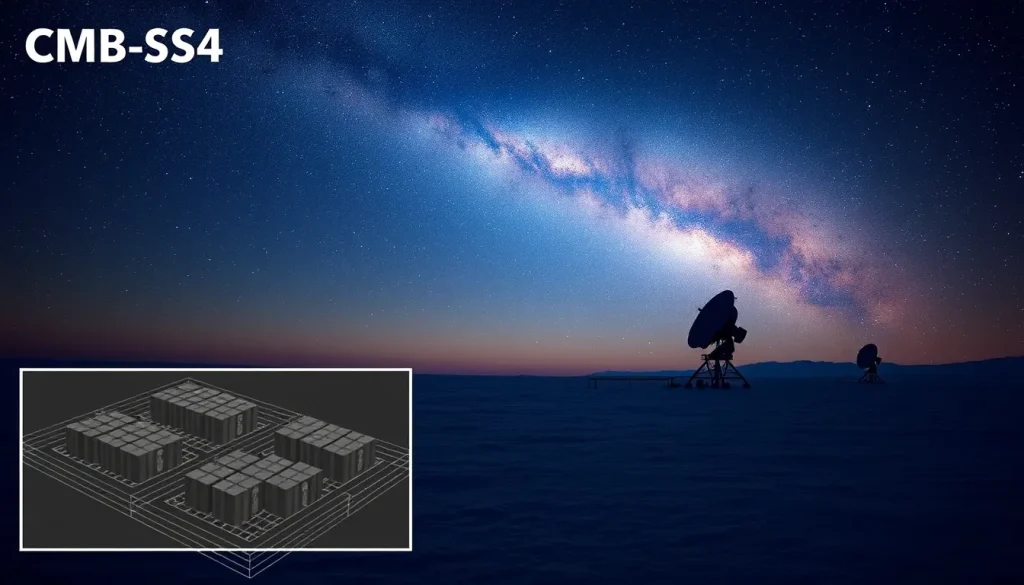
CMB-S4 (the Stage-4 Cosmic Microwave Background Experiment) was a planned next-generation ground-based observatory designed to map the cosmic microwave background with unprecedented sensitivity. Jointly funded by the U.S. Department of Energy and the National Science Foundation, the project aimed to deploy over 500,000 superconducting detectors across telescopes at the South Pole and the Chilean Atacama plateau to test cosmic inflation, measure neutrino masses, and probe new physics. In July 2025, the funding agencies announced they could no longer support the project, and CMB-S4 entered an orderly shutdown.
| Property | Detail |
|---|---|
| Type | Ground-based CMB experiment (planned) |
| Status | Cancelled (July 2025) |
| Sites | South Pole; Atacama Desert, Chile |
| Telescopes | Small-aperture (0.55 m); large-aperture (6 m) |
| Detectors | >500,000 superconducting detectors |
| Funding | DOE Office of Science; NSF |
| Science Book | arXiv:1610.02743 (2016) |
Main Explanation
The cosmic microwave background (CMB) is the oldest light in the universe — a faint glow of microwave radiation that has been traveling through space for nearly 13.8 billion years. It is the afterglow of the Big Bang, released when the universe cooled enough for protons and electrons to combine into neutral hydrogen atoms, allowing photons to stream freely for the first time. This moment, called recombination, occurred roughly 380,000 years after the Big Bang at a temperature of about 3,000 K. As space expanded, those photons were stretched, or redshifted, to microwave wavelengths, and today they appear as a nearly uniform glow at just 2.725 K.
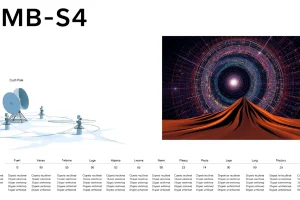
CMB-S4 was designed to be the ultimate ground-based probe of this relic radiation. Building on the legacy of NASA’s COBE and WMAP missions and the European Space Agency’s Planck satellite, CMB-S4 would have pushed sensitivity far beyond anything previously achieved, with over 500,000 superconducting detectors spread across dedicated telescopes at two of the driest, highest-altitude observatory sites on Earth: the South Pole and the Atacama plateau in Chile.
The Cosmic Epochs
To understand what CMB-S4 would have studied, it helps to trace the universe through its major epochs. The standard cosmological model — Lambda-CDM — describes a universe that began in a hot, dense state and has been expanding and cooling ever since.
| Epoch | Time After Big Bang | Temperature | Key Events |
|---|---|---|---|
| Planck epoch | 0 to 10⁻⁴³ s | >10³² K | Quantum gravity era; all four forces unified |
| Grand Unification epoch | 10⁻⁴³ to 10⁻³⁶ s | 10²⁷–10³² K | Strong force separates from electroweak force |
| Inflationary epoch | 10⁻³⁶ to 10⁻³² s | ~10²⁷ K | Exponential expansion; seeds of structure formed |
| Electroweak epoch | 10⁻³² to 10⁻¹² s | 10¹⁵–10²⁷ K | Electromagnetic and weak forces separate |
| Quark epoch | 10⁻¹² to 10⁻⁶ s | 10¹²–10¹⁵ K | Quarks and gluons form quark-gluon plasma |
| Hadron epoch | 10⁻⁶ to 1 s | 10¹⁰–10¹² K | Protons and neutrons form |
| Lepton epoch | 1 to 10 s | 10⁹–10¹⁰ K | Leptons dominate; neutrinos decouple |
| Photon epoch | 10 s to 380,000 yr | 3,000–10⁹ K | Photons dominate; Big Bang nucleosynthesis forms light elements |
| Recombination | ~380,000 yr | ~3,000 K | Atoms form; CMB released |
| Dark Ages | 380,000 to ~150 million yr | ~60 K (and falling) | No stars yet; universe dark and neutral |
| Reionization | ~150 million to ~1 billion yr | ~20–60 K | First stars and galaxies ionize hydrogen |
| Structure Formation | ~1 billion yr to present | 2.725 K (today) | Galaxies, clusters, and large-scale structure form |
Inflation and the Seeds of Structure
One of CMB-S4’s primary science goals was to test cosmic inflation — the theory that the universe underwent a brief period of exponential expansion in the first fraction of a second after the Big Bang. Inflation explains why the universe appears so remarkably uniform on large scales and why it is so flat. It also predicts that quantum fluctuations stretched to macroscopic scales seeded the density variations that later grew into galaxies and galaxy clusters.
Inflation makes a specific, testable prediction: it should have generated a faint pattern of polarization in the CMB called primordial B-modes — a curl-like pattern in the polarization of the microwave background. Detecting these B-modes would be a smoking gun for inflation. CMB-S4 was designed with the sensitivity to detect or rule out B-modes from a wide range of inflationary models, a measurement no current experiment can make.
From the First Atoms to the First Stars
After recombination, the universe entered the Dark Ages — a period with no sources of light. The neutral hydrogen gas slowly clumped under gravity, and eventually, around 150 million years after the Big Bang, the first stars ignited. These first stars were massive, hot, and short-lived. Their ultraviolet radiation began to reionize the neutral hydrogen, a process called reionization that completed roughly a billion years after the Big Bang. The James Webb Space Telescope (JWST) has recently begun to observe this cosmic dawn, revealing galaxies that existed just a few hundred million years after the Big Bang.
Mission Facts
Launch and Deployment
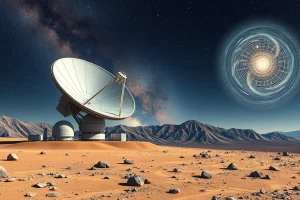
CMB-S4 was not a space mission; it was planned as a ground-based observatory. The project intended to deploy telescopes at the South Pole and the Chilean Atacama plateau — two of the driest and highest observatory sites on Earth, where atmospheric water vapor minimally interferes with microwave observations.
Telescope and Instrument
The CMB-S4 instrument concept included small-aperture (0.55-meter) telescopes for deep, targeted observations of the CMB polarization and large-aperture (6-meter) telescopes for wide-area surveys. Together, they would have hosted more than 500,000 superconducting transition-edge sensor (TES) bolometers, a leap of roughly an order of magnitude over previous experiments.
Wavelength
CMB-S4 would have observed in the millimeter and submillimeter wavelength range, roughly 1 to 10 mm, across multiple frequency bands to separate the CMB from foreground emission from our own galaxy and from extragalactic sources.
Objective
The central objectives were to test inflation by searching for primordial B-modes, determine the number and masses of neutrinos, constrain new light relic particles, provide precise constraints on dark energy, and test general relativity on cosmological scales.
Major Results
As of July 2025, CMB-S4 had not yet begun collecting data. The project completed design studies, a Science Book (arXiv:1610.02743), and extensive technical development. On July 9, 2025, the DOE and NSF jointly announced they could no longer support the project. The project proceeded with an orderly shutdown, documenting technical advances, survey simulations, and instrumentation designs, and preserving its document archive.
Legacy
Even though CMB-S4 will not be built as planned, its legacy lives on in the technical advances, detector designs, and survey simulations it produced. The scientific questions it was designed to answer — the nature of inflation, the neutrino mass scale, and new light relics — remain central to cosmology and will be addressed by successor experiments and the broader CMB community.
Why It Matters
The cosmic microwave background is the most direct observational window we have into the early universe. It carries the imprint of quantum fluctuations from inflation, the signature of the first atoms, and the gravitational influence of dark matter. CMB-S4 represented the next step in reading that imprint. Its cancellation does not diminish the importance of the questions it was built to answer. Those questions remain open, and the tools and techniques developed by the CMB-S4 project will inform the next generation of experiments.
Understanding the CMB is understanding the origin of everything — the expansion of space, the formation of the first elements, the birth of the first stars, and the large-scale structure of the universe we inhabit today.
Evidence / Sources
The scientific case for CMB-S4 is documented in the CMB-S4 Science Book (arXiv:1610.02743), published in October 2016 by the global CMB-S4 community. Project status and technical details are archived in the NSF Public Access Repository (PAR) and in the SPIE conference proceedings. The official CMB-S4 website (cmb-s4.org) preserves the project’s document archive and the July 2025 statement from DOE and NSF.
Related Registry Entries
- Cosmic Microwave Background
- Inflation
- Recombination
- Planck Mission
- WMAP Mission
- COBE Mission
- Dark Ages
- Reionization
- First Stars & Galaxies
FAQ
What was CMB-S4?
CMB-S4 was a planned next-generation ground-based cosmic microwave background experiment with over 500,000 superconducting detectors on telescopes at the South Pole and in Chile. It was designed to test inflation, measure neutrino masses, and probe new physics.
Why was CMB-S4 cancelled?
On July 9, 2025, the U.S. Department of Energy and the National Science Foundation jointly announced that they could no longer support the CMB-S4 Project. The project then proceeded with an orderly shutdown.
What did CMB-S4 plan to measure?
CMB-S4 planned to measure the polarization of the cosmic microwave background with unprecedented precision, searching for primordial B-modes from inflation, and to measure the CMB's temperature and polarization fluctuations to constrain neutrino masses, dark energy, and new light relics.
How did CMB-S4 relate to COBE, WMAP, and Planck?
COBE, WMAP, and Planck were space-based missions that successively mapped the CMB with increasing precision. CMB-S4 was designed as a ground-based successor with far greater sensitivity and resolution, capable of measuring the faint polarization signals that space missions could not fully resolve.
References
- CMB-S4 Science Book, First Edition. arXiv:1610.02743 (2016)
- CMB-S4 Project website. https://cmb-s4.org/
- Leitner et al., 'Project Overview of the Stage-4 CMB Experiment (CMB-S4),' NSF PAR
- Bender et al., 'The CMB-S4 experiment: Project overview and status,' Proc. SPIE 11453 (2020)
Related Articles
Leave a Reply