Short Answer
Main Explanation
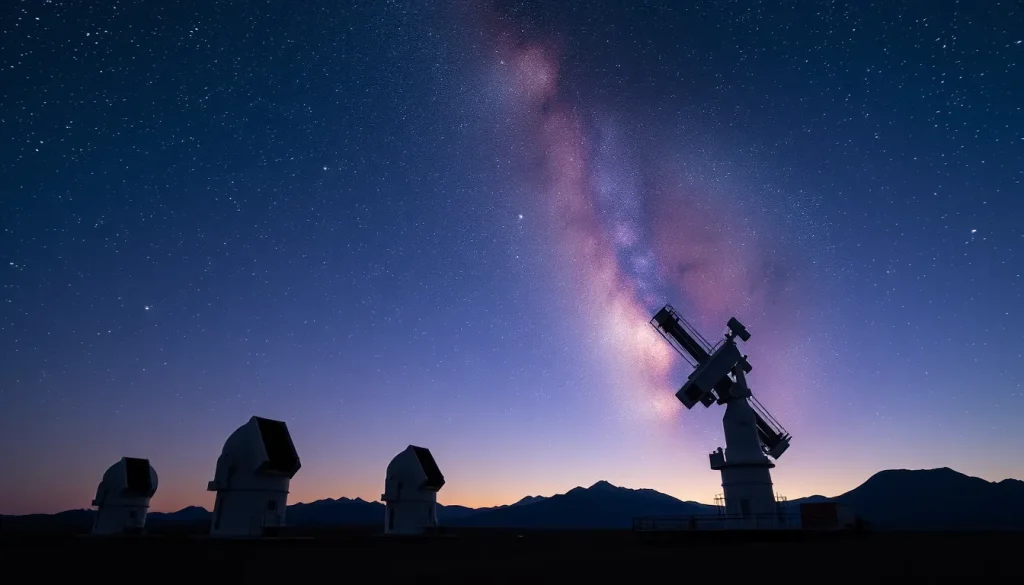
The Simons Observatory (SO) is a next-generation cosmic microwave background (CMB) experiment located at an elevation of 5,190 meters (17,000 feet) on Cerro Toco in the Atacama Desert of Northern Chile, near the town of San Pedro de Atacama. It is an experimental cosmology facility designed to provide scientists with an unprecedented platform to study the fundamental physical processes that governed the origin and evolution of the universe via high-precision measurements of the temperature and polarization of the CMB—the oldest light in the universe. The observatory currently consists of three 0.5-meter diameter Small Aperture Telescopes (SATs) and one six-meter diameter Large Aperture Telescope (LAT), with plans to add two more SATs through the SO:UK project and a sixth SAT through SO:JP collaboration. The Simons Observatory builds on decades of support from the National Science Foundation and is funded by the Simons Foundation and the Heising-Simons Foundation, with a combined $40.1 million grant from the Simons Foundation and participating universities.
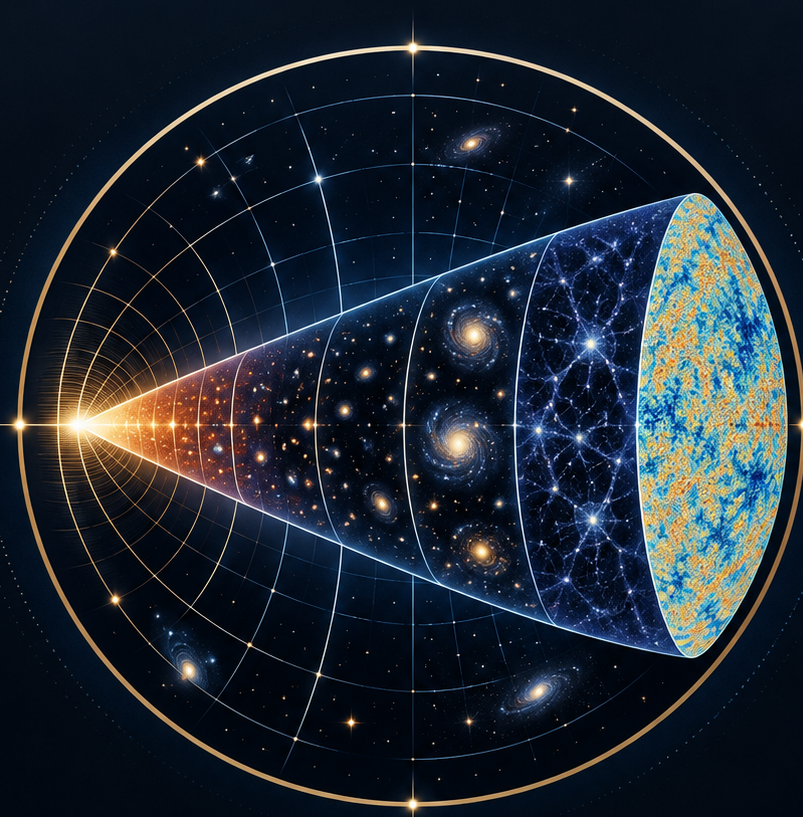
The CMB is a relic radiation field that permeates the entire universe, a faint glow left over from the hot, dense state that existed just after the Big Bang. As the universe expanded and cooled, protons and electrons combined to form neutral hydrogen for the first time about 380,000 years after the Big Bang, allowing photons to travel freely. These photons have been redshifted by the expansion of space and now appear as microwaves with a nearly perfect blackbody spectrum at a temperature of about 2.7 K. Tiny fluctuations in the temperature and polarization of the CMB encode information about the density perturbations that seeded the formation of galaxies and large-scale structure, as well as about the physics of the very early universe, including cosmic inflation.
The Cosmic Microwave Background as a Relic
The CMB is a direct snapshot of the universe at the epoch of recombination, when the universe became transparent. By measuring its temperature and polarization anisotropies, cosmologists can infer the composition of the universe (baryonic matter, dark matter, dark energy), the geometry of space, and the initial conditions that led to the large-scale structure we observe today. The Simons Observatory aims to make these measurements with unprecedented sensitivity and resolution, covering between 10% and 40% of the sky at multiple frequencies. This will allow scientists to tackle questions about the primordial universe, neutrino physics, dark energy, and galaxy evolution, as well as the nature of cosmic dust in our Milky Way.
Cosmic Epochs Timeline
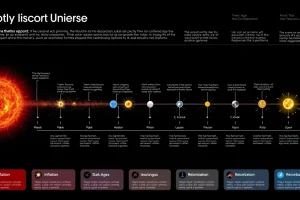
The history of the universe is divided into distinct epochs, each characterized by different physical processes and dominant particles. The Simons Observatory is designed to probe several of these epochs, particularly through its measurements of the CMB and its polarization, which can reveal the imprint of gravitational waves from inflation. The table below summarizes the major epochs from the Planck epoch to the present day, with approximate times, temperatures, and redshifts.
| Epoch | Time After Big Bang | Temperature | Approx. Redshift | Key Events |
|---|---|---|---|---|
| Planck epoch | < 10⁻⁴³ s | > 10³² K | — | Quantum gravity effects dominate; all forces unified. |
| Grand Unification epoch | 10⁻⁴³ – 10⁻³⁶ s | 10²⁷ – 10³² K | — | Strong force separates from electroweak force. |
| Inflationary epoch | 10⁻³⁶ – 10⁻³² s | ~10²⁷ K | — | Exponential expansion; quantum fluctuations stretched to cosmic scales. |
| Electroweak epoch | 10⁻³² – 10⁻¹² s | 10¹⁵ – 10²⁷ K | — | Electromagnetic and weak forces separate; W and Z bosons acquire mass. |
| Quark epoch | 10⁻¹² – 10⁻⁶ s | 10¹² – 10¹⁵ K | — | Quarks and gluons form a quark-gluon plasma. |
| Hadron epoch | 10⁻⁶ – 1 s | 10¹⁰ – 10¹² K | — | Quarks combine to form protons and neutrons; matter-antimatter annihilation. |
| Lepton epoch | 1 – 10 s | 10⁹ – 10¹⁰ K | — | Leptons dominate; neutrinos decouple. |
| Photon epoch | 10 s – 380,000 yr | 3,000 – 10⁹ K | ~3,000 | Photons dominate; Big Bang nucleosynthesis forms light elements. |
| Recombination | ~380,000 yr | ~3,000 K | ~1,100 | Electrons combine with protons to form neutral hydrogen; universe becomes transparent; CMB released. |
| Dark Ages | 380,000 – 150 million yr | ~10 – 3,000 K | ~20 – 1,100 | No stars yet; neutral hydrogen fills the universe. |
| Reionization | 150 million – 1 billion yr | ~10 – 30 K | ~6 – 20 | First stars and galaxies ionize neutral hydrogen. |
| Structure Formation | 1 billion yr – present | ~2.7 K | 0 – 6 | Galaxies, clusters, and large-scale structure form; dark energy accelerates expansion. |
The Simons Observatory is particularly sensitive to the inflationary epoch through its search for primordial gravitational waves, which would imprint a specific polarization pattern (B-modes) on the CMB. It also probes the recombination epoch through precise measurements of the CMB temperature and polarization anisotropies, and the later epochs through its sensitivity to the Sunyaev-Zel’dovich effect and gravitational lensing.
How the Simons Observatory Investigates the Universe
The observatory uses a combination of small and large aperture telescopes. The three SATs are optimized to observe large patches of sky at multiple frequencies to search for the faint B-mode polarization signal from inflation, while the LAT is designed to make high-resolution maps of the CMB temperature and polarization to measure acoustic peaks, gravitational lensing, and the distribution of galaxy clusters. The instruments are equipped with highly sensitive superconducting detectors (transition-edge sensors) that operate at temperatures near absolute zero, enabling them to detect the tiny variations in the CMB.
Mission
Mission Facts
- Location: Cerro Toco, Atacama Desert, Chile, at 5,190 m (17,000 ft) elevation.
- Current instruments: 3 Small Aperture Telescopes (0.5 m) and 1 Large Aperture Telescope (6 m).
- Future additions: Two more SATs (SO:UK) and one SAT (SO:JP).
- Science goals: Measure CMB polarization (B-modes), temperature anisotropies, gravitational lensing, and galaxy clusters.
- Collaboration: ~200 scientists from over 40 institutions worldwide.
Launch
The Simons Observatory is a ground-based observatory, not a space mission. Construction began in the late 2010s, with first light achieved in 2020. The observatory is fully operational and currently collecting data.
Telescope/Instrument
The observatory consists of three SATs and one LAT. The SATs are designed for large-area surveys with moderate resolution, while the LAT provides high-resolution observations of smaller regions. All telescopes are equipped with multichroic arrays of superconducting detectors covering multiple frequency bands (e.g., 27–240 GHz) to separate CMB signals from foreground emission such as galactic dust and synchrotron radiation.
Wavelength
The instruments observe in the millimeter and submillimeter wavelength range, corresponding to frequencies from about 27 to 240 GHz. This range is essential for measuring the CMB peak and separating foregrounds.
Objective
The primary objectives of the Simons Observatory are to: (1) search for the B-mode polarization signature of primordial gravitational waves from inflation, (2) measure the sum of neutrino masses, (3) constrain the number of relativistic species, (4) probe dark energy through measurements of galaxy clusters and the integrated Sachs-Wolfe effect, and (5) study the reionization epoch and the first stars and galaxies.
Major Results
As of the latest available data, the Simons Observatory has produced initial maps and measurements of the CMB temperature and polarization, contributing to constraints on cosmological parameters. The collaboration has released data products that are used by the wider cosmology community, though the most anticipated results—particularly on B-modes—are expected in the coming years.
Dataset
The observatory produces high-resolution maps of the CMB at multiple frequencies, as well as catalogs of galaxy clusters detected via the Sunyaev-Zel’dovich effect. Data products are made public through the Simons Observatory data release policy.
Legacy
The Simons Observatory is a pathfinder for the future CMB-S4 experiment, testing technologies and observational strategies that will be used in the next generation of ground-based CMB experiments. Its measurements will complement space missions like Planck and JWST, providing a more complete picture of the early universe.
Why It Matters
The Simons Observatory represents a major step forward in our ability to probe the earliest moments of the universe. By measuring the CMB with unprecedented precision, it addresses some of the most profound questions in cosmology: What happened during the first fraction of a second after the Big Bang? What is the nature of dark matter and dark energy? What are the masses of neutrinos? How did the first stars and galaxies form? The answers to these questions not only deepen our understanding of the cosmos but also test fundamental physics at energy scales far beyond those achievable in particle accelerators. The observatory’s legacy will be a legacy of discovery, potentially rewriting textbooks on the origin and evolution of the universe.
Evidence / Sources
The scientific basis for the Simons Observatory rests on decades of observations from earlier CMB experiments, including the Cosmic Background Explorer (COBE), which discovered the CMB’s blackbody spectrum and its anisotropies; the Wilkinson Microwave Anisotropy Probe (WMAP), which mapped the CMB temperature fluctuations with high precision; and the Planck mission, which provided the most detailed all-sky CMB maps to date. These missions established the standard Lambda-CDM model of cosmology, which the Simons Observatory aims to refine and extend. The James Webb Space Telescope (JWST) is also providing complementary observations of the early universe, including the epoch of reionization and the first galaxies.
Key sources for the information in this article include the official Simons Observatory website, the Simons Foundation, and Wikipedia’s entry on the Simons Observatory.
Related Registry Entries
- Cosmic Microwave Background
- Inflation
- Recombination
- Dark Ages
- Reionization
FAQ
What makes the Simons Observatory different from earlier CMB experiments like Planck?
The Simons Observatory is a ground-based experiment with a larger number of detectors and higher sensitivity in specific frequency bands. It is designed to search for the faint B-mode polarization signal from inflation, which Planck could not fully measure. It also complements space missions by providing high-resolution observations of smaller sky regions and testing technology for future CMB-S4.
How does the Simons Observatory measure the cosmic microwave background?
It uses superconducting transition-edge sensor detectors cooled to near absolute zero, mounted in the focal planes of its telescopes. These detectors measure the minute temperature and polarization differences in the CMB across the sky at multiple frequencies, allowing separation of cosmological signals from galactic foregrounds.
What are the main scientific goals of the Simons Observatory?
The primary goals are to detect primordial gravitational waves via B-mode polarization, measure the sum of neutrino masses, constrain the number of relativistic species, probe dark energy and galaxy cluster evolution, and study the epoch of reionization and the first stars and galaxies.


Leave a Reply