Short Answer
Main Explanation
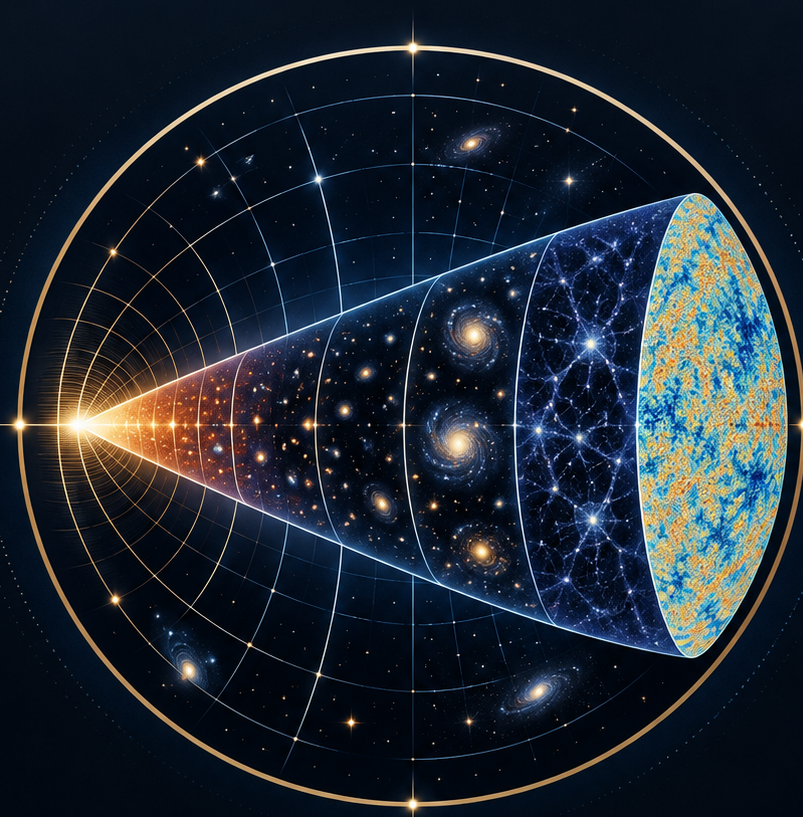
The story of galaxy formation begins with the Big Bang, the event that started the universe’s expansion and cooling. In the first fraction of a second, the universe underwent a series of rapid epoch transitions, each governed by distinct physical processes. The standard framework for understanding this is the Lambda-Cold Dark Matter (ΛCDM) model, which posits that quantum fluctuations during an early inflationary period seeded all large-scale structure.
The Cosmic Epochs
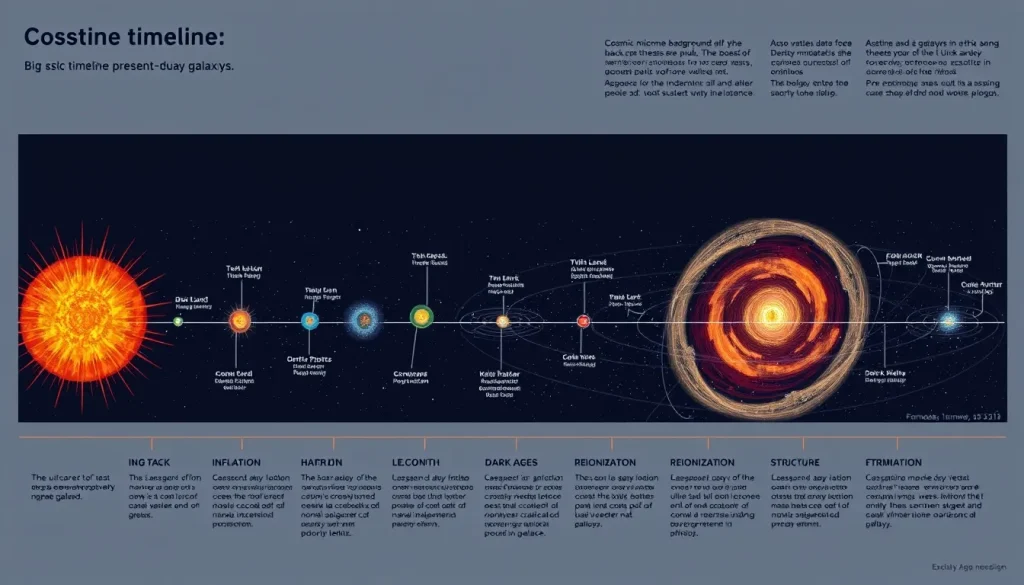
From the Planck epoch to the present, the universe evolved through several distinct phases. The Planck epoch (up to 10⁻⁴³ seconds) saw the unification of all fundamental forces; quantum gravity dominated. The Grand Unification epoch followed, where the strong force separated. Then came inflation, a brief period of exponential expansion (~10⁻³⁶ to 10⁻³² seconds), which stretched quantum fluctuations to cosmic scales, providing the seeds for galaxies. The Electroweak epoch saw the separation of electromagnetic and weak forces, and the Quark epoch (10⁻¹² to 10⁻⁶ seconds) featured a quark-gluon plasma. As the universe cooled, quarks combined into hadrons (Hadron epoch), then leptons dominated (Lepton epoch). The Photon epoch began when matter and radiation decoupled, leading to nucleosynthesis of light elements. About 380,000 years after the Big Bang, recombination occurred: electrons combined with protons to form neutral hydrogen, and photons decoupled, creating the cosmic microwave background (CMB). This marks the end of the Photon epoch and the start of the Dark Ages, when no stars existed.
From Dark Ages to Reionization
During the Dark Ages, the universe was filled with neutral hydrogen and dark matter. Dark matter, which does not interact electromagnetically, began to clump under gravity, forming halos. These halos attracted normal matter (baryons), which cooled and condensed. The first stars and galaxies formed around 12.5 billion years ago, ending the Dark Ages and initiating Reionization—the process by which ultraviolet radiation from these first objects ionized the surrounding hydrogen. Reionization completed about 1 billion years after the Big Bang.
Structure Formation
Galaxies continued to merge and grow, forming larger structures such as clusters and superclusters, separated by vast voids. The CMB, observed by COBE, WMAP, and Planck, shows tiny temperature fluctuations that correspond to the initial density variations. The James Webb Space Telescope (JWST) is now revealing the earliest galaxies, providing direct observations of galaxy formation in progress. The ΛCDM model successfully explains the observed large-scale structure, including the cosmic web of filaments and voids.
Question Article
Short Answer
Galaxies formed from gravitational collapse of dark matter halos that gathered gas, which then cooled and fragmented into stars. The process is hierarchical: small structures merged to form larger ones.
What We Know
We know the universe began in a hot, dense state and has been expanding and cooling for 13.8 billion years. The CMB provides a snapshot of the universe at 380,000 years, showing small anisotropies that seeded structure. Dark matter is essential to explain the observed galaxy clustering and rotation curves. The first galaxies appeared about 12.5 billion years ago, and galaxy formation continues today.
What We Don’t Know
The exact details of the first star formation (Population III stars) remain uncertain. The role of supermassive black holes in galaxy evolution is still being clarified. The nature of dark matter itself is unknown, though its gravitational effects are well established.
Evidence
Key evidence includes the CMB anisotropies measured by Planck, the large-scale distribution of galaxies from surveys like SDSS, and deep observations by JWST that capture galaxies in their infancy. The agreement between theoretical predictions and observations supports the ΛCDM model.
Competing Explanations
While ΛCDM is the consensus, alternative models like MOND (Modified Newtonian Dynamics) attempt to explain galaxy dynamics without dark matter, but they fail to match the CMB and large-scale structure. Other modifications to gravity are also less successful.
Current Research
Current research focuses on the epoch of reionization, the properties of the first galaxies, and the connection between black holes and galaxy formation. Missions like JWST and future observatories like the Roman Space Telescope will provide more data.
Why It Matters
Understanding galaxy formation is fundamental to cosmology because it links the physics of the early universe to the structures we observe today. It tests our models of dark matter, dark energy, and gravity. Moreover, galaxies are the crucibles of star formation and planetary systems, making this research essential to understanding our cosmic origins.
Evidence / Sources
- NASA Goddard Space Flight Center: The Hidden Lives of Galaxies – Formation of Galaxies
- Physics LibreTexts: 28.6 The Formation and Evolution of Galaxies and Structure in the Universe
- Primack, J.R. (2024). Galaxy Formation in ΛCDM Cosmology. Annual Review of Nuclear and Particle Science, 74:173-206.
- Wikipedia: Galaxy formation and evolution
Related Registry Entries
- Cosmic Microwave Background
- Inflation
- Recombination
- Dark Ages
- Reionization
FAQ
What triggered the formation of galaxies?
Tiny quantum fluctuations during cosmic inflation were amplified and served as gravitational seeds. Dark matter clumped around these seeds, attracting gas that cooled and formed stars.
How does the cosmic microwave background help us understand galaxy formation?
The CMB shows tiny temperature variations that correspond to density fluctuations in the early universe. These fluctuations are the seeds that grew into galaxies and large-scale structure.
What role does dark matter play in galaxy formation?
Dark matter provides the gravitational scaffolding that attracts normal matter. Without dark matter, galaxies would not have enough mass to hold together or form as early as observed.
When did the first galaxies appear?
The first galaxies appeared about 12.5 billion years ago, roughly 1.3 billion years after the Big Bang, as observed by deep surveys like the Hubble Ultra Deep Field and JWST.
Leave a Reply