Short Answer
Main Explanation
Cosmic reionization is the last major global phase transition in the history of the universe. It marks the moment when the cold, neutral hydrogen gas that filled intergalactic space after recombination was heated and ionized by the first generations of stars and galaxies. Before reionization, the universe was largely opaque to certain wavelengths of light; afterward, it became the transparent, ionized cosmos we observe today.
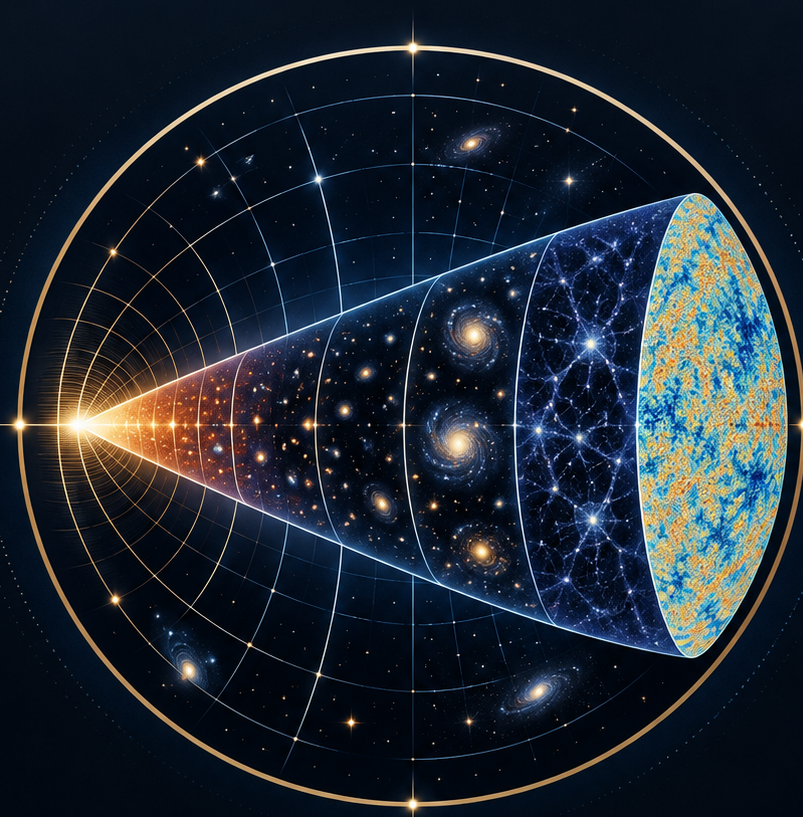
In the standard Lambda-CDM cosmological model, the universe began in a hot, dense state and has been expanding and cooling ever since. The earliest moments are described by a sequence of epochs, each defined by the dominant physical processes and particles. Reionization is the final chapter in this early history, bridging the dark ages and the emergence of the structured universe of galaxies.
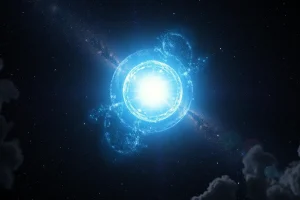
More than 13 billion years ago, during the Era of Reionization, the universe was a very different place. The gas between galaxies was largely opaque to energetic light, making it difficult to observe young galaxies.
The First Minutes and the Cosmic Microwave Background
Immediately after the Big Bang, the universe passed through the Planck epoch, the grand unification epoch, and a brief but dramatic inflationary epoch. During inflation, space expanded exponentially, smoothing out irregularities and setting the initial conditions for all later structure. As the universe cooled, the electroweak and quark epochs gave way to the hadron and lepton epochs, when protons, neutrons, and electrons formed. Big Bang nucleosynthesis produced the lightest elements—mostly hydrogen and helium—within the first few minutes.
For about 380,000 years, the universe remained a hot plasma of photons, electrons, and nuclei. Then, during recombination, the temperature dropped enough for electrons to combine with protons and form neutral hydrogen atoms. This released the cosmic microwave background (CMB), a relic radiation field that still fills the universe at a temperature of about 2.7 kelvin. The CMB is not perfectly uniform: it contains tiny temperature anisotropies that encode the density fluctuations from which galaxies and clusters would later grow.
Timeline of the Early Universe
| Epoch | Time After Big Bang | Approximate Redshift | Key Events |
|---|---|---|---|
| Planck epoch | < 10⁻⁴³ s | — | Quantum gravity dominates; all forces unified |
| Grand unification epoch | 10⁻⁴³ – 10⁻³⁶ s | — | Strong force separates; possible baryogenesis |
| Inflationary epoch | 10⁻³⁶ – 10⁻³² s | — | Exponential expansion; seeds of structure |
| Electroweak epoch | 10⁻³² – 10⁻¹² s | — | Weak and electromagnetic forces separate |
| Quark epoch | 10⁻¹² – 10⁻⁶ s | — | Quarks and gluons form a plasma |
| Hadron epoch | 10⁻⁶ – 1 s | — | Protons and neutrons form |
| Lepton epoch | 1 – 10 s | — | Leptons dominate; neutrinos decouple |
| Photon epoch | 10 s – 380,000 yr | — | Nucleosynthesis; plasma of photons and nuclei |
| Recombination | ~380,000 yr | ~1100 | Neutral hydrogen forms; CMB released |
| Dark Ages | 380,000 yr – ~150 Myr | ~1100 – ~20 | Universe neutral and opaque; no stars |
| Reionization | ~150 Myr – 1 Gyr | ~20 – ~6 | First stars and galaxies ionize intergalactic hydrogen |
| Structure formation | ~1 Gyr – present | < 6 | Galaxies, clusters, and large-scale structure evolve |
From Recombination to the Dark Ages
After recombination, the universe entered the dark ages. With no stars or galaxies, the only light was the fading glow of the CMB, stretched by cosmic expansion into the infrared and radio. Neutral hydrogen filled space, absorbing ultraviolet and visible light. The universe was effectively opaque to energetic photons, and no new sources of light existed to illuminate it.
During this period, dark matter—whose gravitational influence had been growing since inflation—began to pull ordinary matter into the first gravitationally bound structures. These small halos of dark matter would become the cradles of the first stars.
First Stars, First Galaxies, and the Epoch of Reionization
When the first stars ignited, perhaps 100 to 200 million years after the Big Bang, they emitted intense ultraviolet radiation. These first stars, often called Population III stars, were likely massive, hot, and short-lived. Their photons escaped into the surrounding neutral gas, ionizing hydrogen atoms—stripping electrons from protons—and creating expanding bubbles of ionized gas around each galaxy.
As more galaxies formed and their ionized bubbles grew, they eventually overlapped. By about one billion years after the Big Bang, the entire intergalactic medium had been reionized. This is the epoch of reionization. The process was not instantaneous; it proceeded patchily, with some regions becoming transparent earlier than others. The James Webb Space Telescope (JWST) is now observing galaxies from this era, providing direct evidence of the sources that drove reionization.
Structure Formation and the Present Universe
After reionization, the universe continued to evolve under the influence of dark matter and dark energy. Galaxies merged, clusters formed, and the large-scale cosmic web took shape. The CMB, now observed in exquisite detail by the COBE, WMAP, and Planck satellites, provides a snapshot of the universe at recombination. Measurements of the CMB anisotropies, combined with observations of galaxy clustering, supernovae, and baryon acoustic oscillations, have established the Lambda-CDM model as the standard cosmological framework.
Cosmic Epoch: Reionization in Context
When It Happened
Reionization began when the first luminous sources appeared, roughly 150 million years after the Big Bang, and ended approximately one billion years after the Big Bang. The exact timing is still uncertain, but multiple lines of evidence point to a midpoint around 500–700 million years.
Temperature
At the start of reionization, the intergalactic gas had cooled to only a few tens of kelvin. The ionizing radiation from stars and galaxies heated the gas to roughly 10,000–20,000 kelvin in the ionized regions, although the overall intergalactic medium remained much cooler on average.
Approximate Redshift
Reionization corresponds to redshifts from about 20 down to about 6. A redshift of 6 means the universe was about one-seventh its present size, and light from that time has been stretched by a factor of 7.
Dominant Particles/Physics
The dominant components were neutral hydrogen atoms, protons, electrons, photons, and dark matter. The key physics involved radiative transfer of ionizing ultraviolet photons, gas dynamics, and the gravitational growth of dark matter halos. The ionizing sources were the first stars and accreting black holes in early galaxies.
What Happened
Ultraviolet and X-ray radiation escaped from the first generations of galaxies, heating and ionizing their surroundings and subsequently the entire intergalactic medium. Ionized bubbles grew around galaxies, eventually overlapping to complete reionization. This transition made the universe transparent to ultraviolet light and ended the neutral hydrogen era.
What Came Before
Before reionization was the Dark Ages, a period from recombination at redshift ~1100 to the formation of the first stars. The universe was filled with neutral hydrogen and helium, and no stars or galaxies existed. The only background radiation was the cooling CMB.
What Came Next
After reionization, the intergalactic medium remained almost fully ionized. Galaxies continued to form and evolve, and the universe entered the era of structure formation that continues today. The ionized gas allowed light from distant objects to travel freely, enabling modern astronomy to observe the high-redshift universe.
Evidence
Evidence for reionization comes from several independent observations. Spectra of distant quasars show the Gunn-Peterson trough—a nearly complete absorption of light blueward of the Lyman-alpha line—indicating neutral hydrogen along the line of sight at high redshifts. The polarization of the CMB, measured by WMAP and Planck, shows a characteristic signal from scattering of CMB photons off free electrons during reionization. JWST has directly detected galaxies at redshifts greater than 10, confirming that luminous sources existed early enough to drive reionization.
Why It Matters
Cosmic reionization is a bridge between the simple, nearly uniform early universe and the complex, structured cosmos we inhabit. It marks the moment when the first stars and galaxies began to shape their environment on a cosmic scale. Understanding reionization tells us about the nature of the first luminous objects, the escape of ionizing radiation from galaxies, and the growth of structure in the early universe. It also provides a crucial test of the Lambda-CDM model: the timing and duration of reionization depend on the abundance and formation history of early galaxies, which in turn depend on dark matter and the initial conditions set by inflation.
Moreover, reionization affects the cosmic microwave background. Free electrons produced during reionization scatter CMB photons, imprinting a polarization signal that has been measured with increasing precision. This signal is one of the few direct probes of the universe between recombination and the present day.
Evidence / Sources
The scientific picture of reionization is built on a combination of observations and theory. Key sources of evidence include:
- Quasar absorption spectra: The Gunn-Peterson trough in high-redshift quasars reveals neutral hydrogen in the early universe.
- CMB polarization: WMAP and Planck measured the optical depth to reionization, indicating that a significant fraction of CMB photons were scattered by free electrons.
- Deep galaxy surveys: Hubble and JWST have identified galaxies at redshifts beyond 10, providing candidate sources of ionizing photons.
- Radio experiments: Instruments such as LOFAR, MWA, and HERA aim to detect the 21-cm signal from neutral hydrogen during the epoch of reionization.
- Theoretical simulations: Numerical models of galaxy formation and radiative transfer reproduce the observed timing and patchiness of reionization.
Related Registry Entries
- Cosmic Microwave Background — The relic radiation from recombination, carrying imprints of early density fluctuations and reionization.
- Dark Ages — The period between recombination and the first stars, when the universe was neutral and opaque.
- Recombination — The epoch when protons and electrons combined to form neutral hydrogen, releasing the CMB.
- First Stars & Galaxies — The Population III stars and early galaxies that provided the ionizing photons for reionization.
- Lambda-CDM Model — The standard cosmological model that describes the evolution of the universe from inflation to the present.
- James Webb Space Telescope — The infrared observatory designed to observe the first galaxies and the epoch of reionization.
FAQ
What exactly is cosmic reionization?
Cosmic reionization is the process by which the neutral hydrogen gas that filled the early universe was ionized by ultraviolet radiation from the first stars and galaxies, making the intergalactic medium transparent to light.
When did reionization happen?
It began roughly 150 million years after the Big Bang and ended about one billion years after the Big Bang, corresponding to redshifts from about 20 to 6.
What caused reionization?
The first generations of stars and galaxies emitted intense ultraviolet and X-ray radiation that escaped into the surrounding neutral gas, stripping electrons from hydrogen atoms and creating expanding ionized bubbles.
How do we know reionization occurred?
Evidence includes the Gunn-Peterson trough in quasar spectra, polarization of the cosmic microwave background measured by WMAP and Planck, and direct observations of early galaxies by JWST.
What was the universe like before reionization?
Before reionization, during the Dark Ages, the universe was filled with neutral hydrogen and helium, had no stars or galaxies, and was opaque to ultraviolet and visible light.
Leave a Reply