Short Answer
Short Answer / Definition
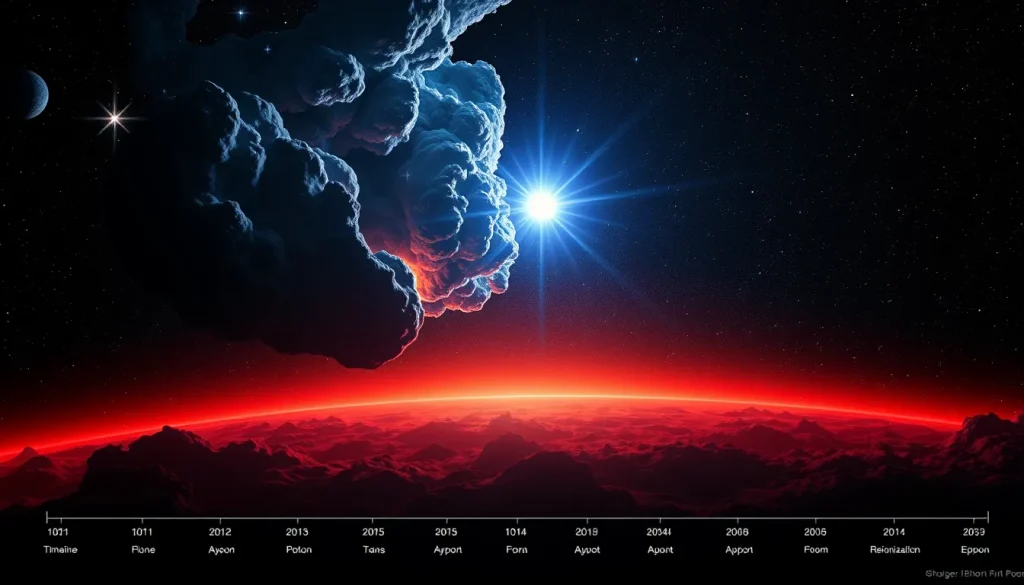
The first stars—known as Population III stars—are thought to have formed approximately 100 to 200 million years after the Big Bang, when dense regions of primordial hydrogen and helium collapsed under gravity. These stars were likely extremely massive, hot, and short-lived, and their appearance marked the end of the cosmic dark ages and the beginning of reionization. The exact timing remains uncertain, but observations with the James Webb Space Telescope (JWST) are now probing this era.
Main Explanation
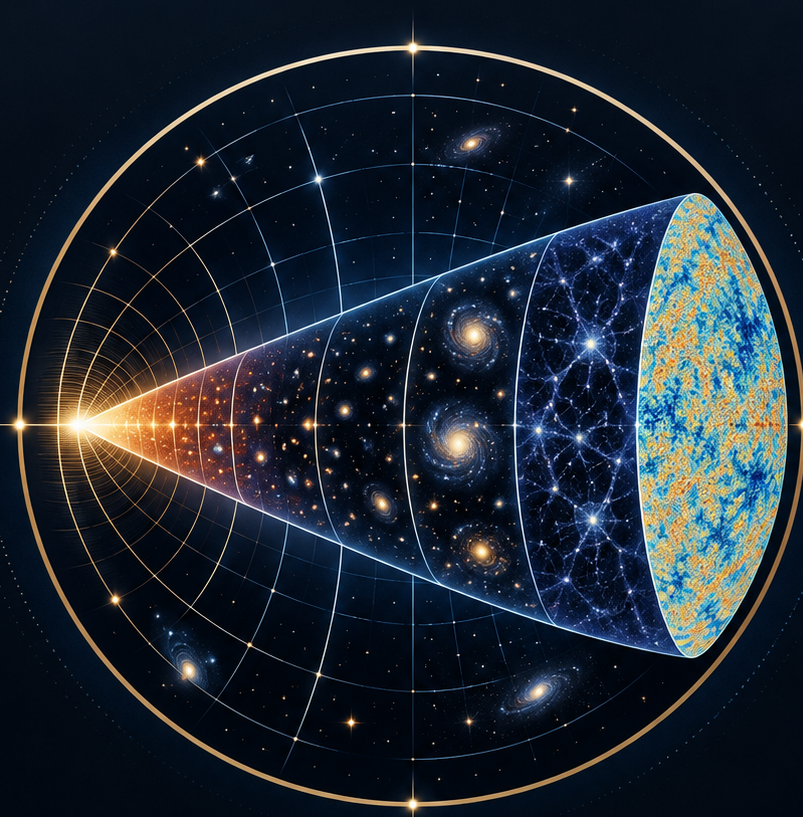
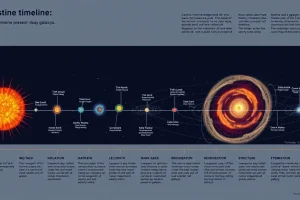
The history of the universe is a story of cooling and condensation. In the first fraction of a second, the cosmos was a seething soup of energy and particles, expanding and cooling from unimaginable temperatures. To understand when the first stars formed, we must trace the entire sequence of cosmic epochs—from the Planck epoch to the present day.
The Planck Epoch and Inflation
The earliest moment we can describe is the Planck epoch, lasting from t=0 to about 10-43 seconds, when quantum gravitational effects dominated. Our physics breaks down here. Immediately after, the Grand Unification epoch (10-43 to 10-36 s) saw the separation of the strong nuclear force. Then came the Inflationary epoch (10-36 to 10-32 s), a period of exponential expansion driven by a hypothetical scalar field. Inflation stretched quantum fluctuations to cosmic scales, seeding the large-scale structure we observe today. After inflation, the universe was filled with a hot quark-gluon plasma.
From Quarks to Photons
The Electroweak epoch (10-32 to 10-12 s) saw the unification of the electromagnetic and weak forces. The Quark epoch (10-12 to 10-6 s) ended when quarks combined into hadrons (protons and neutrons) during the Hadron epoch (10-6 to 1 s). Next, the Lepton epoch (1 s to 10 s) saw leptons dominate, and then the Photon epoch began (10 s to ~380,000 years). During this long epoch, the universe was a hot, opaque plasma of nuclei, electrons, and photons. At about 3 minutes, Big Bang nucleosynthesis produced helium-4, deuterium, and trace lithium. The universe remained opaque until the temperature dropped to about 3,000 K.
Recombination and the Cosmic Microwave Background
At approximately 380,000 years after the Big Bang, the universe had cooled enough for electrons to combine with protons to form neutral hydrogen. This event, called recombination, allowed photons to travel freely—creating the cosmic microwave background (CMB) radiation. The CMB is a relic of this era, observed today as a nearly uniform glow at 2.725 K. Missions like COBE, WMAP, and Planck have mapped its tiny temperature fluctuations, providing a snapshot of the universe at age 380,000 years.
The Dark Ages and the First Stars
After recombination, the universe entered the Dark Ages—a period lasting from about 380,000 years to roughly 100–200 million years. No stars or galaxies had yet formed; the universe was filled with neutral hydrogen and helium. Gravity slowly amplified the density fluctuations seeded by inflation. Dense regions collapsed into halos of dark matter, which then attracted baryonic gas. When the gas in the smallest halos reached sufficiently high density and temperature, nuclear fusion ignited—the first stars were born.
These Population III stars are thought to have been very massive (perhaps tens to hundreds of solar masses) because the primordial gas lacked carbon and oxygen, which normally help fragment clouds into smaller stars. They were extremely hot and luminous, emitting intense ultraviolet radiation that began to reionize the surrounding neutral hydrogen. Their lifetimes were short—only a few million years—and they likely ended as supernovae, enriching the cosmos with the first heavy elements.
Reionization and Structure Formation
The ultraviolet light from the first stars and accreting black holes gradually reionized the intergalactic medium, a process called reionization. This epoch is often called Cosmic Dawn. It likely occurred over a period from about 200 million to 1 billion years after the Big Bang. The first galaxies assembled as dark matter halos merged, and the universe transformed from a neutral, dark expanse to the transparent, structured cosmos we see today.
Observations with the James Webb Space Telescope (JWST) are now pushing the frontier of detection, finding galaxies at redshifts beyond 10, corresponding to less than 500 million years after the Big Bang. While direct observation of Population III stars remains elusive, JWST’s deep fields are beginning to reveal the early galaxies that hosted these first stars.
Cosmic Epoch: When It Happened
When It Happened
The first stars formed roughly 100–200 million years after the Big Bang (redshift z ≈ 15–30), but the exact timing is model-dependent. The earliest galaxies observed by JWST date to about 300–400 million years after the Big Bang.
Temperature
At the time of first star formation, the cosmic gas had cooled to about 50–100 K, allowing molecular hydrogen to form and act as a coolant, enabling collapse.
Approximate Redshift
Redshift z ≈ 15–30, corresponding to look-back times of over 13.5 billion years.
Dominant Particles/Physics
Neutral hydrogen and helium gas, dark matter, and radiation. Gravity and gas cooling dominate; nuclear fusion ignites in stellar cores.
What Happened
Primordial gas collapsed in dark matter halos, forming the first stars (Population III). These stars emitted ionizing radiation, beginning the process of reionization.
What Came Before
The Dark Ages—a period of no luminous sources, with only neutral gas and dark matter.
What Came Next
Reionization and the assembly of the first galaxies, leading to the large-scale structure we see today.
Evidence
Indirect evidence from the optical depth of the CMB (measured by WMAP and Planck) and direct observations of early galaxies by JWST. The absence of metals in high-redshift gas also supports the existence of Population III stars.
Why It Matters
The first stars mark a pivotal transition in cosmic history—from the simple, homogeneous early universe to the complex, structured one we inhabit. They produced the first heavy elements, seeded the formation of galaxies and black holes, and ended the dark ages. Understanding when and how they formed is essential for explaining the reionization of the universe, the chemical enrichment of the intergalactic medium, and the origins of the elements that make up our own bodies. Studies of the first stars also test our models of cosmology, star formation, and galaxy evolution.
Evidence / Sources
Key evidence comes from multiple sources:
- The cosmic microwave background measured by COBE, WMAP, and Planck provides the initial conditions and constrains the timing of reionization.
- JWST’s deep-field observations reveal galaxies at redshifts >10, showing that star formation was underway less than 500 million years after the Big Bang.
- Spectroscopic studies of distant quasars show the intergalactic medium was reionized by redshift ~6, implying the first stars formed earlier.
- Theoretical simulations of primordial gas collapse (e.g., by Bromm, 2013) provide detailed predictions for Population III star formation.
Related Registry Entries
- Big Bang Nucleosynthesis
- Cosmic Microwave Background
- Reionization
- Dark Ages
- James Webb Space Telescope
FAQ
How do we know the first stars formed if we haven't directly observed them?
We infer their existence from several lines of evidence: the reionization of the universe (measured via the CMB optical depth), the lack of metals in high-redshift gas, and the early galaxies seen by JWST that must have been built on earlier star formation.
Why were the first stars so massive?
The primordial gas contained only hydrogen and helium, lacking carbon and oxygen which are efficient coolants in modern star-forming clouds. Without these coolants, the gas remained warmer and more stable, preventing fragmentation into small clumps. As a result, the collapse produced large, massive stars, often tens to hundreds of times the Sun's mass.
What happened to the first stars?
They lived short lives (a few million years) and likely ended as supernovae or directly collapsed into black holes. Their explosions enriched the surrounding gas with heavy elements, influencing subsequent star formation.
Can JWST see the first stars directly?
JWST is designed to detect the first galaxies, but individual Population III stars are likely too faint and distant. However, JWST may detect their supernovae or the integrated light from early star clusters, and its deep surveys are revealing galaxies from the first 500 million years.
Leave a Reply