
Short Answer
Main Explanation
The universe began in an incredibly hot, dense state and has been expanding and cooling ever since. To understand its evolution, cosmologists divide the history of the cosmos into distinct epochs, each characterized by different physical processes and particle content. One of the most pivotal transitions is the electroweak symmetry breaking, which occurred about 10−12 seconds after the Big Bang. This event gave mass to the W and Z bosons, fundamentally shaping the forces we observe today.
In the Standard Model of particle physics, the electromagnetic and weak forces are unified at high energies into a single electroweak force. As the universe cooled, a phase transition—the Higgs mechanism—broke this symmetry, giving the W± and Z0 bosons their masses (around 80 GeV/c²) while leaving the photon massless. This is analogous to how a ferromagnet loses its magnetic alignment when heated above a critical temperature; the underlying laws are symmetric, but the ground state is not.
The Cosmic Timeline
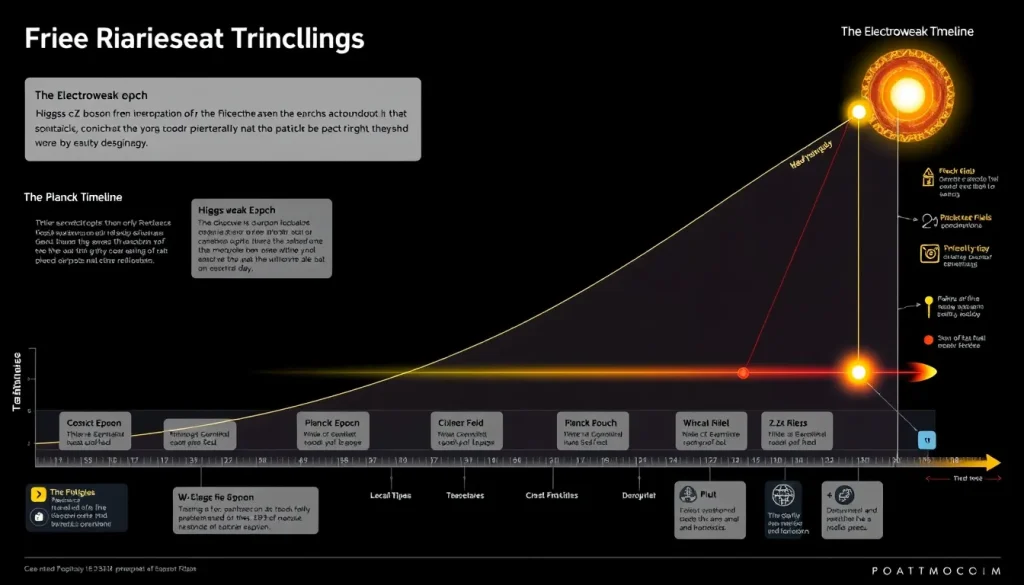
The following table summarizes the major epochs of the universe, from the Planck epoch to the present day. Times are approximate and temperatures are given in electronvolts (eV) or Kelvin (K).
| Epoch | Time After Big Bang | Temperature | Key Events |
|---|---|---|---|
| Planck epoch | 0 – 10−43 s | >1032 K | Quantum gravity effects dominate; no known physics. |
| Grand Unification epoch | 10−43 – 10−36 s | 1027 – 1032 K | Strong and electroweak forces unified; possible inflation begins. |
| Inflationary epoch | 10−36 – 10−32 s | Dropping rapidly | Exponential expansion; quantum fluctuations seeded structure. |
| Electroweak epoch | 10−12 – 10−10 s | ~1015 – 1016 K | Electroweak symmetry breaking; W and Z bosons acquire mass. |
| Quark epoch | 10−12 – 10−6 s | 1012 – 1015 K | Quarks and gluons form quark-gluon plasma. |
| Hadron epoch | 10−6 – 1 s | 1010 – 1012 K | Quarks combine into protons and neutrons; matter-antimatter asymmetry. |
| Lepton epoch | 1 – 10 s | 109 – 1010 K | Leptons dominate; neutrinos decouple. |
| Photon epoch | 10 s – 380,000 yr | 104 – 109 K | Photons dominate; nucleosynthesis forms light elements. |
| Recombination | ~380,000 yr | ~3000 K | Electrons combine with nuclei; cosmic microwave background released. |
| Dark Ages | 380,000 yr – ~150 million yr | ~100 – 3000 K | No stars yet; universe is dark and neutral. |
| Reionization | ~150 million – 1 billion yr | ~10 – 100 K | First stars and galaxies ionize hydrogen. |
| Structure Formation | 1 billion yr – present | 2.7 K (now) | Galaxies, clusters, and large-scale structure form. |
The Electroweak Epoch in Detail
Using the framework of the Cosmic Epoch module, we can examine the electroweak epoch specifically.
When It Happened
The electroweak epoch began roughly 10−12 seconds after the Big Bang and lasted until about 10−10 seconds. This is an incredibly brief window, but it was crucial for setting the masses of fundamental particles.
Temperature
The temperature during this epoch was around 1015 to 1016 K, corresponding to energies of about 100 GeV to 1 TeV. This is the energy scale at which the electroweak symmetry is restored.
Approximate Redshift
Because this epoch occurred so early, the redshift is astronomically large—on the order of 1015 or higher. In practice, we do not observe light from this era directly; instead, we infer its physics from particle collider experiments and theoretical models.
Dominant Particles/Physics
Before symmetry breaking, all particles were massless and the electromagnetic and weak forces were unified. The universe was filled with a hot plasma of quarks, leptons, and gauge bosons, all in thermal equilibrium. The Higgs field, which permeates all space, had not yet acquired a nonzero vacuum expectation value.
What Happened
As the universe expanded and cooled below the critical temperature, the Higgs field underwent spontaneous symmetry breaking. This is the Higgs mechanism: the field settled into a lower-energy state, and its interactions with the W and Z bosons gave them mass. The photon remained massless because it does not couple to the Higgs field in the same way. This process also gave mass to fermions, though through a different coupling.
What Came Before
Before the electroweak epoch, the universe was in the inflationary epoch, which ended about 10−32 seconds after the Big Bang. Inflation stretched space exponentially, smoothing out initial irregularities and seeding the density fluctuations that later grew into galaxies.
What Came Next
After electroweak symmetry breaking, the universe entered the quark epoch, where quarks and gluons existed as a plasma. Eventually, quarks combined into hadrons, and later nucleosynthesis produced the light elements.
Evidence
The most direct evidence for electroweak symmetry breaking comes from particle accelerators. The Large Hadron Collider (LHC) at CERN announced the discovery of the Higgs boson on 14 March 2013, confirming the mechanism that gives mass to gauge bosons. The measured masses of the W and Z bosons (around 80 GeV/c²) match predictions of the Standard Model with the Higgs mechanism. Additionally, the observed pattern of weak interactions—short-range and parity-violating—is consistent with massive W and Z bosons.
Why It Matters
Electroweak symmetry breaking is not just a footnote in particle physics; it is central to our understanding of the universe. Without it, the weak force would be infinite in range, and atoms could not form as we know them. The masses of the W and Z bosons determine the strength and range of the weak interaction, which governs nuclear fusion in stars and the radioactive decay that drives stellar nucleosynthesis. Moreover, the Higgs mechanism is the only known way to give mass to fundamental particles in a renormalizable quantum field theory. Understanding this process helps us probe the earliest moments of the universe and test the Standard Model at the highest energies.
Evidence / Sources
The evidence for the cosmic timeline and electroweak symmetry breaking comes from multiple independent lines of inquiry:
- Particle colliders: The LHC’s discovery of the Higgs boson (2013) confirmed the Higgs mechanism. Measurements of W and Z masses align with predictions.
- Cosmic microwave background (CMB): The CMB, first detected by COBE, then mapped with increasing precision by WMAP and Planck, provides a snapshot of the universe at recombination (380,000 years). Its anisotropies match the predictions of inflation and the ΛCDM model.
- Big Bang nucleosynthesis (BBN): The observed abundances of light elements (hydrogen, helium, lithium) agree with BBN calculations, which depend on the expansion rate and particle content during the first few minutes.
- Large-scale structure: Galaxy surveys, such as those using baryon acoustic oscillations, confirm the growth of structure from initial density fluctuations.
- James Webb Space Telescope (JWST): JWST is now probing the epoch of reionization and the first galaxies, providing direct observations of the universe’s early structure formation.
These observations collectively support the standard ΛCDM model, which includes inflation, dark matter, and dark energy as essential components.
Related Registry Entries
This article is part of a series on the cosmic timeline. Related entries include:
- The Planck Epoch: The First 10−43 Seconds
- Cosmic Inflation: The Exponential Expansion
- Big Bang Nucleosynthesis: The First Elements
- Recombination and the Cosmic Microwave Background
- The Dark Ages and Reionization
FAQ
What is electroweak symmetry breaking?
Electroweak symmetry breaking is the process by which the unified electromagnetic and weak forces became distinct at low energies. It occurs via the Higgs mechanism, which gives mass to the W and Z bosons while leaving the photon massless.
When did electroweak symmetry breaking occur?
It occurred about 10^-12 to 10^-10 seconds after the Big Bang, when the universe cooled below the critical temperature of roughly 10^15 K.
How do we know electroweak symmetry breaking happened?
The discovery of the Higgs boson at the LHC in 2013, along with precise measurements of W and Z boson masses, strongly confirms the Higgs mechanism. The observed short range of the weak force also requires massive W and Z bosons.
What is the role of the Higgs field?
The Higgs field permeates all space and has a nonzero vacuum expectation value at low temperatures. Its interactions with particles give them mass, breaking the electroweak symmetry.


Leave a Reply