
Short Answer
Main Explanation
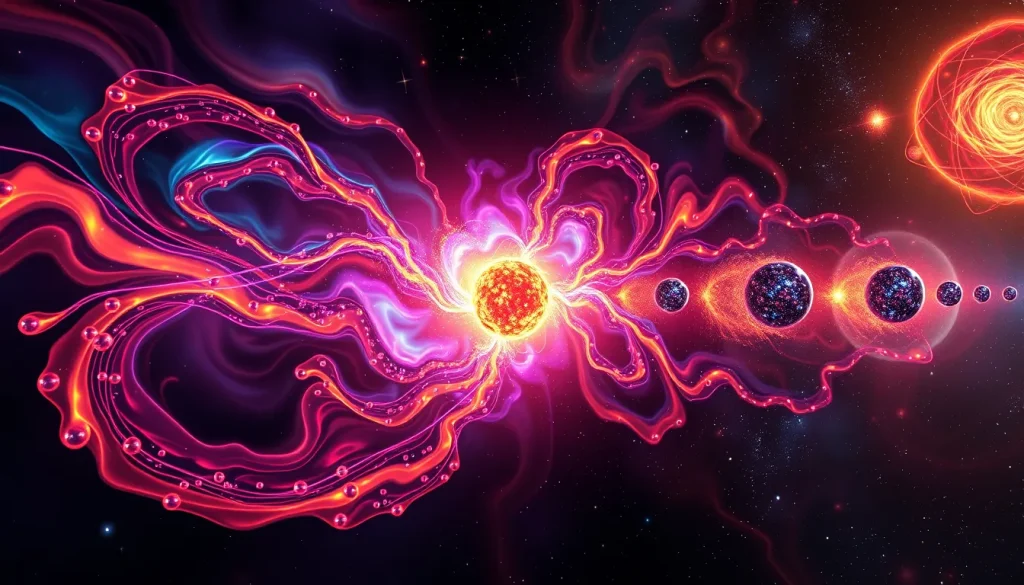
The quark–gluon plasma represents a fundamental phase of matter predicted by quantum chromodynamics (QCD), the theory of the strong force. In ordinary matter, quarks are permanently confined inside hadrons—protons, neutrons, and mesons—by gluons, the carriers of the strong force. However, at extremely high temperatures or densities, the confining force weakens, and quarks and gluons become free to roam over large volumes. This deconfined state is the quark–gluon plasma.
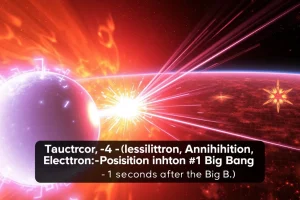
According to the standard model of cosmology, the universe underwent a series of phase transitions as it expanded and cooled. About 20 microseconds after the Big Bang, the temperature was still around 2 trillion kelvin—hot enough to melt hadrons into a quark–gluon plasma. This epoch, called the Quark Epoch, lasted only a few microseconds before the universe cooled further, allowing quarks to recombine into hadrons.
To study this elusive state, physicists use particle accelerators to collide heavy ions (like gold or lead) at ultrarelativistic energies. At CERN’s Large Hadron Collider (LHC) and Brookhaven’s Relativistic Heavy Ion Collider (RHIC), these collisions create tiny fireballs that briefly recreate the conditions of the early universe. The resulting plasma is a nearly perfect liquid with extremely low viscosity, as discovered at RHIC in 2005.
Cosmic Epoch
When It Happened
The quark–gluon plasma existed during the Quark Epoch, roughly 10−6 to 10−4 seconds after the Big Bang. It was preceded by the Electroweak Epoch and followed by the Hadron Epoch.
Temperature
The temperature during the Quark Epoch was above the QCD critical temperature, about 2×10¹² K (≈170 MeV).
Approximate Redshift
Redshift values for such early times are extremely high, on the order of 1012 or more (though not directly observable).
Dominant Particles/Physics
Quarks, gluons, leptons, and photons, all in thermal equilibrium. The strong force was still unified with the electroweak force until the Electroweak phase transition.
What Happened
During the Quark Epoch, the universe was a dense soup of free quarks and gluons, along with leptons and photons. As the universe expanded and cooled, the strong force began to confine quarks into hadrons—a process known as hadronization—marking the end of the Quark Epoch.
What Came Before
The Electroweak Epoch, during which the electromagnetic and weak forces separated, and before that, the Inflationary Epoch and the Grand Unification Epoch.
What Came Next
The Hadron Epoch, when quarks became bound into protons and neutrons. This was followed by the Lepton Epoch, Photon Epoch, Recombination, and the formation of atoms, stars, and galaxies.
Evidence
Direct evidence for the quark–gluon plasma comes from heavy-ion collisions at RHIC and the LHC, which produce a fluid with quark–gluon degrees of freedom. The cosmic microwave background and Big Bang nucleosynthesis provide indirect evidence for the early universe’s conditions.
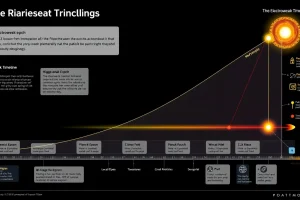
Timeline of Cosmic Epochs
| Epoch | Time after Big Bang | Temperature | Key Events |
|---|---|---|---|
| Planck Epoch | 0 – 10−43 s | >1032 K | Quantum gravity effects dominate; all forces unified. |
| Grand Unification Epoch | 10−43 – 10−36 s | >1028 K | Strong force separates from electroweak. |
| Inflationary Epoch | 10−36 – 10−32 s | Cooling from 1028 K | Exponential expansion; seeds of large-scale structure. |
| Electroweak Epoch | 10−32 – 10−12 s | 1028 – 1015 K | Electromagnetic and weak forces separate; W, Z bosons acquire mass. |
| Quark Epoch | 10−12 – 10−6 s | 1015 – 1012 K | Quark–gluon plasma exists; quarks and gluons deconfined. |
| Hadron Epoch | 10−6 – 1 s | 1012 – 1010 K | Quarks combine into hadrons; matter–antimatter asymmetry develops. |
| Lepton Epoch | 1 – 10 s | 1010 – 109 K | Leptons and antileptons dominate; neutrinos decouple. |
| Photon Epoch | 10 s – 380,000 yrs | 109 – 3,000 K | Photons dominate; nucleosynthesis forms light elements. |
| Recombination | ~380,000 yrs | ~3,000 K | Electrons combine with nuclei to form neutral atoms; CMB released. |
| Dark Ages | 380,000 – ~150 million yrs | 3,000 – 50 K | No stars yet; universe dark and neutral. |
| Reionization | ~150 million – 1 billion yrs | ~50 – 20 K | First stars and galaxies ionize hydrogen. |
| Structure Formation | 1 billion yrs – present | 20 K – 2.7 K | Galaxies, clusters, and large-scale structure form. |
Why It Matters
Studying the quark–gluon plasma is not just about understanding an exotic state of matter—it is a window into the earliest moments of our universe. By recreating the QGP in laboratory collisions, physicists test the fundamental theory of the strong force and probe the conditions that governed the cosmos when it was only microseconds old. Moreover, the QGP’s properties, such as its near-perfect fluidity, challenge our understanding of strongly interacting systems and may have implications for nuclear physics and astrophysics.
Additionally, the cosmic timeline from the Planck epoch to the present is a story of phase transitions, symmetry breaking, and structure formation. The cosmic microwave background (CMB) is the oldest light we can see, a relic from recombination that carries imprints of the early universe’s density fluctuations. Missions like COBE, WMAP, and Planck have measured the CMB with exquisite precision, confirming the Lambda-CDM model and revealing the seeds of galaxies. The James Webb Space Telescope (JWST) is now probing the epoch of reionization, directly observing the first galaxies that ended the cosmic Dark Ages.
Evidence / Sources
Evidence for the quark–gluon plasma comes from high-energy heavy-ion experiments. At RHIC and the LHC, collisions produce a hot, dense medium that exhibits collective flow, jet quenching, and quarkonium suppression—all signatures of deconfinement. The cosmic microwave background, measured by COBE, WMAP, and Planck, provides a snapshot of the universe at recombination, confirming the predictions of Big Bang nucleosynthesis and inflation. The abundance of light elements (hydrogen, helium, lithium) matches theoretical predictions, further validating our model of the early universe.
Key sources include:
- Wikipedia: Quark–gluon plasma
- CERN: Heavy ions and quark-gluon plasma
- MIT News: Explained: Quark-gluon plasma
Related Registry Entries
Explore related topics: Cosmic Microwave Background, Big Bang Nucleosynthesis, Inflation, Recombination, Dark Ages, Reionization, Large-Scale Structure, and the Planck Mission.
FAQ
What is the quark–gluon plasma?
It is a state of matter in which quarks and gluons are no longer confined inside hadrons but move freely. It existed in the early universe about 20 microseconds after the Big Bang and is recreated in high-energy heavy-ion collisions.
How do scientists study the quark–gluon plasma?
By colliding heavy ions (like gold or lead) at ultrarelativistic speeds in particle accelerators such as the LHC at CERN and RHIC at Brookhaven. The collisions create tiny fireballs with temperatures above 2 trillion kelvin, mimicking the early universe.
What is the cosmic microwave background?
The CMB is the oldest light in the universe, emitted about 380,000 years after the Big Bang when atoms formed and photons decoupled. It provides a snapshot of the universe at that time and is a key piece of evidence for the Big Bang model.
What are the major cosmic epochs?
The major epochs include Planck, Grand Unification, Inflation, Electroweak, Quark, Hadron, Lepton, Photon, Recombination, Dark Ages, Reionization, and Structure Formation, spanning from the Big Bang to the present.
Leave a Reply