
Short Answer
Main Explanation
In the first fractions of a second after the Big Bang, the universe was an ultra-hot, dense state where all fundamental forces were unified. As it expanded and cooled, it underwent a series of symmetry-breaking transitions—each a phase change analogous to water freezing into ice—that determined the distinct forces and particles we observe. (Source: [2]) Symmetry, in physics, is a property of a system that remains unchanged under a transformation. In the early universe, even when particles were unstable, symmetry was preserved; for every virtual electron created, a virtual positron appeared, maintaining a mirror-like balance. (Source: [1])
Symmetry Breaking and Inflation
The concept of symmetry breaking is central to understanding cosmic inflation. Inflation, a period of exponential expansion lasting from about 10⁻³⁶ to 10⁻³² seconds after the Big Bang, is thought to have been driven by a scalar field (often called the inflaton) that was in a false vacuum state. When this field decayed, it released enormous energy, causing the universe to expand by a factor of at least 10²⁶. This process also amplified quantum fluctuations into the seeds for galaxies and large-scale structure. (Source: [4])
The Cosmic Epochs
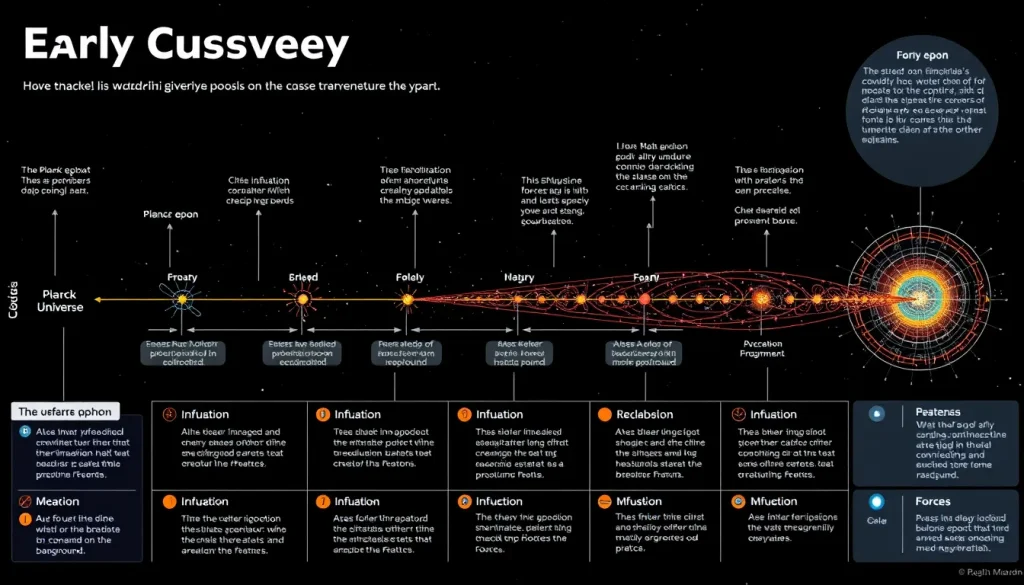
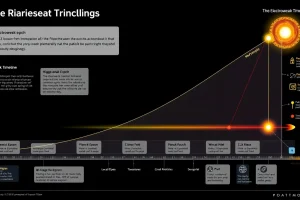
The standard cosmological timeline is divided into epochs, each marked by specific symmetry-breaking events and particle processes. The table below summarizes the main epochs, and the following sections detail each one.
| Epoch | Time | Temperature | Redshift | Key Physics |
|---|---|---|---|---|
| Planck | 0 to 10⁻⁴³ s | >10³² K | z > 10³² | Quantum gravity, all forces unified |
| Grand Unification | 10⁻⁴³ to 10⁻³⁶ s | 10²⁸–10³² K | 10²⁸–10³² | Strong force separates |
| Inflation | 10⁻³⁶ to 10⁻³² s | ~10²⁷ K | ~10²⁷ | Exponential expansion, scalar field |
| Electroweak | 10⁻³² to 10⁻¹² s | 10¹⁵–10²⁷ K | 10¹⁵–10²⁷ | Electromagnetic and weak forces separate |
| Quark | 10⁻¹² to 10⁻⁶ s | 10¹²–10¹⁵ K | 10¹²–10¹⁵ | Quarks and gluons in quark-gluon plasma |
| Hadron | 10⁻⁶ to 1 s | 10¹⁰–10¹² K | 10¹⁰–10¹² | Protons and neutrons form |
| Lepton | 1 to 10 s | 10⁹–10¹⁰ K | 10⁹–10¹⁰ | Leptons dominate; neutrinos decouple |
| Photon | 10 s to 380,000 yr | 3000–10⁹ K | 1100–10⁹ | Photons dominate; nucleosynthesis |
| Recombination | ~380,000 yr | ~3000 K | ~1100 | Atoms form; CMB released |
| Dark Ages | 380,000 yr to ~150 million yr | ~10–3000 K | 20–1100 | No luminous sources; neutral hydrogen |
| Reionization | ~150 million to ~1 billion yr | ~10–100 K | 6–20 | First stars and galaxies reionize hydrogen |
| Structure Formation | >1 billion yr to present | <10 K | 0–6 | Galaxies, clusters, large-scale structure |
Planck Epoch (0 to 10⁻⁴³ s)
- When It Happened: The very first instant after the Big Bang.
- Temperature: Above 10³² K.
- Approximate Redshift: z > 10³².
- Dominant Particles/Physics: Quantum gravity effects dominate; all four forces are unified.
- What Happened: The universe is a quantum foam of spacetime; our current physics cannot describe it.
- What Came Before: The Big Bang itself (singularity).
- What Came Next: Grand Unification epoch.
- Evidence: No direct evidence; inferred from the need for a quantum theory of gravity.
Grand Unification Epoch (10⁻⁴³ to 10⁻³⁶ s)
- When It Happened: After Planck time.
- Temperature: 10²⁸–10³² K.
- Approximate Redshift: z ~ 10²⁸–10³².
- Dominant Particles/Physics: Grand Unified Theory (GUT) forces, X and Y bosons.
- What Happened: The strong force separates from the electroweak force; symmetry breaking produces baryon asymmetry (baryogenesis).
- What Came Before: Planck epoch.
- What Came Next: Inflationary epoch.
- Evidence: Indirect; proton decay (not yet observed) and baryon asymmetry.
Inflationary Epoch (10⁻³⁶ to 10⁻³² s)
- When It Happened: ~10⁻³⁶ s after the Big Bang.
- Temperature: ~10²⁷ K.
- Approximate Redshift: z ~ 10²⁷.
- Dominant Particles/Physics: Inflaton field; quantum fluctuations.
- What Happened: The universe expands exponentially, smoothing out inhomogeneities and solving the horizon and flatness problems. (Source: [1])
- What Came Before: Grand Unification epoch.
- What Came Next: Electroweak epoch.
- Evidence: CMB flatness, large-scale structure, and B-mode polarization (partially observed).
Electroweak Epoch (10⁻³² to 10⁻¹² s)
- When It Happened: ~10⁻¹² s.
- Temperature: 10¹⁵–10²⁷ K.
- Approximate Redshift: z ~ 10¹⁵–10²⁷.
- Dominant Particles/Physics: Electroweak force (electromagnetic and weak unified); Higgs field.
- What Happened: Symmetry breaking via the Higgs mechanism gives mass to W and Z bosons; electrons and quarks acquire mass. (Source: [2])
- What Came Before: Inflation.
- What Came Next: Quark epoch.
- Evidence: Higgs boson discovered at LHC; electroweak theory well tested.
Quark Epoch (10⁻¹² to 10⁻⁶ s)
- When It Happened: 10⁻¹² to 10⁻⁶ s.
- Temperature: 10¹²–10¹⁵ K.
- Approximate Redshift: z ~ 10¹²–10¹⁵.
- Dominant Particles/Physics: Quarks, antiquarks, gluons in a quark-gluon plasma.
- What Happened: Quarks and gluons are free; the strong force is still symmetric.
- What Came Before: Electroweak epoch.
- What Came Next: Hadron epoch.
- Evidence: Heavy-ion collisions at RHIC and LHC recreate this plasma.
Hadron Epoch (10⁻⁶ to 1 s)
- When It Happened: 10⁻⁶ to 1 second.
- Temperature: 10¹⁰–10¹² K.
- Approximate Redshift: z ~ 10¹⁰–10¹².
- Dominant Particles/Physics: Hadrons (protons, neutrons, mesons); strong force becomes confining.
- What Happened: Quarks combine to form protons and neutrons; baryon-antibaryon annihilation leaves a slight excess of matter.
- What Came Before: Quark epoch.
- What Came Next: Lepton epoch.
- Evidence: Baryon asymmetry, observed proton/neutron ratio.
Lepton Epoch (1 to 10 s)
- When It Happened: 1 to 10 seconds.
- Temperature: 10⁹–10¹⁰ K.
- Approximate Redshift: z ~ 10⁹–10¹⁰.
- Dominant Particles/Physics: Leptons (electrons, neutrinos) and photons; weak interactions.
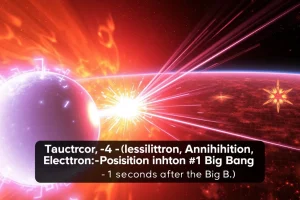
- What Happened: Neutrinos decouple (free-stream); electron-positron annihilation occurs.
- What Came Before: Hadron epoch.
- What Came Next: Photon epoch.
- Evidence: Cosmic neutrino background (indirect), CMB temperature.
Photon Epoch (10 s to 380,000 yr)
- When It Happened: 10 seconds to 380,000 years.
- Temperature: 3000–10⁹ K.
- Approximate Redshift: z ~ 1100–10⁹.
- Dominant Particles/Physics: Photons dominate; matter is ionized; Big Bang nucleosynthesis (BBN) produces light elements (H, He, Li).
- What Happened: The universe is a hot plasma; photons are tightly coupled to electrons and protons.
- What Came Before: Lepton epoch.
- What Came Next: Recombination.
- Evidence: Observed primordial abundances (BBN), CMB.
Recombination (380,000 yr)
- When It Happened: ~380,000 years after the Big Bang.
- Temperature: ~3000 K.
- Approximate Redshift: z ~ 1100.
- Dominant Particles/Physics: Neutral atoms (hydrogen, helium) form; photons decouple.
- What Happened: Electrons combine with nuclei to form atoms; the universe becomes transparent, releasing the cosmic microwave background (CMB).
- What Came Before: Photon epoch.
- What Came Next: Dark Ages.
- Evidence: CMB observed by COBE, WMAP, and Planck; precise measurements of temperature anisotropies.
Dark Ages (380,000 yr to ~150 million yr)
- When It Happened: After recombination.
- Temperature: ~10–3000 K.
- Approximate Redshift: z ~ 20–1100.
- Dominant Particles/Physics: Neutral hydrogen and helium; no stars yet.
- What Happened: The universe is dark and cooling; gravity begins to amplify density fluctuations.
- What Came Before: Recombination.
- What Came Next: Reionization.
- Evidence: 21-cm line (currently being searched), CMB polarization.
Reionization (~150 million to ~1 billion yr)
- When It Happened: ~150 million to 1 billion years.
- Temperature: ~10–100 K.
- Approximate Redshift: z ~ 6–20.
- Dominant Particles/Physics: First stars (Population III) and galaxies emit ultraviolet radiation, reionizing hydrogen.
- What Happened: The intergalactic medium becomes ionized again.
- What Came Before: Dark Ages.
- What Came Next: Structure Formation.
- Evidence: JWST observations of high-z galaxies, quasar absorption spectra, CMB polarization.
Structure Formation (>1 billion yr to present)
- When It Happened: From about 1 billion years to now.
- Temperature: <10 K (current CMB temperature 2.725 K).
- Approximate Redshift: z < 6.
- Dominant Particles/Physics: Dark matter, baryonic matter, dark energy; gravity drives clustering.
- What Happened: Galaxies, clusters, and large-scale structure form; dark energy accelerates expansion.
- What Came Before: Reionization.
- What Came Next: Present day.
- Evidence: Galaxy surveys (SDSS, DES), CMB, BAO, supernovae.
Why It Matters
Symmetry breaking is not just a historical curiosity—it explains why the universe has distinct forces, why matter exists, and why the CMB shows a nearly uniform temperature with tiny fluctuations that seeded galaxies. Understanding these processes helps us test fundamental physics, from particle physics at the LHC to cosmological observations from missions like COBE, WMAP, Planck, and JWST. The standard ΛCDM model, which incorporates inflation and symmetry breaking, is the most successful description of cosmic evolution to date. (Source: [4])
Evidence / Sources
The evidence for symmetry breaking and the cosmic epochs comes from multiple independent observations: the CMB (COBE, WMAP, Planck), Big Bang nucleosynthesis abundances, large-scale structure surveys, and particle physics experiments. The CMB, discovered in 1965, is the relic radiation from recombination and provides a snapshot of the universe at 380,000 years. (Source: [1]) The Planck satellite measured CMB anisotropies to high precision, confirming the flat geometry and the spectrum of primordial fluctuations predicted by inflation.
Related Registry Entries
- Planck Epoch
- Inflation
- Electroweak Epoch
- Recombination
- Reionization
- Cosmic Microwave Background
- Big Bang Nucleosynthesis
FAQ
What is symmetry breaking in simple terms?
Symmetry breaking is like a perfectly balanced spinning top that topples over, choosing a specific direction. In the early universe, as temperatures dropped, the unified forces 'toppled' into distinct forces with different properties, leading to the particles and interactions we see today.
How does inflation relate to symmetry breaking?
Inflation is thought to be driven by a scalar field (the inflaton) that undergoes a symmetry-breaking transition, releasing energy that drives exponential expansion. This process also amplifies quantum fluctuations into the seeds for galaxies.
What evidence do we have for symmetry breaking?
Evidence includes the existence of distinct forces with different strengths, the Higgs boson discovered at the LHC, the baryon asymmetry (matter over antimatter), and the CMB's near-uniformity with tiny fluctuations, all consistent with the standard cosmological model.


Leave a Reply