
Short Answer
Short Answer / Definition
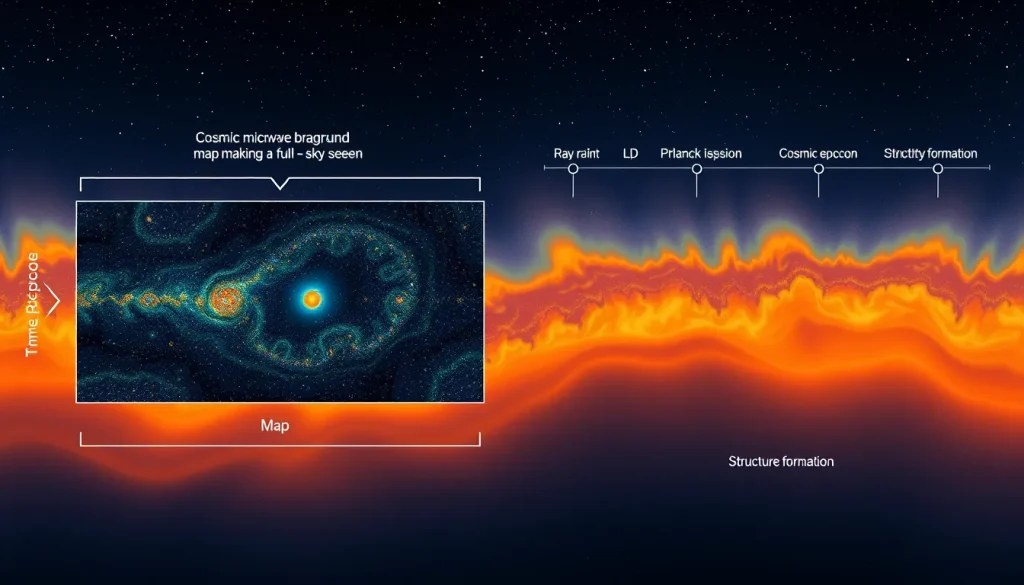
CMB map-making is the process of converting raw time-ordered data (TOD) from cosmic microwave background experiments into sky maps, compressing data by orders of magnitude while retaining all cosmological information. Optimal methods include the COBE DMR approach and Wiener filtering.
Main Explanation
The cosmic microwave background (CMB) is a relic radiation field that permeates the universe, a snapshot of the universe when it was just 380,000 years old. To extract cosmological information from this faint glow, astronomers must first translate the raw, time-ordered data recorded by detectors into maps of the sky. This process, called map-making, is a critical step in the data pipeline, reducing data volume by orders of magnitude while preserving all relevant information.
As described in a 2024 introduction to map-making (Biquard, arXiv:2405.10239), the time-ordered data (TOD) are first calibrated and quality-checked. The map-making operation then estimates the sky signal at each observed frequency. The underlying model assumes that each detector sample is a linear combination of the sky signal at the pointing direction plus noise. The goal is to invert this relationship to produce a pixelated sky map.
Max Tegmark’s seminal 1997 paper (Astrophysical Journal, 480:L87) compared ten map-making methods and proved that for Gaussian noise, both the COBE DMR team’s method and various forms of Wiener filtering are optimal: they produce maps that retain all cosmological information present in the TOD. This means that parameter estimation from the map yields error bars as small as if one had used the full TOD.
The MAXIMA experiment (Stompor et al., 2001) demonstrated these techniques in practice, producing high-resolution CMB maps that helped constrain cosmological parameters. Modern experiments like Planck use refined versions of these algorithms to produce full-sky maps with unprecedented precision.
Map-making is not just a technical necessity; it is a gateway to understanding the universe. The resulting maps are used to measure the CMB power spectrum, which encodes the physics of the early universe, including the seeds of cosmic structure.
Cosmic Epoch
The CMB we observe today is a direct relic of the early universe, and its maps allow us to probe the sequence of cosmic epochs that followed the Big Bang. Below is a timeline of the major epochs, from the Planck epoch to the formation of large-scale structure.
| Epoch | Time | Temperature | Redshift | Key Events |
|---|---|---|---|---|
| Planck epoch | <10⁻⁴³ s | >10³² K | >10³² | Quantum gravity effects dominate; all forces unified |
| Grand Unification epoch | 10⁻⁴³–10⁻³⁶ s | 10²⁷–10³² K | 10²⁷–10³² | Strong force separates from electroweak |
| Inflationary epoch | 10⁻³⁶–10⁻³² s | ~10²⁷ K | ~10²⁷ | Exponential expansion; quantum fluctuations become seeds of structure |
| Electroweak epoch | 10⁻³²–10⁻¹² s | 10¹⁵–10²⁷ K | 10¹⁵–10²⁷ | Electromagnetic and weak forces separate; W, Z bosons acquire mass |
| Quark epoch | 10⁻¹²–10⁻⁶ s | 10¹²–10¹⁵ K | 10¹²–10¹⁵ | Quarks and gluons form quark-gluon plasma |
| Hadron epoch | 10⁻⁶–1 s | 10¹⁰–10¹² K | 10¹⁰–10¹² | Protons and neutrons form; matter-antimatter asymmetry develops |
| Lepton epoch | 1–10 s | 10⁹–10¹⁰ K | 10⁹–10¹⁰ | Leptons dominate; neutrinos decouple |
| Photon epoch | 10 s–380,000 yr | 3,000–10⁹ K | 10⁹–1100 | Photons coupled to matter; Big Bang nucleosynthesis produces light elements |
| Recombination | ~380,000 yr | ~3,000 K | ~1100 | Electrons combine with protons to form neutral hydrogen; CMB released |
| Dark Ages | 380,000 yr–~150 million yr | ~50–3,000 K | ~20–1100 | No stars; universe filled with neutral hydrogen and dark matter |
| Reionization | ~150 million–1 billion yr | ~10–50 K | ~6–20 | First stars and galaxies ionize intergalactic medium |
| Structure Formation | 1 billion yr–present | <10 K | 0–6 | Galaxies, clusters, and large-scale structure form under gravity |
Each epoch is marked by a distinct physical process, and the CMB provides a direct view of the recombination epoch. The tiny temperature fluctuations in CMB maps are the seeds of all cosmic structure, magnified over billions of years by gravity.
Why It Matters
CMB maps are among the most powerful tools in cosmology. They allow us to measure the universe’s age, curvature, composition, and the parameters of the standard ΛCDM model. Without map-making, the raw data from experiments like COBE, WMAP, and Planck would be unusable. The maps themselves have confirmed inflation, constrained the nature of dark matter and dark energy, and tested our understanding of the early universe.
Moreover, the map-making techniques developed for CMB experiments have influenced data analysis in other fields, from gravitational wave astronomy to medical imaging. The ability to compress massive time-ordered data sets into informative maps while preserving all relevant information is a triumph of applied statistics.
Evidence / Sources
Key evidence supporting the CMB map-making process and the cosmic epochs includes: the detection of CMB anisotropies by COBE (1992), the measurement of the acoustic peaks by WMAP (2003) and Planck (2013), and the deep observations of the early universe by JWST. The map-making methods are validated by their ability to recover known signals and by the consistency of cosmological parameters across experiments. Sources: Biquard (2024) arXiv:2405.10239; Tegmark (1997) ApJ 480:L87; Stompor et al. (2001) arXiv:astro-ph/0106451; Hu & Dodelson (2002) Annu. Rev. Astron. Astrophys. 40:171.
Related Registry Entries
Explore related topics: Cosmic Microwave Background, Inflation, Recombination, Large-Scale Structure.
FAQ
What is CMB map-making?
CMB map-making is the process of converting raw time-ordered detector data into pixelated sky maps, compressing data by orders of magnitude while preserving all cosmological information. It involves solving a linear inversion problem, often using optimal methods like Wiener filtering or the COBE DMR approach.
Why is CMB map-making important?
Map-making is essential because raw time-ordered data are too large and complex to analyze directly. Maps allow scientists to measure the CMB power spectrum, test cosmological models, and extract parameters like the universe's age, curvature, and composition.
What are the major cosmic epochs?
The major epochs are: Planck, Grand Unification, Inflation, Electroweak, Quark, Hadron, Lepton, Photon, Recombination, Dark Ages, Reionization, and Structure Formation. Each marks a distinct phase in the universe's evolution, from the first instants to the formation of galaxies and large-scale structure.
How do COBE, WMAP, and Planck contribute?
COBE produced the first full-sky CMB map and detected anisotropies. WMAP measured the acoustic peaks with high precision, confirming the ΛCDM model. Planck provided even higher resolution and precision, refining cosmological parameters and testing inflation.
Leave a Reply