The History of BigBangRegistry.com
BigBangRegistry.com has a history that predates the current website.
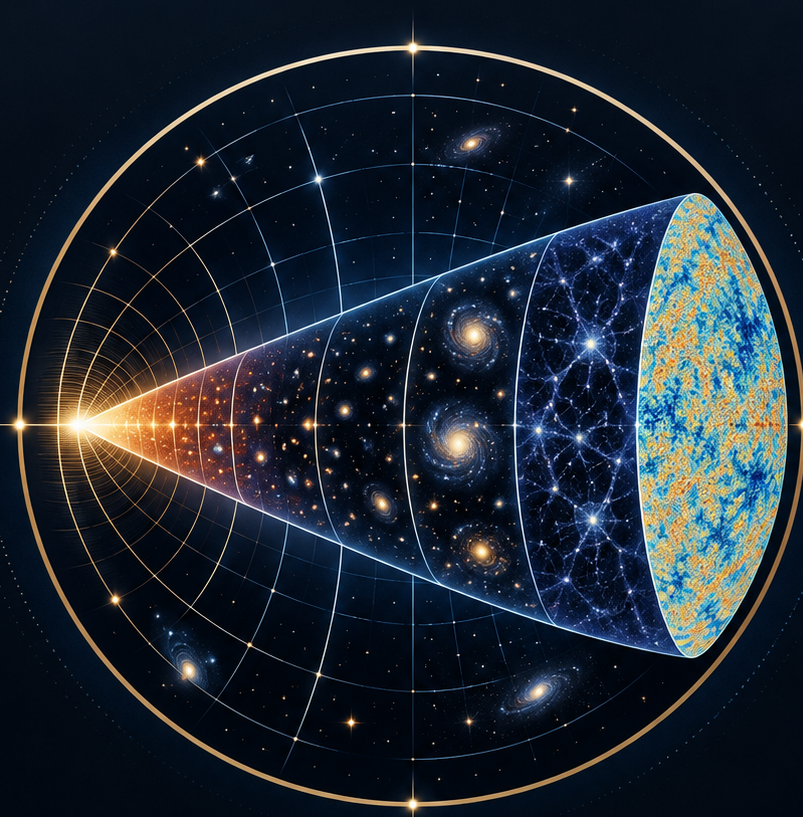
The domain was publicly associated in 2012 with an educational project built around one of the most important images in modern cosmology: the Cosmic Microwave Background, or CMB.
The current Big Bang Registry draws inspiration from that history while operating as a new and independent educational publication.
This page explains what is known about the earlier project, how the name Big Bang Registry was used, and how the present website differs from its historical predecessor.
The Original Big Bang Registry
On June 7, 2012, MinutePhysics published a video titled Picture of the Big Bang (a.k.a. Oldest Light in the Universe).
The video, created by Henry Reich, introduced viewers to the Cosmic Microwave Background and explained how this ancient radiation provides a view of the universe when it was extremely young. The official MinutePhysics video description directed viewers to explore a map of the Big Bang, while the video itself introduced BigBangRegistry.com as the destination for that interactive experience.
MinutePhysics also released a companion video on the same date titled Tour of the Map of the Big Bang. Its description specifically invited viewers to explore the Cosmic Background Radiation through BigBangRegistry.com. The video remains listed in the official MinutePhysics video archive.
The earlier Big Bang Registry therefore appears to have been conceived not as a conventional astronomy encyclopedia, but as an interactive way to explore the early universe.
Turning the Early Universe Into a Map
The central idea behind the historical project was unusual and memorable: treating the Cosmic Microwave Background almost like the geography of an unexplored world.
In the original MinutePhysics presentation, the CMB was turned into an adventure-style map. Temperature variations became map-like geographical features, and the visualization could be explored alongside information about constellations, galaxies, and an infrared view of the sky.
Visitors were also encouraged to participate by helping name features on the map.
The concept worked because the CMB really is a map of physical variations across the early universe.
The Cosmic Microwave Background is relic radiation left from the early universe. It became able to travel freely when the universe became transparent roughly 380,000 years after the Big Bang. Today, scientists observe extremely small variations in its temperature across the sky. Those variations correspond to differences in the density of the young universe and represent the seeds from which later cosmic structures developed.
NASA notes that CMB temperature variations are extraordinarily small—on the order of roughly one part in 100,000—but contain information about the density variations that ultimately contributed to the formation of the structures seen throughout the universe today.
This scientific background gave the original Big Bang Registry map its distinctive idea: the oldest observable light in the universe could be explored almost as though it were a landscape.
A Snapshot of an Earlier Era of Cosmology
The historical Big Bang Registry also appeared during an interesting period in CMB research.
NASA’s COBE mission had previously established important properties of the Cosmic Microwave Background and detected its tiny temperature anisotropies. WMAP later produced substantially more detailed all-sky measurements.
Meanwhile, ESA’s Planck mission was actively observing the sky when the original Big Bang Registry appeared in 2012. In March 2013, ESA released Planck’s first major all-sky cosmological map, providing what was then the most detailed view ever produced of the Cosmic Microwave Background.
The broader scientific context has continued to advance since then.
BigBangRegistry.com today therefore exists in a very different information environment—one in which more precise cosmological datasets, modern observatories, improved simulations, and new research into the early universe can all contribute to a much broader educational reference.
The Current Big Bang Registry
The present BigBangRegistry.com is a new, independently operated educational publication.
It is not presented as the official continuation of the original MinutePhysics project.
The current project is not affiliated with, operated by, sponsored by, or endorsed by:
- MinutePhysics;
- Henry Reich;
- the Perimeter Institute;
- NASA;
- the European Space Agency;
- the Planck Collaboration;
- the WMAP Science Team;
- or other organizations, scientists, missions, or institutions discussed on this website.
References to the earlier Big Bang Registry are included solely to document the publicly available history of the domain and the concept previously associated with it.
What We Do Not Claim
The current Big Bang Registry does not claim ownership of the original project’s intellectual property.
In particular, the current website does not claim to possess or own any historical:
- databases;
- user submissions;
- maps;
- source code;
- illustrations;
- design assets;
- documentation;
- photographs;
- datasets;
- trademarks;
- or other proprietary materials
created for an earlier version of BigBangRegistry.com unless specific rights to such material have been independently established.
Historical material will not be reproduced merely because it once appeared at this domain.
Where older material is discussed for historical or educational purposes, the goal is to identify its original context and, where possible, point readers toward relevant surviving sources.
Why Preserve the Name?
Although the current site is a new project, the basic idea behind the name Big Bang Registry remains unusually appropriate.
Modern cosmology consists of much more than a single theory or timeline.
It includes interconnected:
- cosmic epochs;
- observations;
- experiments;
- missions;
- measurements;
- cosmological parameters;
- physical processes;
- evidence;
- datasets;
- and unanswered questions.
The word Registry therefore provides a useful framework for organizing this information.
Rather than rebuilding the original website, the new project expands the broader concept into a structured reference to the beginning and evolution of the universe.
From a CMB Map to a Cosmology Registry
The historical site focused primarily on exploring the Cosmic Microwave Background.
The new Big Bang Registry keeps the CMB as an important part of its identity while expanding the scope to include the larger history of the cosmos.
Subjects covered by the current project may include:
The Big Bang
What the model says, how it developed, and what evidence supports it.
The Early Universe
Inflation, particle epochs, nucleosynthesis, recombination, and other stages in cosmic history.
The Cosmic Microwave Background
Its discovery, temperature, anisotropies, polarization, maps, and scientific importance.
Cosmic Evolution
The dark ages, cosmic dawn, first stars, galaxies, large-scale structure, and the modern universe.
Observational Evidence
Expansion, redshift, elemental abundances, CMB measurements, baryon acoustic oscillations, supernova observations, and other tests of cosmological models.
Missions and Experiments
Projects such as COBE, WMAP, Planck, and newer observational programs.
Cosmological Measurements
Quantities including the Hubble constant, matter density, dark-energy density, redshift, and other parameters.
Open Questions
Areas where scientific understanding remains incomplete or actively debated.
Respecting Scientific Uncertainty
The new project’s purpose is also different from simply creating a modern-looking version of an old map.
Big Bang Registry aims to distinguish between what has been observed, what is strongly supported by evidence, what depends upon particular models, and what remains unknown.
The CMB itself illustrates why this distinction matters.
It gives scientists the earliest view of the universe currently accessible using electromagnetic radiation and preserves information from approximately 380,000 years after the Big Bang. Yet the universe had already undergone an enormous amount of physical evolution before that light was released.
There are consequently important differences between observing evidence from the early universe and claiming direct knowledge of its earliest possible moments.
Our goal is to make those distinctions clear.
Preserving History Without Recreating It
BigBangRegistry.com has an interesting place in the history of online science communication.
The earlier project demonstrated that complex cosmological data could be presented not only as graphs and equations, but also as something readers could explore.
That idea remains valuable.
The current Big Bang Registry seeks to preserve the spirit of exploration and mapping while creating an original resource designed for today’s web and today’s understanding of cosmology.
We may document historical references to BigBangRegistry.com when they help explain the evolution of the project. However, our purpose is not to recreate an unavailable website pixel by pixel or to imply institutional continuity where none exists.
Instead, we are building something new.
A New Chapter
The original Big Bang Registry invited people to explore a map of the oldest observable light in the universe.
The new Big Bang Registry begins from the same fundamental curiosity but asks a broader question:
What if the history of the universe itself could be explored as a connected registry?
From the earliest cosmic epochs to the CMB, from the first stars to modern cosmological measurements, the current project is being developed as an independent reference for understanding how scientists reconstruct the history of our universe.
The website has changed.
The science has advanced.
But the underlying invitation remains compelling:
Explore the beginning of the universe.
Big Bang Registry — Mapping the Beginning of the Universe.