

Short Answer
Key Facts
| Core Problem | Matter–antimatter imbalance (baryon asymmetry) |
| First Formalized | Andrei Sakharov, 1967 |
| Excess Ratio | Roughly 1 excess baryon per ~10⁹ particle–antiparticle pairs |
| Consensus Model | Lambda-CDM (standard cosmological model) |
| Status | Unsolved; requires physics beyond the Standard Model |
| Key Observational Missions | COBE, WMAP, Planck, JWST |
Main Explanation
The Cosmic Asymmetry
Everything scientists know about particle physics, summarized in the Standard Model, indicates that the Big Bang should have produced equal quantities of matter and antimatter. Antimatter consists of partner particles for every regular particle—identical in every way except for opposite electric charge. When a particle and its antiparticle collide, they destroy one another completely, converting their mass into pure energy. If creation had been perfectly symmetric, the universe would have annihilated itself long ago, leaving behind nothing but light in an empty cosmos.
Yet we exist. The fact that enough leftover matter survived this great annihilation to form galaxies, stars, and planets—while virtually no antimatter remains—is what physicists call the matter–antimatter imbalance. This existential anomaly is one of the most profound unsolved puzzles in cosmology.
The Cosmic Epochs: A Timeline
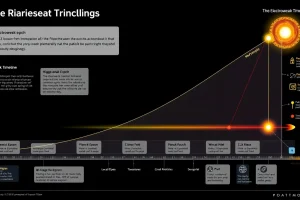
The history of the universe is conventionally divided into distinct epochs, each characterized by its own dominant physical processes and particle content. The following table summarizes the major epochs from the Planck era to the present day.
| Epoch | Time After Big Bang | Temperature | Key Events |
|---|---|---|---|
| Planck Epoch | 0 to ~10⁻⁴³ s | >10³² K | Quantum gravity dominates; no current theory describes this era. |
| Grand Unification Epoch | ~10⁻⁴³ to ~10⁻³⁶ s | ~10²⁸ K | Strong and electroweak forces unified; possible origin of asymmetry. |
| Inflationary Epoch | ~10⁻³⁶ to ~10⁻³² s | ~10²⁷ K | Exponential expansion smooths and flattens the universe; quantum fluctuations seed structure. |
| Electroweak Epoch | ~10⁻³² to ~10⁻¹² s | ~10¹⁵ K | Electromagnetic and weak forces separate; electroweak symmetry breaking. |
| Quark Epoch | ~10⁻¹² to ~10⁻⁶ s | ~10¹² K | Quarks and gluons form a quark–gluon plasma. |
| Hadron Epoch | ~10⁻⁶ to ~1 s | ~10¹⁰ K | Quarks combine into hadrons (protons, neutrons); matter–antimatter annihilation proceeds. |
| Lepton Epoch | ~1 to ~10 s | ~10⁹ K | Leptons dominate; electron–positron pairs annihilate. |
| Photon Epoch | ~10 s to ~380,000 yr | ~10⁹ to ~3,000 K | Photons dominate; primordial nucleosynthesis forms light elements. |
| Recombination | ~380,000 yr | ~3,000 K | Electrons combine with nuclei to form neutral atoms; the cosmic microwave background is released. |
| Dark Ages | ~380,000 yr to ~150 million yr | ~3,000 to ~60 K | The universe is dark and neutral; no stars have yet formed. |
| Reionization | ~150 million to ~1 billion yr | ~60 to ~20 K | First stars and galaxies ionize the intergalactic medium. |
| Structure Formation | ~1 billion yr to present | <20 K | Galaxies, clusters, and large-scale structure assemble; dark energy accelerates expansion. |
The Sakharov Conditions
In 1967, Soviet physicist Andrei Sakharov identified three necessary conditions that any interaction must satisfy to generate a baryon asymmetry. First, baryon number violation must occur—processes that change the number of baryons. Second, C-symmetry and CP-symmetry violation must be present, meaning the physics of particles differs from that of antiparticles. Third, departure from thermal equilibrium is required, so that the asymmetry is not washed out by inverse reactions. The Standard Model provides some—but not enough—CP violation, and its baryon-number-violating processes are too weak. This is why physicists believe new physics beyond the Standard Model is needed.
Inflation and the Early Universe
The inflationary epoch, a period of exponential expansion lasting from roughly 10⁻³⁶ to 10⁻³² seconds after the Big Bang, played a crucial role in shaping the cosmos. Inflation stretched quantum fluctuations to macroscopic scales, seeding the density variations that later grew into galaxies and galaxy clusters. It also smoothed and flattened the universe, explaining why the cosmic microwave background is so remarkably uniform. Some theories of baryogenesis tie the creation of the matter–antimatter asymmetry to the end of inflation, when the enormous energy stored in the inflaton field was converted into particles.
The First Atoms and the Cosmic Microwave Background
For the first ~380,000 years, the universe was a hot, dense plasma of protons, electrons, and photons. Photons constantly scattered off free electrons, making the universe opaque. As the universe expanded and cooled to about 3,000 K, electrons combined with protons and helium nuclei to form neutral atoms—a process called recombination. At that moment, photons decoupled from matter and began traveling freely. Those photons have been cooling ever since and now form the cosmic microwave background (CMB), a faint glow of radiation at 2.725 K that fills the entire sky. Missions such as COBE, WMAP, and Planck have mapped the CMB with extraordinary precision, revealing tiny temperature fluctuations that encode the seeds of cosmic structure.
Dark Ages, Reionization, and Structure Formation
After recombination, the universe entered the Dark Ages—a period with no stars or galaxies, only neutral hydrogen and helium. Gravity slowly amplified the density fluctuations seeded by inflation, causing matter to clump. Around 150 million years after the Big Bang, the first stars ignited, ending the Dark Ages and beginning reionization. The intense ultraviolet light from these first stars and galaxies stripped electrons from neutral hydrogen, ionizing the intergalactic medium. Over the next billion years, galaxies assembled into clusters and filaments, forming the large-scale structure we observe today. The James Webb Space Telescope (JWST) is now probing this cosmic dawn, revealing galaxies that existed just a few hundred million years after the Big Bang.
Key Missions and Their Revelations
NASA’s COBE mission (1989–1993) made the first precise measurements of the CMB spectrum and discovered its tiny temperature anisotropies. WMAP (2001–2010) refined these measurements, pinning down the age of the universe at 13.8 billion years and the flat geometry of space. The Planck satellite (2009–2013) achieved even higher resolution, providing the definitive CMB dataset that underpins the Lambda-CDM model. JWST, launched in 2021, is now extending these observations to the era of first-star formation and reionization.
Question Article
Short Answer
The universe contains vastly more matter than antimatter because of an asymmetry that arose in the first moments after the Big Bang. The exact mechanism is unknown, but it must involve baryon number violation, CP violation, and a departure from thermal equilibrium—the three Sakharov conditions.
What We Know
We know with high confidence that the observable universe contains essentially no primordial antimatter. The cosmic microwave background, the abundances of light elements from Big Bang nucleosynthesis, and the absence of annihilation radiation from galaxy boundaries all confirm this. We also know that the asymmetry must have been established very early, before nucleosynthesis began at about one second after the Big Bang, because the predicted light-element abundances match observations only if matter dominated by then.
What We Don’t Know
The fundamental question remains: what physical process created the asymmetry? The Standard Model does not contain enough CP violation to explain the observed baryon-to-photon ratio of roughly 6 × 10⁻¹⁰. Physicists do not yet know whether the asymmetry was generated during inflation, at the electroweak phase transition, through leptogenesis, or via some other mechanism entirely.
Evidence
Observational evidence for the asymmetry comes from multiple independent lines. The cosmic microwave background shows no signs of matter–antimatter annihilation at recombination. Big Bang nucleosynthesis predicts light-element abundances that match observations only if the baryon density is consistent with a matter-dominated universe. Searches for antinuclei in cosmic rays and for gamma rays from annihilation at galaxy-cluster boundaries have found no primordial antimatter.
Competing Explanations
Several competing hypotheses attempt to explain baryogenesis. Electroweak baryogenesis relies on the electroweak phase transition and requires new sources of CP violation. Leptogenesis proposes that a lepton asymmetry was generated first and then converted into a baryon asymmetry. Affleck–Dine baryogenesis involves scalar fields in supersymmetric theories. Baryogenesis during reheating ties the asymmetry to the decay of the inflaton field after inflation. None of these has achieved consensus, and all require physics beyond the Standard Model.
Current Research
Current research focuses on searching for new sources of CP violation in particle physics experiments, such as the LHCb experiment at CERN, which studies matter–antimatter asymmetries in B-meson decays. Cosmological surveys, including those using the CMB and large-scale structure, continue to constrain the parameters of the early universe. Future experiments, including next-generation CMB observatories and dark-energy surveys, may indirectly probe the physics of baryogenesis through their measurements of neutrino masses and other fundamental parameters.
Why It Matters
The matter–antimatter asymmetry is not an abstract curiosity. It is the reason anything exists at all. Every atom in your body, every star in the sky, and every galaxy in the observable universe is a survivor of the cosmic annihilation that should have erased everything. Understanding why matter won is essential to completing our picture of the universe’s origin and evolution. It also points directly to physics beyond the Standard Model—new particles, new forces, or new symmetries that governed the first moments of creation. Solving the baryon asymmetry problem would be a monumental step toward a deeper theory of nature, one that unifies the quantum world with the cosmos.
Evidence / Sources
The following sources provide authoritative grounding for the content presented in this article:
- Scientific American (2024) — “Why Aren’t We Made of Antimatter?” by Luke Caldwell, discusses the Standard Model’s prediction of equal matter and antimatter and the mystery of the imbalance. scientificamerican.com/article/why-arent-we-made-of-antimatter/
- Wikipedia — “Baryon asymmetry” entry, detailing the Sakharov conditions and competing baryogenesis hypotheses. en.wikipedia.org/wiki/Baryon_asymmetry
- Scientific American (2019) — “Why Is There More Matter Than Antimatter?” by Marco Gersabeck, discussing LHCb results at CERN. scientificamerican.com/article/why-is-there-more-matter-than-antimatter/
- New Journal of Physics (2012) — “Matter and antimatter in the universe” by Canetti, Drewes, and Shaposhnikov, a comprehensive review of the observational evidence. iopscience.iop.org/article/10.1088/1367-2630/14/9/095012
Related Registry Entries
- Cosmic Microwave Background — The relic radiation from recombination, a primary observational anchor for the Lambda-CDM model.
- Cosmic Inflation — The epoch of exponential expansion that seeded structure and may have set the stage for baryogenesis.
- Big Bang Nucleosynthesis — The production of light elements in the first minutes, which constrains the baryon density.
- Lambda-CDM Model — The standard cosmological model that incorporates dark matter, dark energy, and the CMB framework.
- Reionization and First Stars — The cosmic dawn when the first stars and galaxies transformed the neutral universe.
FAQ
What is the matter–antimatter asymmetry?
The matter–antimatter asymmetry, also known as the baryon asymmetry problem, is the observed imbalance between matter and antimatter in the universe. The Big Bang should have produced equal amounts of both, but matter vastly outnumbers antimatter, and the reason remains unknown.
What are the Sakharov conditions?
In 1967, Andrei Sakharov proposed three necessary conditions for generating a baryon asymmetry: baryon number violation, C-symmetry and CP-symmetry violation, and a departure from thermal equilibrium. These conditions guide all current theories of baryogenesis.
Could there be antimatter galaxies?
No observational evidence supports the existence of antimatter galaxies. If they existed, they would produce detectable gamma rays at their boundaries where matter and antimatter annihilate. No such emissions have been observed, and cosmic-ray surveys find no antinuclei.
How do we know the universe is mostly matter?
Multiple independent observations confirm this: the cosmic microwave background shows no annihilation signatures, Big Bang nucleosynthesis light-element abundances match a matter-dominated universe, and cosmic-ray detectors find no primordial antimatter particles.
References
- https://www.scientificamerican.com/article/why-arent-we-made-of-antimatter/
- https://en.wikipedia.org/wiki/Baryon_asymmetry
- https://www.scientificamerican.com/article/why-is-there-more-matter-than-antimatter/
- https://iopscience.iop.org/article/10.1088/1367-2630/14/9/095012
Related Articles
Leave a Reply