
Short Answer
Main Explanation
Big Bang nucleosynthesis (BBN) is the era in the first few minutes of cosmic history when the cooling universe produced the first atomic nuclei heavier than ordinary hydrogen. According to the standard hot Big Bang model, the early universe was a dense, hot plasma of radiation and elementary particles. As space expanded, the plasma cooled, and for a brief window the temperature and density were just right for protons and neutrons to fuse into deuterium, helium-3, helium-4, and lithium-7. The process is sometimes called primordial nucleosynthesis because it set the initial abundances of the light elements long before any star existed.
The predictions of BBN are a cornerstone of modern cosmology. They depend on well-understood nuclear reaction rates and thermodynamic conditions in the early universe, and they agree remarkably well with the primordial abundances inferred from astronomical observations. This agreement spans about nine orders of magnitude, from a helium-4 abundance of roughly 8 percent by number relative to hydrogen down to lithium-7 at about one part in ten billion.
BBN did not make the heavier elements of the periodic table. Elements beyond lithium were produced much later inside stars, through stellar nucleosynthesis during the lives and deaths of stars. BBN is therefore a clean probe of the universe when it was only seconds to minutes old.
A Timeline of the Early Universe
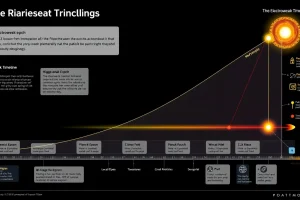
The standard Lambda-CDM cosmology divides the earliest history into epochs defined by the dominant physical processes. The following table summarizes the major stages from the Planck epoch to the present.
| Epoch | Approximate Time After Big Bang | Key Events |
|---|---|---|
| Planck epoch | Earlier than 10−43 s | Quantum gravity dominates; current physics cannot yet describe this era. |
| Grand unification epoch | 10−43 to 10−36 s | Strong and electroweak forces may have been unified; possible baryogenesis. |
| Inflationary epoch | About 10−36 to 10−32 s | Extremely rapid expansion stretches quantum fluctuations to cosmic scales. |
| Electroweak epoch | 10−32 to 10−12 s | Electromagnetic and weak forces separate; Higgs field gives particles mass. |
| Quark epoch | 10−12 to 10−6 s | Quarks, leptons, and gluons form a hot quark–gluon plasma. |
| Hadron epoch | 10−6 to 1 s | Quarks combine into protons and neutrons; matter and antimatter annihilate. |
| Lepton epoch | 1 s to 10 s | Leptons and antileptons dominate; neutrinos decouple. |
| Photon epoch | 10 s to about 380,000 years | Photons dominate the energy density; BBN occurs in the first minutes. |
| Recombination | About 380,000 years | Electrons combine with nuclei to form neutral atoms; CMB released. |
| Dark Ages | 380,000 years to first stars | Universe is neutral and dark; no stars or galaxies yet. |
| Reionization | Roughly 150 million to 1 billion years | First stars and galaxies ionize intergalactic hydrogen. |
| Structure formation | From first stars to present | Galaxies, clusters, and cosmic web grow under gravity. |
BBN belongs to the photon epoch, but its nuclear reactions begin within the first second and are essentially complete after about three to twenty minutes. The exact duration depends on how one defines the start, but the key point is that the universe had to cool enough for deuterium to survive without being immediately photodisintegrated by high-energy photons.
The BBN Epoch in Detail
When It Happened
BBN occurred during the first few minutes of cosmic time. The conditions that determined the final abundances were set even earlier, around one second after the Big Bang, when the temperature was about 1 MeV and weak interactions that interconverted protons and neutrons fell out of equilibrium. The actual fusion of light nuclei then proceeded from roughly one second to a few minutes, ending when the universe became too cool and diffuse for nuclear reactions to continue.
Temperature
The relevant temperature for BBN was around 1 MeV, which corresponds to roughly 10 billion kelvin. At higher temperatures, any deuterium that formed would have been quickly broken apart by energetic photons. As the universe expanded and cooled below this threshold, deuterium could survive long enough to participate in further reactions that built helium and lithium.
Approximate Redshift
BBN took place at a cosmological redshift of roughly 109 to 1010. At such extreme redshifts, the scale factor of the universe was about a billion times smaller than it is today, and the average density and temperature were correspondingly enormous.
Dominant Particles/Physics
The main actors in BBN were protons, neutrons, electrons, positrons, neutrinos, and photons. Protons and neutrons are baryons, and their ratio was crucial. Because the neutron is slightly heavier than the proton, the equilibrium favored protons. Once weak interactions froze out, free neutrons began to decay with a half-life of about 15 minutes, further reducing the number available for fusion. The surviving neutrons were mostly captured into helium-4, which is very stable.
What Happened
The first step was the formation of deuterium, a hydrogen isotope with one proton and one neutron. Before the universe cooled enough, deuterium was fragile: high-energy photons would break it apart as soon as it formed. This ‘deuterium bottleneck’ delayed heavier-element production. Once the temperature dropped sufficiently, deuterium survived, and a chain of reactions rapidly converted much of it into helium-4. Small amounts of deuterium, helium-3, and lithium-7 remained. The predicted primordial abundances are about 0.08 for helium-4 relative to hydrogen by number, with deuterium and helium-3 at much lower levels and lithium-7 around 10−10 relative to hydrogen.
What Came Before
Before BBN, the universe passed through the Planck, grand unification, inflationary, electroweak, quark, and hadron epochs. By the end of the hadron epoch, protons and neutrons had formed from quarks, and most matter–antimatter pairs had annihilated, leaving a small excess of matter. The lepton epoch followed, during which electrons, positrons, and neutrinos were abundant. BBN began as the lepton epoch gave way to the photon epoch.
What Came Next
After BBN, the universe remained a hot plasma of nuclei, electrons, and photons for hundreds of thousands of years. At about 380,000 years after the Big Bang, the temperature fell to around 3,000 K, allowing electrons to combine with nuclei to form neutral atoms. This event, called recombination, released the cosmic microwave background (CMB). The universe then entered the Dark Ages, followed by the formation of the first stars and galaxies, reionization, and the growth of large-scale structure.
Evidence
The strongest evidence for BBN comes from measuring the primordial abundances of deuterium, helium-3, helium-4, and lithium-7 in environments that have undergone little stellar processing. Observations of ancient, metal-poor gas clouds and dwarf galaxies provide estimates of these abundances. The agreement between predicted and observed values is a major success of the standard hot Big Bang model. The CMB also provides an independent check: its temperature and density fluctuations are consistent with the same baryon density inferred from BBN.
Why It Matters
BBN is one of the few direct probes of the universe when it was only seconds to minutes old. Because the physics is based on well-tested nuclear and particle physics, BBN offers a reliable way to test cosmology and to constrain the density of ordinary baryonic matter. It also places limits on new physics beyond the Standard Model, such as additional neutrino species or changes in fundamental constants. The fact that predicted light-element abundances match observations across nine orders of magnitude is a powerful validation of the Big Bang framework.
BBN also connects the very early universe to later cosmic history. The hydrogen and helium produced in the first minutes became the raw material for the first stars. Those stars later forged heavier elements and helped reionize the universe. Thus BBN is not an isolated event; it is the bridge between the primordial plasma and the emergence of structure.
Evidence / Sources
Modern cosmology has tested BBN with a combination of laboratory nuclear physics, astronomical abundance measurements, and CMB observations. Satellite missions and observatories have played key roles:
- COBE measured the near-perfect blackbody spectrum of the CMB and found tiny temperature fluctuations, confirming that the early universe was hot and nearly uniform.
- WMAP refined the CMB temperature and polarization maps, pinning down the baryon density and the age of the universe.
- Planck provided the most precise CMB maps to date, yielding a baryon density consistent with BBN predictions.
- JWST is now observing the first galaxies and the era of reionization, testing how the light elements from BBN were incorporated into the first stars.
The standard Lambda-CDM model remains the consensus framework. Within this model, BBN, the CMB, and large-scale structure observations all point to a consistent picture: a hot, dense beginning, a brief period of nucleosynthesis, and a long subsequent history of expansion, cooling, and structure formation.
Related Registry Entries
- Big Bang — the prevailing cosmological model for the origin and evolution of the universe.
- Cosmic Microwave Background — relic radiation released at recombination, about 380,000 years after the Big Bang.
- Recombination — the epoch when electrons and nuclei combined to form neutral atoms.
- Dark Ages — the period after recombination before the first stars formed.
- Reionization — the era when the first luminous sources ionized intergalactic hydrogen.
- Primordial abundance — the initial abundances of light elements set by BBN.
FAQ
What elements did Big Bang nucleosynthesis create?
It produced the light isotopes deuterium (hydrogen-2), helium-3, helium-4, and lithium-7. Heavier elements were made later in stars.
When did Big Bang nucleosynthesis occur?
The key nuclear reactions took place from about one second to a few minutes after the Big Bang, when the universe had cooled to about 1 MeV (roughly 10 billion kelvin).
Why couldn't BBN make carbon or oxygen?
The universe expanded and cooled too quickly, and there are no stable nuclei with mass number 5 or 8 to serve as stepping stones. Heavier elements require the high densities and long timescales inside stars.
How do we know BBN really happened?
The predicted abundances of deuterium, helium, and lithium match observations of ancient, metal-poor gas clouds and dwarf galaxies. The CMB also gives a consistent baryon density.

Leave a Reply