Short Answer
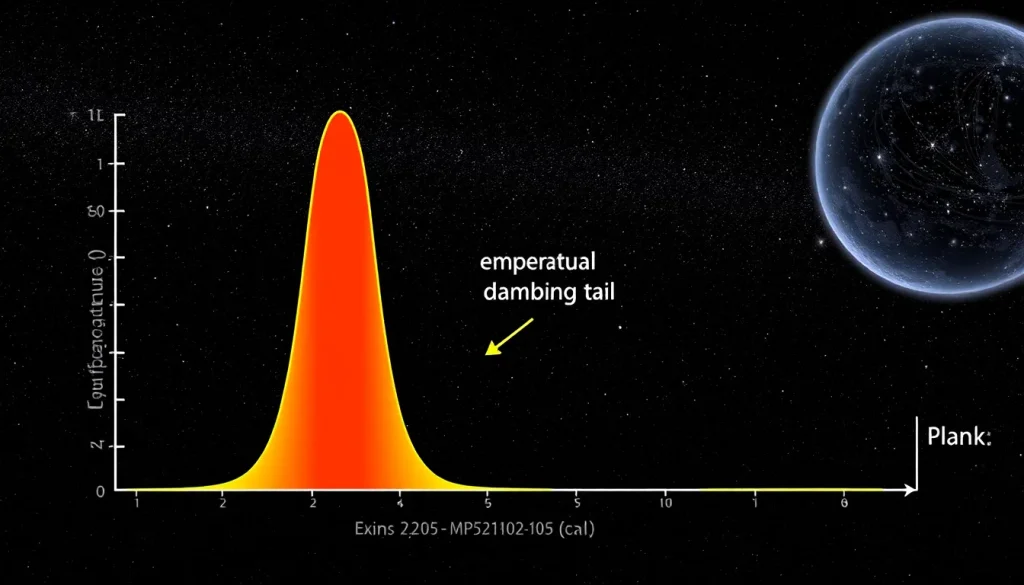
The damping tail is the region of the cosmic microwave background (CMB) power spectrum at high multipoles (small angular scales) where the amplitude of temperature fluctuations is exponentially suppressed. This suppression arises from the diffusion of photons out of overdense regions before the epoch of recombination, an effect known as Silk damping. The damping tail is a powerful probe of the baryon density, the expansion history, and the physics of the primordial plasma, and it has been precisely measured by the COBE, WMAP, and Planck satellites.
| Property | Value |
|---|---|
| Definition | High-ℓ region of the CMB power spectrum where temperature fluctuations are exponentially damped |
| Physical cause | Photon diffusion (Silk damping) and the finite thickness of the last-scattering surface |
| Angular scale | Typically ℓ ≳ 1000 (arcminute scales and smaller) |
| First measured | COBE (1992), then WMAP (2003), and Planck (2013–2018) |
| Key theoretical work | Hu & White (1997) decomposed the damping tail into transfer functions |
Main Explanation
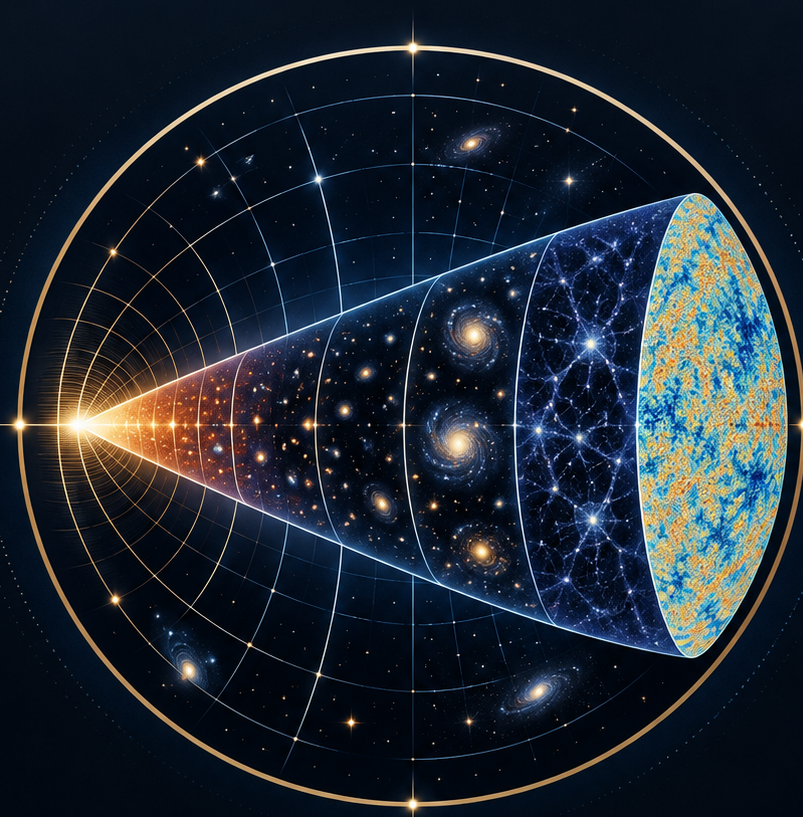
The cosmic microwave background is a snapshot of the universe when it was about 380,000 years old, at the moment photons decoupled from baryons. The temperature fluctuations in the CMB encode the initial density perturbations that seeded the formation of galaxies and clusters. These fluctuations are statistically described by the angular power spectrum, which plots the variance of temperature fluctuations as a function of angular multipole ℓ (roughly 180°/θ).
At low multipoles (large angular scales), the spectrum is dominated by the Sachs–Wolfe effect and the acoustic peaks. At high multipoles (small angular scales), the spectrum falls off exponentially—this is the damping tail. The physical mechanism is photon diffusion: before recombination, photons and baryons were tightly coupled via Thomson scattering, but the finite mean free path of photons allowed them to random-walk out of overdense regions, erasing small-scale temperature anisotropies. This process, first analyzed by Joseph Silk in 1968, is called Silk damping. The damping tail is also affected by the finite thickness of the last-scattering surface, which smears small-scale features.
In their 1997 paper, Wayne Hu and Martin White decomposed the damping tail into a series of transfer functions representing individual physical effects, such as diffusion damping and reionization damping. They showed that these effects are largely model-independent and provide robust constraints on the background cosmology. Removing these effects reveals model-dependent processes like acoustic peak modulation and gravitational enhancement, which can distinguish between different models of structure formation.
The damping tail is a standard ruler for cosmology. Its shape depends on the baryon density (which affects the photon diffusion length), the Hubble constant, and the epoch of recombination. Precise measurements of the damping tail by WMAP and Planck have helped pin down the baryon density to about 5% of the critical density and have confirmed the predictions of the ΛCDM model.
Cosmic Epochs and the CMB
The CMB and its damping tail are intimately connected to the thermal history of the universe. The following table summarizes the major epochs from the Planck epoch to the present day, highlighting the role of the CMB.
| Epoch | Time after Big Bang | Temperature | Redshift | Key Events |
|---|---|---|---|---|
| Planck epoch | < 10⁻⁴³ s | > 10³² K | > 10³² | Quantum gravity effects dominate; all forces unified |
| Grand Unification epoch | 10⁻⁴³ – 10⁻³⁶ s | 10²⁸ – 10³² K | 10²⁸ – 10³² | Strong force separates from electroweak |
| Inflationary epoch | 10⁻³⁶ – 10⁻³² s | ~10²⁸ K | ~10²⁸ | Exponential expansion; quantum fluctuations seeded |
| Electroweak epoch | 10⁻³² – 10⁻¹² s | 10¹⁵ – 10²⁸ K | 10¹⁵ – 10²⁸ | Electromagnetic and weak forces separate |
| Quark epoch | 10⁻¹² – 10⁻⁶ s | 10¹² – 10¹⁵ K | 10¹² – 10¹⁵ | Quarks and gluons form quark–gluon plasma |
| Hadron epoch | 10⁻⁶ – 1 s | 10¹⁰ – 10¹² K | 10¹⁰ – 10¹² | Protons and neutrons form; baryogenesis |
| Lepton epoch | 1 – 10 s | 10⁹ – 10¹⁰ K | 10⁹ – 10¹⁰ | Leptons dominate; neutrinos decouple |
| Photon epoch | 10 s – 380,000 yr | 3,000 – 10⁹ K | 1,100 – 10⁹ | Photons dominate; Big Bang nucleosynthesis |
| Recombination | ~380,000 yr | ~3,000 K | ~1,100 | Electrons and protons form hydrogen; photons decouple → CMB |
| Dark Ages | 380,000 yr – ~150 million yr | ~3,000 K – ~50 K | 1,100 – ~20 | No luminous sources; neutral hydrogen |
| Reionization | ~150 million – 1 billion yr | ~50 K – ~10 K | 20 – 6 | First stars and galaxies reionize hydrogen |
| Structure Formation | ~1 billion yr – present | ~10 K – 2.7 K | 6 – 0 | Galaxies, clusters, and large-scale structure form |
Concept
Definition
The damping tail is the portion of the CMB temperature power spectrum at high multipoles (ℓ ≳ 1000) where the power is exponentially suppressed relative to the acoustic peaks. It is also called the Silk damping tail, after Joseph Silk who first described the diffusion damping mechanism.
How It Works
Before recombination, photons and baryons were coupled through Thomson scattering, forming a photon–baryon fluid. Density perturbations in this fluid oscillated as acoustic waves. However, photons had a finite mean free path, so they could diffuse from high-density regions to low-density regions, erasing small-scale perturbations. The diffusion length scale depends on the baryon density and the expansion rate. After recombination, the photons free-stream, carrying the imprint of this damping.
Equation
The damping envelope is often approximated as an exponential suppression: Cℓ ∝ exp[−(ℓ/ℓd)²], where ℓd is the damping multipole. The exact form involves a transfer function that depends on the diffusion scale and the thickness of the last-scattering surface. Hu & White (1997) provide a detailed decomposition into diffusion and reionization damping transfer functions.
Example
In the Planck 2018 power spectrum, the damping tail is clearly visible for ℓ between ~1000 and ~2500, where the power falls by more than an order of magnitude from the third acoustic peak. The precise shape of this falloff constrains the baryon density Ωbh² to about 0.022, consistent with Big Bang nucleosynthesis.
Observable Consequences
The damping tail affects the CMB temperature anisotropies on arcminute scales. It also generates polarization in the CMB, because the diffusion of photons creates a quadrupole anisotropy that leads to linear polarization. The damping tail is also a source of gravitational lensing signal, as the small-scale features are lensed by intervening matter.
Common Misconceptions
One misconception is that the damping tail is caused by the expansion of the universe. In fact, it is caused by photon diffusion before recombination. Another is that the damping tail is a separate physical component; it is simply the high-ℓ extension of the same power spectrum that contains the acoustic peaks.
Why It Matters
The damping tail is a precision probe of the baryon density and the physics of the early universe. Because the diffusion length depends on the baryon density and the Hubble rate, measuring the damping tail allows cosmologists to constrain these parameters independently of other probes. It also tests the standard model of recombination and the thermal history. The agreement between the predicted and observed damping tail is a major success of the ΛCDM model. Moreover, the damping tail is the primary source of CMB polarization on small scales, which is used to search for primordial gravitational waves and to measure gravitational lensing.
Evidence / Sources
The existence of the damping tail was predicted theoretically long before it was measured. The first detection of the CMB power spectrum by COBE in 1992 showed a hint of the damping, but it was WMAP (2003) that clearly resolved the acoustic peaks and the onset of the damping tail. The Planck mission (2013–2018) measured the damping tail with unprecedented precision, confirming the exponential suppression and providing tight constraints on cosmological parameters.
Key theoretical work includes Hu & White (1997), “The Damping Tail of Cosmic Microwave Background Anisotropies,” which decomposed the damping tail into transfer functions and calibrated the effects of diffusion and reionization damping. Wayne Hu’s presentation “The Silk Damping Tail of the CMB” (2002) further explains the physics and its use as a standard ruler.
- Hu, W., & White, M. (1997). The Damping Tail of Cosmic Microwave Background Anisotropies. The Astrophysical Journal, 479(2), 568–576. doi:10.1086/303928
- Hu, W. (2002). The Silk Damping Tail of the CMB. Presentation, Oxford. https://background.uchicago.edu/~whu/Presentations/joe60w.pdf
- Planck Collaboration (2020). Planck 2018 results. Astronomy & Astrophysics, 641, A6.
Related Registry Entries
FAQ
What causes the damping tail in the CMB power spectrum?
The damping tail is caused by photon diffusion (Silk damping) in the photon–baryon fluid before recombination. Photons random-walk out of overdense regions, erasing small-scale temperature fluctuations. The finite thickness of the last-scattering surface also contributes to the suppression.
Why is the damping tail important for cosmology?
The damping tail provides precise constraints on the baryon density, the Hubble constant, and the epoch of recombination. Its shape is sensitive to the physics of the early universe and serves as a standard ruler for measuring cosmological parameters.
How was the damping tail measured?
The damping tail was first hinted at by COBE in 1992, then clearly resolved by WMAP in 2003, and measured with high precision by the Planck satellite from 2013 to 2018. These missions mapped the CMB temperature anisotropies on arcminute scales.
Does the damping tail affect CMB polarization?
Yes, the same diffusion process that damps temperature anisotropies also generates linear polarization in the CMB. The polarization signal in the damping tail is used to study gravitational lensing and to search for primordial gravitational waves.
Leave a Reply