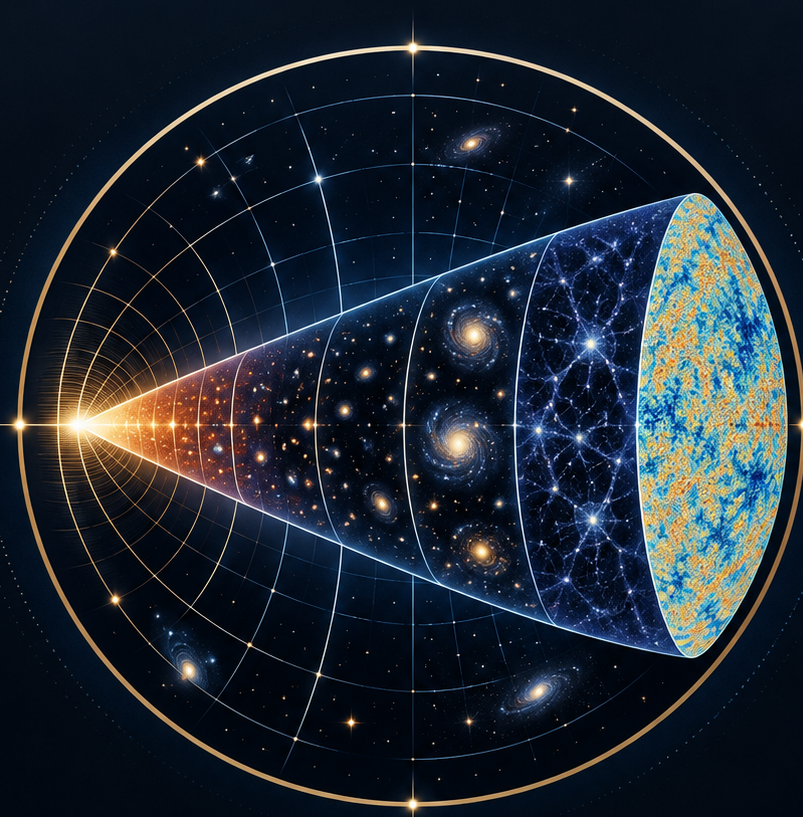
Interactive Cosmic Timeline
Slide from the first sliver of a second after the Big Bang all the way to today. The axis below is logarithmic, so each step to the right covers vastly more time than the last — the only way to fit 10−43 seconds and 13.8 billion years on one line. Drag the handle, press Play, or pick an epoch to read its entry.
Planck Epoch
Before 10⁻⁴³ seconds — where our physics runs out.
The earliest instant we can name, before the universe reached the Planck time of about 10⁻⁴³ seconds. At these energies gravity is expected to be as strong as the other three forces, so describing this era would require a quantum theory of gravity that we do not yet have. Temperatures approached the Planck temperature, roughly 1.4 × 10³² K.
Grand Unification Epoch
Gravity separates; the other forces stay merged.
As the universe expanded and cooled below the Planck temperature, gravity is thought to have frozen out as a separate force while the strong, weak and electromagnetic interactions remained merged in a single "grand unified" force. The theories that describe this (GUTs) are well motivated but have not been confirmed by experiment.
Inflationary Epoch
A sliver of a second of runaway expansion that shaped everything.
In a tiny fraction of a second the universe is thought to have expanded by a factor of at least 10²⁶. Inflation neatly explains why the cosmos is so flat and uniform, why no magnetic monopoles are seen, and it plants the microscopic quantum fluctuations later imprinted on the CMB. The temperature plummeted during the expansion and then "reheating" refilled the universe with particles. The field that drove inflation is still unknown, which is why the mechanism remains an open question even though the evidence for inflation is strong.
Electroweak Epoch
The electromagnetic and weak forces still act as one.
After inflation the universe was a searing soup of particles in which the electromagnetic and weak nuclear forces behaved as a single electroweak force. This ended at about 10⁻¹² seconds — an energy near 100 GeV, or ~10¹⁵ K — when the Higgs field switched on, gave mass to the W and Z bosons, and split the two forces apart. This is the highest-energy epoch we can probe directly, at the Large Hadron Collider.
Quark Epoch
A quark–gluon plasma far too hot for protons to form.
All four fundamental forces now act separately, but the universe is still far too hot for quarks to bind together. Instead they roam freely as a quark–gluon plasma, mixed with gluons and other particles. Heavy-ion collisions at RHIC and the LHC briefly recreate this exotic state of matter in the laboratory.
Hadron Epoch
Quarks bind into protons and neutrons.
As the universe cooled through about a trillion kelvin, quarks became locked together into hadrons — including the protons and neutrons that make up ordinary matter. Most matter and antimatter then annihilated, leaving a tiny residual excess of matter, about one part in a billion, from which everything we see today is built.
Lepton Epoch
Leptons dominate; neutrinos go their own way.
With most hadrons and antihadrons annihilated, leptons — electrons, positrons and neutrinos — dominated the mass-energy of the universe. At around one second the neutrinos stopped interacting and streamed freely, forming a cosmic neutrino background that still fills space today. Electron–positron annihilation followed as the temperature kept falling.
Big Bang Nucleosynthesis
The first atomic nuclei are forged in minutes.
For a few minutes the entire universe was a nuclear furnace. Protons and neutrons fused into deuterium and then helium-4 — about a quarter of all ordinary matter by mass — with traces of helium-3 and lithium-7. The abundances predicted for these light elements match what we measure in the oldest gas remarkably well, making nucleosynthesis one of the strongest pillars of Big Bang cosmology.
Photon Epoch
An opaque, radiation-filled fog of plasma and light.
After nucleosynthesis, the energy of the universe was dominated by photons. Ordinary matter existed as a hot plasma of nuclei and free electrons that scattered light endlessly, so the universe was opaque — like being inside a star. At around 50,000 years the density of matter finally overtook that of radiation, setting the stage for structure to grow.
Recombination
Atoms form, the fog lifts, and the CMB is set free.
As the universe cooled to about 3,000 K, electrons and protons combined into neutral hydrogen atoms and light was free to travel at last. That released radiation — stretched by expansion into microwaves — is the cosmic microwave background we still detect today: a direct snapshot of the universe when it was just 380,000 years old.
Cosmic Dark Ages
A starless universe of neutral hydrogen.
With the CMB released and no stars yet born, the universe entered a long, dark stretch lit only by the fading afterglow and the faint 21-centimetre radio whisper of neutral hydrogen. Out of sight, gravity drew dark matter and gas into ever-denser filaments and halos — the scaffolding on which the first stars would form. Radio experiments are now racing to detect this era directly.
Cosmic Dawn
The first stars ignite and light returns.
Gravity finally collapsed the densest clouds of hydrogen and helium into the first stars — massive, brilliant, metal-free Population III stars. Their light ended the dark ages, and their supernovae forged the first elements heavier than lithium. The James Webb Space Telescope is now peering into this era and finding early galaxies that are surprisingly bright and mature.
Reionization
Starlight strips electrons from hydrogen across space.
Ultraviolet light from the first stars, galaxies and quasars ionized the neutral hydrogen filling intergalactic space, making the universe transparent to ultraviolet once more. Reionization was largely complete by about a billion years after the Big Bang (z ≈ 6). It was the last great phase change of the gas between the galaxies.
Galaxy Formation & Evolution
Galaxies, clusters and the cosmic web assemble.
Galaxies grew by merging and by drawing in fresh gas, building the spirals and ellipticals we see today and gathering into groups, clusters and the vast filamentary cosmic web. Cosmic star formation peaked around 10 billion years ago (z ≈ 2). Then, roughly 5 billion years ago, the expansion of the universe began to accelerate as dark energy came to dominate.
The Modern Universe
13.8 billion years on — and expansion is speeding up.
Today the universe is about 13.8 billion years old and still expanding — faster and faster, driven by dark energy. Its ingredients, measured precisely by Planck, are roughly 68% dark energy, 27% dark matter and 5% ordinary matter. The relic light of the Big Bang has cooled to just 2.725 K, and we now read cosmic history through starlight, gravitational waves and the faint glow of the very first galaxies.